A Broward County judge dismissed a red-light camera citation and ruled part of Florida’s automated enforcement law unconstitutional.
The ruling says the law improperly assumes the vehicle’s registered owner committed the violation.
If higher courts uphold the decision, it could significantly affect red-light camera enforcement statewide.
A Broward County judge has dismissed a red light camera citation issued to Kayla Erin McFadden and ruled that part of Florida’s automated traffic enforcement law violates due process.
In a written order, Judge Steven P. DeLuca concluded the law improperly presumes a vehicle’s registered owner is responsible for a red light violation. DeLuca explained in his ruling that Florida’s law violated due process protections guaranteed in the United States Constitution.
The ruling strikes down a part of Florida’s Mark Wandall Traffic Safety Act, which allows cities to issue traffic citations based on red light camera evidence.
While DeLuca’s decision applies only to this particular case, the legal fight is likely not over.
McFadden’s attorney, Bret Lusskin, said the case could have broader statewide implications if the ruling is appealed. If that happens, the case would likely be reviewed by the Florida Fourth District Court of Appeals and could ultimately reach the Florida Supreme Court.
If a higher court upholds the ruling, it may affect how red light camera citations are enforced across Florida.
In Okaloosa County, the city of Crestview operates two red-light cameras along State Road 85 at the intersections with U.S. Highway 90 and Redstone Avenue. These are the only two red light cameras in Okaloosa and Walton Counties.
In his order, DeLuca wrote that the statute improperly assumes the registered owner committed the violation unless they prove someone else was driving.
The statute, he explains, “impermissibly shifts the burden of proof to the accused.”
Judge DeLuca pointed to Florida’s driver discipline system under Florida Statute 322.27, arguing the red light camera law effectively bypasses it.
Traffic infractions in Florida must still meet due process standards, the order states, meaning the government must prove the elements of a violation beyond a reasonable doubt. The distinction matters because failing to resolve a traffic citation can carry additional legal consequences. In some cases, failing to comply with court requirements related to a citation can ultimately lead to misdemeanor charges for a driver.
This case began after a red light camera photographed a vehicle registered to McFadden entering an intersection after the signal turned red.
McFadden challenged the ticket in county court and won when DeLuca dismissed the citation.
Her attorney, Bret Lusskin, argued the law requires the vehicle owner to prove they were not the driver rather than requiring the government to prove who actually committed the violation.
Lusskin said the ruling could have broader implications if higher courts uphold it.
“If an appellate court affirms Judge DeLuca’s ruling, it would have statewide implications,” Lusskin said. “If the appellate courts ultimately agree that the law violates constitutional due-process protections, the government would not be able to continue enforcing these automated tickets under the current system.”
Appeals in the case could take time to move through the courts.
“A typical appeal through the District Court of Appeal could take roughly a year, sometimes longer depending on the complexity of the issues and whether further review is sought,” Lusskin said. “Because this case involves the constitutionality of a state statute, it’s likely the issue will ultimately reach the Florida Supreme Court.”
Lusskin said he believes Florida’s red light camera law conflicts with core legal principles surrounding due process.
“I’m personally opposed to red-light camera systems, in part because they invert one of the most fundamental principles of our legal system: the presumption of innocence,” Lusskin said.
He continued, “The Constitution requires the government to prove its case while providing meaningful due process. The red-light camera system flips that principle on its head and treats motorists as guilty until they prove themselves innocent. That’s why this case is so serious.”
Under Florida law, local governments may use automated cameras to detect vehicles entering intersections after a traffic signal has turned red. This law falls under the Mark Wandall Traffic Safety Act.
When a camera detects a potential violation, images or video of the vehicle are reviewed before a notice of violation is issued to the registered owner. The owner typically receives a notice by mail and has several options:
• Pay the civil penalty
• Contest the violation in court
• Submit an affidavit identifying another person who was driving the vehicle
If the violation is paid within a certain time period, it is treated as a civil penalty rather than a criminal offense and generally does not add points to a driver’s license under Florida Statute 322.27.
If the owner contests the ticket or fails to respond, the violation can be converted into a uniform traffic citation, which can then be challenged before a judge.
Supporters say automated enforcement helps reduce dangerous red light running at busy intersections. Critics argue the system can issue penalties without identifying the driver responsible for the violation.
DeLuca echoed that criticism in his order.
“Under this red-light camera scenario, the actual violator is never identified,” the judge wrote.
The order also raises concerns about accountability under Florida’s driver discipline system. Violations issued through red light cameras generally do not add points to a driver’s license, meaning repeated violations may not affect a person’s driving record if fines are simply paid.
DeLuca noted that Florida’s point system was designed to identify drivers whose behavior may warrant license suspension or additional oversight.
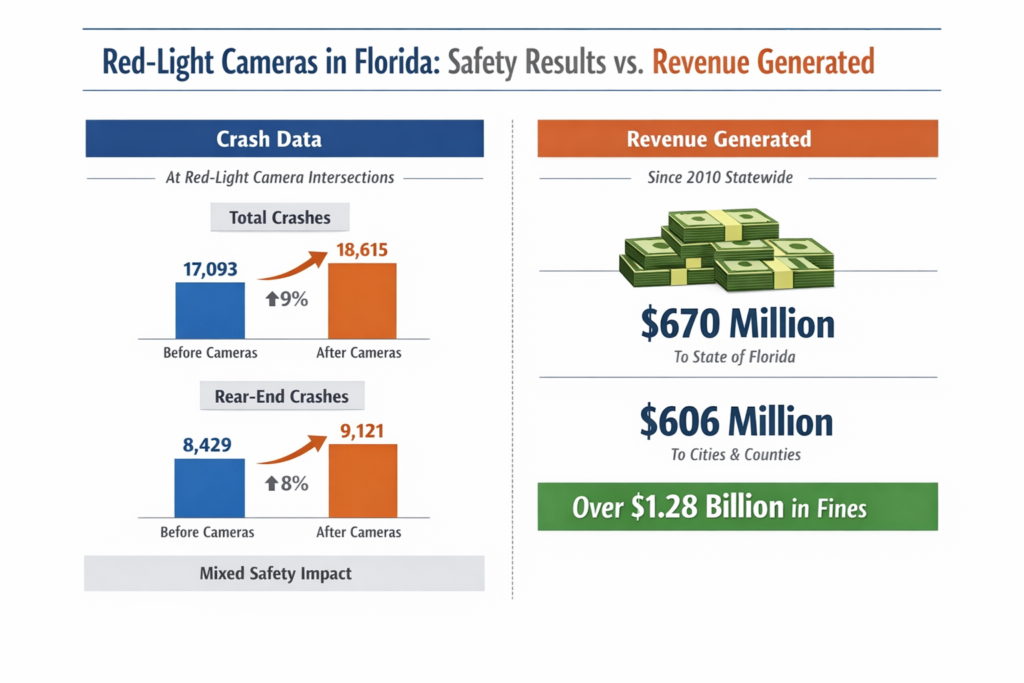
Since Florida authorized red light cameras in 2010, the automated enforcement system has generated more than $1.28 billion in fines statewide, according to state records reviewed by WESH 2 Investigates. Roughly $670 million has gone to the state, while about $606 million has been collected by cities and counties operating the cameras.
Coincidentally, traffic crash patterns have not changed significantly since red light cameras were introduced in 2010. Available data shows a modest increase in crashes of about 8 percent on average.
The law at the center of the case, the Mark Wandall Traffic Safety Act, was passed by the Florida Legislature in 2010.
It is named after Mark Wandall, a Bradenton man killed in 2003 when a driver ran a red light and struck the vehicle he was riding in.
After his death, his wife Melissa Wandall, who was nine months pregnant at the time, became an advocate for red light camera enforcement and spent years lobbying lawmakers to adopt automated traffic enforcement.
Wandall said that the law was born out of a deeply personal tragedy and a desire to prevent similar losses for other families. “In an instant, a preventable decision behind the wheel changed the course of our lives forever,” she said, “My daughter never had the chance to meet her father, and sadly, that choice was made for her by someone who ran a red light. Red-light cameras are one of the tools we have to drive down the heartbreak on our roadways. The focus should never be the ticket — it should be the life that could still be saved.
Since her husband’s death, Melissa Wandall has continued advocating for traffic safety and support for families affected by sudden loss. She also founded the Mark Wandall Foundation, a Florida nonprofit that provides support programs for children and teenagers grieving the loss of a parent, sibling, or guardian.
“If tools like red-light cameras help prevent even one family from living this reality, they matter. No family should have to become the story behind a traffic safety law.”
According to the organization’s website, the foundation serves families across the state and offers resources for young people coping with grief following the death of a loved one.
According to data from the Florida Department of Highway Safety and Motor Vehicles, roughly one quarter of all traffic fatalities in Florida occur at intersections, making them one of the most dangerous points on the state’s roadways. Yet crashes specifically caused by drivers running red lights account for only a small share of those deaths.
Crashes continue to rise year after year by about 9% since 2010, though it should be noted that Florida’s population has increased by 18% in the same period. At the same time, red light cameras have generated more than $1.28 billion in fines for the state and county, which split the money roughly equally, according to the State of Florida.

Register or login with Mid Bay News and never get another pop up on our site!