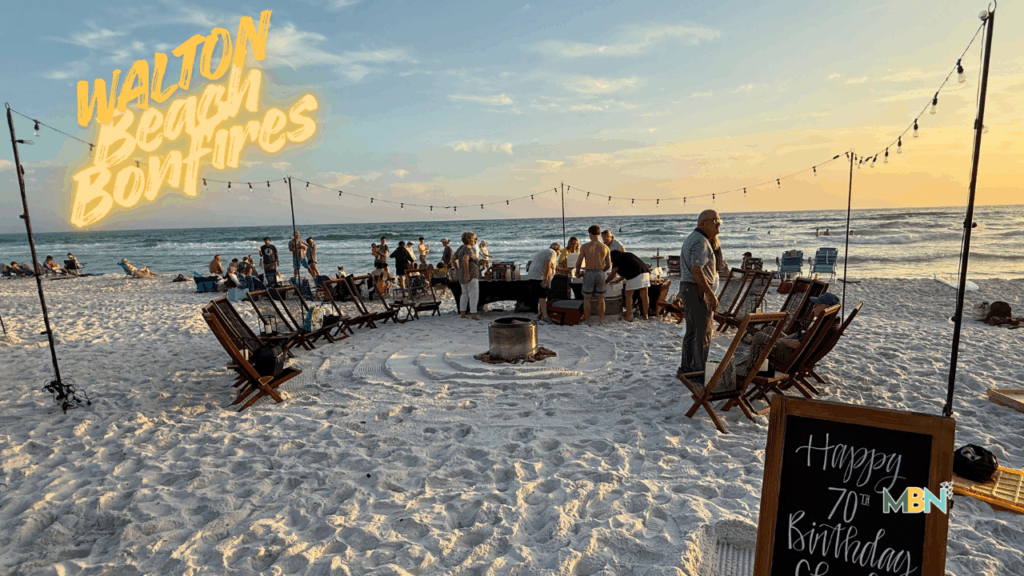
The Walton County Board of County Commissioners (BCC) spent a good deal of time this week in a “heated discussion” over beach bonfires.
Code Enforcement brought up bonfires at the Walton County Commission meeting due to safety concerns and the residue that can remain on the beach after the embers cool.
Over the last quarter, Walton County Code Enforcement has held meetings and made presentations that initially supported a ban on all wood fires on the beach. Code Enforcement brought up this solution as a way to reduce calls about burn waste on the beach.
At every meeting concerning the wood-burning bonfire ban, South Walton Fire District Fire Marshal Sammy Sanchez indicated that moving to a “propane-only” bonfire option would provide a cleaner, smokeless environment and reduce potential debris from evening beach fires. At earlier meetings, it appeared that wood-burning bonfires might be dead ‘at’ the water’s edge.
“I promise you, I am not the smartest guy in the room,” Sanchez said, “but there is [sic] only two solutions I came up with. One was to eliminate them [bonfires] totally, which I don’t think that’s in anybody’s interest. And the other – to go to a program that eliminates smoking debris.”
In a surprising turn of events, Tony Cornman, Director of Code Enforcement, presented to the Board of County Commissioners (BCC) three options that would give Enforcement and the bonfire vendors direction for the upcoming busy season. The three options were:
“To be quite honest, I don’t have enough data to tell you which one’s safer and which one’s not,” Sanchez indicated to the Commission. He told the five board members that his department had asked for feedback from vendors who host bonfires on the beach and added that “propane is a cleaner burn.”
Sanchez noted vendors and their customers shared that propane did not provide heat and that “there is something about the ambiance” of a wood-burning fire. But he continued, “To me a fire is a fire.”
Sanchez told the BCC that the summer months are the busiest months for bonfires. Discussions about fire bans, including bonfires during the summer months in extreme droughts, were not mentioned. There was discussion of the required distance between bonfires and the requirements for vendors to leave the beaches “debris-free” when an event is completed.
Commissioner Donna Johns (District 4 ) shared that she had heard from a number of her constituents who were in favor of maintaining traditional “wood-burning” bonfires. She referred to a recent survey on bonfires, saying, “…the number of propane bonfires people wanted was 15%. The number of wood-burning bonfires was 85%, and that goes along with a lot of the emails that I’ve received.”
Johns spoke about the amount of debris left on the beach (from bonfires). She suggested that in the winter season or “off season,” allow any of the bonfires (traditional, smokeless fireplace, or propane). She then recommended that, because the beaches are more crowded, limiting wood-burning bonfires may be helpful. She added that some people have allergies that restrict their ability to be around the smoke produced by the burn.
Johns also added another idea that could potentially track the vendor “by a simple app.” The application could help identify where the reported waste was found and tie the discovered debris to the vendor hosting the bonfire at that location. She also mentioned the benefit of potentially increasing the annual permit cost for vendors who provide bonfires. She suggested, “…jack up the price for the permit, from $1000 to maybe $5000 so people would have skin in the game, and we [Walton County] could take that money and have the beach cleaned…” Johns then added that fines for leaving the beach with debris or placing debris in the water could be another way to bring vendors into compliance.
Regarding current bonfire vendors (estimated at 67) and permitting of daily bonfires (a limit of 50 per day), Sanchez said that as many as 400 permits could be granted in a week. But this does not
include all the bonfires in the county. County Attorney Clay Adkinson asked Cornman to clarify the situation. Cornman explained that beachfront owners don’t need a permit to burn on their property, except for the annual license they must have.
Shawn Miller, a local vendor who has been in business for about two decades, expressed his concerns about the proposed limitations on when vendors are allowed to set up for events on the beach. Delaying the setup for an event can impact the customer who paid $1,000 for a permit. Miller said, “They [the customer] don’t want to hear from me…’ Well, we’ve got to start a little later.'” Miller concluded, “Sunset is when you want to have these events.”
Potential changes to the ordinances for ‘set-up time’ could affect the customer experience. Sunset (the major attraction) and the event itself are impacted when the ‘set up’ is not completed before the customer arrives. Miller added, “I’m afraid it’s going to affect your [Walton County’s] wedding business. You’re going to have a lot of downfall.”
Another vendor, Anthony McGuire, began by thanking the BCC for allowing him the opportunity to “vend.” He expressed his support for the hybrid option (allowing both propane- and wood-burning bonfires). He stated that there are currently 67 vendors in Walton County and that only 50 bonfires are permitted each day. He addressed the problem that there are more vendors than the number of permits currently allowed each day. He requested that the County pause the issuance of new beach bonfire licenses. “I know some people are not going to like that… It’s gotten out of control. There are] so many of them. I would say ‘pause,’ until we get down to 30 [vendors] or so,” “McGuire said, “And as people’ opt out’ of their vendor permit, there’s [would be] a lottery for some new person [vendor] to get in.”
Discussion concluded with the BCC’s unanimous vote to allow all three bonfire modes on the beach.
An additional item of interest that Code Enforcement addressed was overcrowding at the beaches and the discovery that larger tents can consume much more space than needed on our shared sand. Mr. Cornman shared that the maximum size of tent allowed on the beach is 10 feet by 10 feet. Discussions among citizens about tents exceeding the maximum size have become more apparent over the past year, and the ordinance states that any tent over 10X10 is a violation.
There were also questions about reducing the number of tents allowed on the beach or limiting or abolishing tents on smaller beaches altogether. Adkinson said, “I think you can choose to limit the size of tents [permitted on the beach.] I think the question is going to become when we start defining large and small beaches as a category of beach that is not already in our ordinances.”
The ordinance calls for no tents larger than 10X10, including the lines and weights that extend beyond the tent’s covering. It was also clarified that umbrellas are not considered tents and are not restricted.
We love to bring you, and all of your neighbors, the news for free – it’s a part of who we are. But just because something is free doesn’t mean it’s cheap.
Your sustaining donation of just $10 per month helps us keep the powerful accountable and make the mortgage on time. If you notice you keep coming back for more stories from us – please consider supporting our work so we can do it for the long haul (and not be homeless).

Register or login with Mid Bay News and never get another pop up on our site!