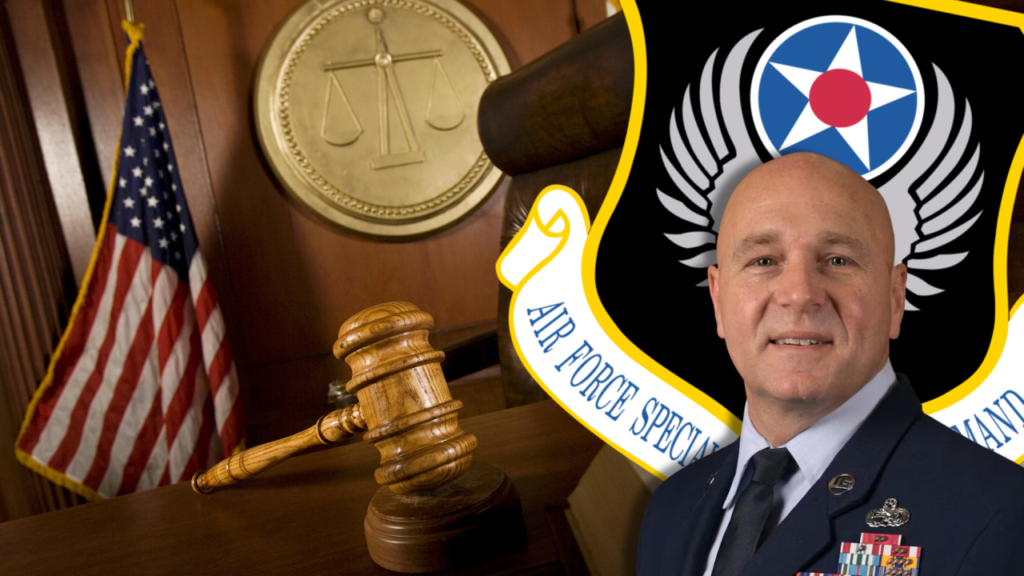
How Courts Martial Work
The Air Force court-martial operates under the Uniform Code of Military Justice (UCMJ). There are three types of courts-martial:
Summary: for minor offenses
Special: for what the Air Force would consider mid-level offenses like fraternization, assault, adultery, Absent Without Leave, theft, and drug use. Think of Special Courts-Martial as courts for misdemeanor offenses.
General: This is where serious alleged offenses end up, and is what CMSgt Green will face beginning in February. It requires a preliminary hearing, which will take place in February, and can result in dismissal or confinement (jail time).
Step One: Establishment of Jurisdiction
At this stage, the Air Force determines whether or not the accused is subject to military law. From there, a convening authority is designated, in this case Lt. General Conley would be the MAJCOM leader for this court martial. The Staff Judge Advocate (attorney) advises the convening authority on matters like this.
Step Two: Investigation and Processing
If there is suspicion of a violation of the UCMJ, the Office of Special Investigations or other investigative unit starts an investigation and notified the servicing legal office within 24 hours.
At this point, attorneys are notified. Alleged victims are also notified of their rights under the Victim and Witness Assistance Program (VWAP). This is the point in the process where no-contact, Military Protective Orders and admin holds on permanent change of station (PCS) can also take place.
Step Three: Preferral of Charges
If there is evidence to do so, charges are filed. The file will include information about the accused, alleged violations, and an accounting of the evidence against the accused. Charges were preferred against Green in November.
Step Four: Pretrial (This is where CMSgt Green’s case is currently)
Authorities can order a pretrial confinement, where they require the accused to stay in jail. Green is not confined as of this summer. This is where the defendant’s Article 32 Hearing, basically a hearing where the court ensures the accused knows their rights, takes place.
Trial must begin within 120 days of preferal (filing of charges) or restraining.
Step Five: Referral to Court-Martial
After the actions in step, the reporting officer sends their report to The Office of Special Trial Counsel (OSTC). OSTC is responsible for formally referring these charges. Charges can be dismissed or modified here.
OSTC is an independent body created to ensure impartiality in the legal process, according to AFSOC Public Affairs.
The Convening Authority (in this case Lt. General Conley) decides to convene the court. This must take place within 21 days of the Article 32 hearing.
Step Six: Convening the Court
The Convening Authority assembles the court and requisitions military members to serve as the jury, a military judge, prosecution and defense council.
Jury members are selected randomly, oaths are administered and the trial is scheduled.
Step Seven: Trial
The accused is arraigned, which means they hear the charges against them and enter a plea. The trial proceeds in a manner identical to a trial in the civilian world. There are opening arguments, presentation of evidence, cross examination and deliberation by the jury.
The trial must end within 75 days.
If the accused is found guilty, then sentencing follows. The court considers aggravating (intensifying) and mitigating factors – as well as victim impact.
Post-Trial
After the court adjourns, the judge writes a Statement of Trial Results, including the verdict and sentence. The accused and victims can submit matters for consideration within 10 days. The Covening Authority reviews the results and takes action. They must either approve, mitigate or suspend the sentence. Notifications are sent out and punishments are served.
Step Nine: Appeals
The accused has the right to an appeal. That process starts automoatically for sentences that are half a year or longer. The case could go to the Air Force Court of Criminal Appeals and could go all the way to the US Supreme Court in some cases.
There are also clemency options via the Air Force’s Clemency Board.