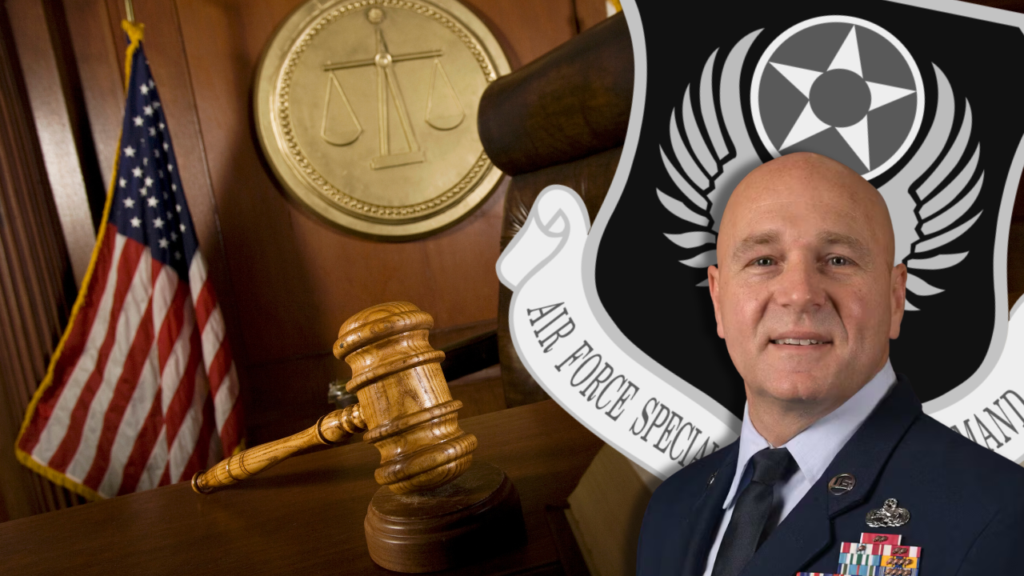
Charges were referred to a General Court-Martial by Brigadier Christopher A. Brown, the Lead Special Trial Counsel. Green is charged with indecent recording, obstruction of justice, and three counts of possession, viewing, and producing child pornography.
“Green is presumed innocent until he is proven guilty at a trial by courts-martial,” the spokesperson added, “AFSOC is committed to the welfare of our Airmen and maintaining good order and discipline to preserve the trust placed in us to execute our critical global missions.”
Differences in the Types of Court Martials
If you are unfamiliar with the different types of courts-martial, as I was, here is a brief primer on the levels of courts-martial.
After an arrest is made and charges are preferred, the leadership of an Air Force Unit where a crime has allegedly taken place confers with their Staff Judge Advocate, or SJA, about what to do next.
From there, an Article 32 hearing is held – similar to a grand jury hearing in the civilian world.
There are three types of courts-martial. They are, in order of severity, General, Special and Summary. You can think of the courts-martial as roughly analogous to a felony for a general court-martial, a misdemeanor for a special court-martial, and a traffic violation for a summary court-martial
Where a case ends up depends on several factors. Those include the rank or title of the alleged offender, the severity of a crime, and the potential length of punishment meted out. So, it’s much more likely that a lieutenant colonel who is accused of DUI manslaughter would see a general court-martial, while an airman basic stealing a pack of gum from the post exchange would see a summary court-martial.
Another thing to note, especially in light of this case, is that a special court-martial has a cap on the punishment it can impose for an offense: one year of confinement, according to this attorney. A general court-martial can deliver the maximum allowable sentence to a convicted offender.
For example; If an airman kills another airman because he was driving drunk on base, a special court-martial could only sentence him to a year of confinement and withhold a year’s pay. But a general court-martial could give him the maximum sentence allowed under the Uniform Code of Military Justice (UCMJ) – 15 years and a dishonorable discharge.