
This story from Emerald Coast history is brought to you by our friends at Okaloosa Gas!
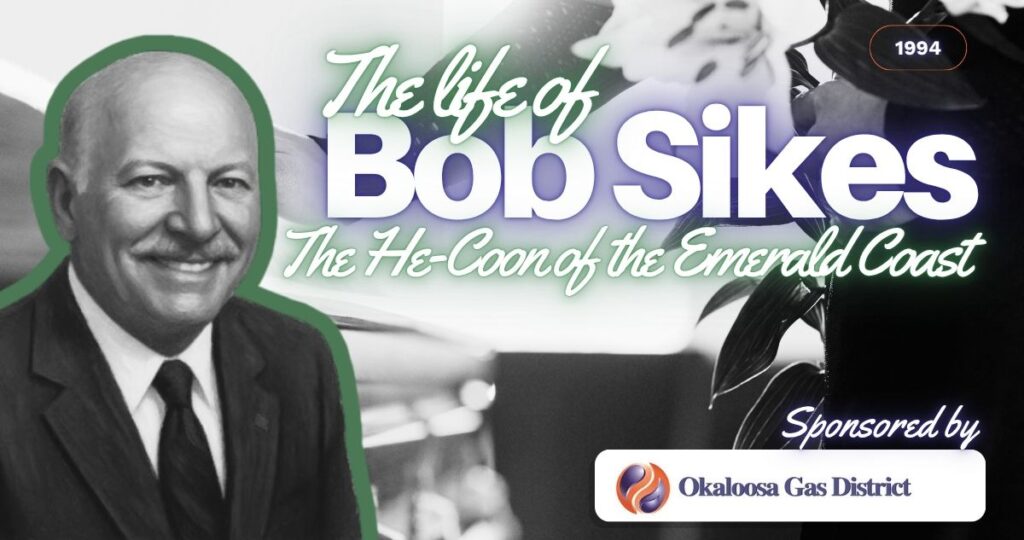
On September 28, 1994, Longtime Northwest Florida Congressman Bob Sikes died from complications related to Alzheimer’s Disease.
Sikes is the single person most responsible for the Emerald Coast as we know it today. He spent more than 30 years in Congress on various defense committees advocating and horse-trading for billions of dollars in defense spending at Eglin, Hurlburt, Tyndall, NAS Pensacola, and the other military bases throughout the region.
Those deals, most directly in the immediate aftermath of the post-World War II drawdown, ensured the survival of the military-based economy on the Emerald Coast to the present day. Sikes advocated for military construction programs for testing weapons during and after the war, which could not be easily relocated or shut down like training missions were in the aftermath of the war.
BC – Before Congress
Robert Lee Fulton Sikes was born to a Confederate Civil War vet just after the turn of the Century in rural Georgia. His elderly father died when Sikes was still very young, and Sikes had to work his way through high school. He did well and earned a spot at the University of Georgia. After graduating from UGA, he moved on to the University of Florida, where he got an advanced degree in agricultural-related studies. He planned to be a teacher, but soon switched to journalism at the height of the Great Depression and spent every nickel he had to purchase the Valparaiso Star newspaper.
With the help of James Plew, a Republican and Yankee dedicated to bringing aviation as an industry to the Emerald Coast, Sikes won election to the Florida House of Representatives as a Democrat. He would spar mightily with the senior statesman on the Emerald Coast, William Mapoles, who also owned a newspaper in the area.
Sikes outmaneuvered his rival and won election to the US Congress in 1940 after future Florida Supreme Court Justice Millard Caldwell announced he would not seek re-election.
During World War II
Sikes would make key votes to initiate the peacetime draft of young men into the armed forces at the urging of then-Speaker of the House, Texan Sam Rayburn. He credited the decision, which was unpopular with his constituency at the time, as a key reason the United States was poised to retaliate against the Japanese after the December 7, 1941, Pearl Harbor attack by the Japanese in his autobiography he wrote with his daughter.
Sikes briefly resigned from his office in 1942 to take a commission in the military as an Army public affairs officer in England. He stayed in the reserves after the war and was promoted to Brigadier General. Many of his critics, Columnist Drew Pearson chief amongst them, correlated his rapid rise to General Officer status with his willingness to defend military spending in the years after the Second World War.
Sikes would be reelected in 1942, resume his place in Congress, and take a subcommittee assignment on the military construction appropriations subcommittee. From his position, he would ensure a pipeline of money for construction in his district – which stretched from Tallahassee in the East to Pensacola in the West.
“With a substantial number of our military bases located in Florida, it would not hurt to have a spokesman in position to watch the flow of defense spending. For example, not long after my new assignment was announced, plans to close Tyndall Air Force Base in Panama City were canceled. Some claimed to see a coincidence, which I neither confirmed nor denied. However, it would not be threatened again,” Sikes wrote in his autobiography in the early 80s.
Post World War II
During the fifties, sixties, and into the seventies, Sikes stood unopposed for almost every two-year term he won from the people of western Florida. He focused most of his energies toward the creation, maintenance, and expansion of the military presence on the Florida Gulf Coast – but also advocated for segregationist and interventionist policies at home and abroad.
By the Country’s bicentennial, Sikes had become one of the most powerful men in Congress. Newspapers across the state and country would refer to him as “Florida’s third senator.” He became chairman of the Defense Appropriation Committee and continued to fund the military missions at Eglin Air Force Base heavily. He’d even welcome JFK to Eglin Air Force Base in 1962.
But a new era of mistrust in government following the Watergate Scandal that ended President Richard Nixon’s presidency brought in a wave of younger, progressive, and aggressive junior representatives to Congress. Instead of banking time to earn seniority, and therefore more prestigious and powerful positions, as Sikes had done, the Young Turks immediately shook up the Democratic Party in Congress by voting themselves into leadership positions and launching inquiries into those representatives with time under their belts and skeletons in their closets.
Sikes, as it would turn out, had several skeletons in his closet. A decade before, Sikes had voted for a transparency bill that would be signed into law after several scandals involving Democrats from other parts of the county stapled themselves to the tops of daily newspapers for more than a year.
That action, which required financial disclosures from all members of Congress, allowed new public advocacy groups, like Common Cause, to look through the books of their Representatives on Capitol Hill.
Those advocates found several things in Sikes’s disclosures that looked ugly in the light of day. Sikes had invested in leases on several Holiday Isle properties in Destin with other local leaders, like Florida Senate President Newman “Buddy” Brackin and another local luminary, Ed Cox. The trio leased the land from a governmental agency Sikes had helped create – the Okaloosa Island Authority – only to turn around and lease it for a large profit to another enterprise – while also voting in Congress to loosen the tight restrictions on the land for the leasee – dramatically increasing the value of the lease.
But that transaction – made in 1964 – would only come home to roost when Common Cause looked into other investments Sikes had made – particularly in Military-affiliated banking enterprises on cases and stock in military contractors. Records revealed that Sikes had advocated for the banks to get property on bases to do business and that he had worked to get contracts for the companies he’d invested in. They weren’t – and still aren’t – illegal actions. Still, they violated the consciences of those Young Turks who would end up stripping Sikes of his committee assignments that had made him so powerful and useful to the Emerald Coast’s defense industrial complex.
You can read more about what the Congressman called a ‘Conspiracy Theory’ here.
Sikes would decide not to stand in the 1978 elections and would be replaced by Earl Hutto, a former television sportscaster, who would stay in his seat until the 1990s and the advent of a man who would go from politics to national television – Joe Scarborough.
Legacy
Bob Sikes left an indelible mark on the Emerald Coast. From the beginning of his time in Congress to the end, the Emerald Coast’s population exploded – driven by the military and, to some extent, tourism.
Several local pieces of infrastructure, from the Bob Sikes Library and Airport in Crestview to the Bob Sikes fishing bridge in Gulf Breeze, are named for him. He even has an exhibit at Northwest Florida State College in Crestview.
But some argue, the most enduring legacy of the ‘He-Coon’ is the strong military presence in the area.