

This piece of Emerald Coast History is brought to you by Okaloosa Gas.
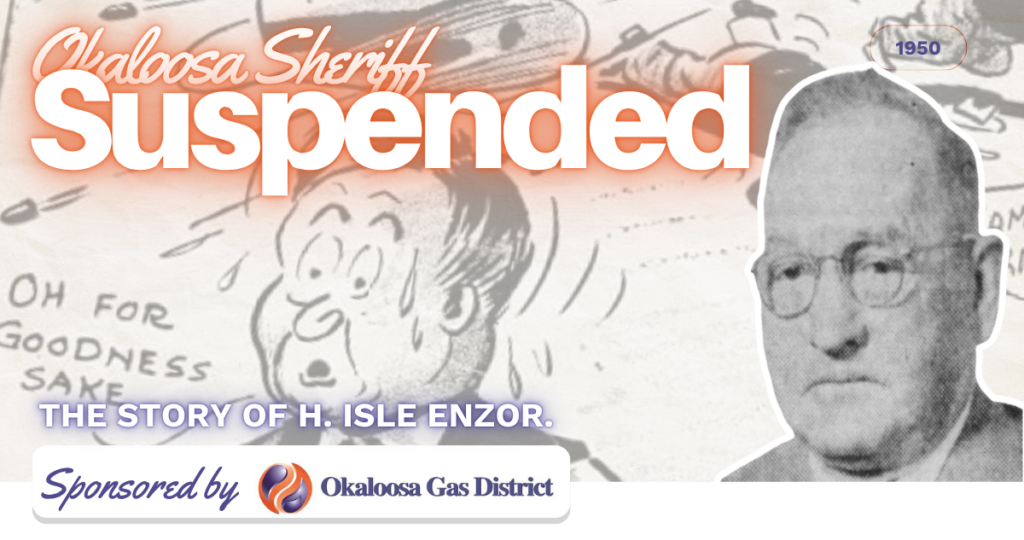
Today in History, Governor Fuller Warren removed Okaloosa County Sheriff Isle Enzor and two Okaloosa County Constables from office. He accused him of lax enforcement of Florida gambling laws. Enzor served from 1940 to 1956, with a break to serve his suspension between 1950-1953.
The removal came after a June article in the Tampa Tribune that investigated casino gambling at the Magnolia and Shalimar clubs in Okaloosa County’s unincorporated areas. The article followed a raid on a casino in Okaloosa County on June 20, 1950.
Sheriff Enzor was one of four local leaders statewide suspended by the Governor who campaigned on a promise to crack down on crime – especially gambling.
Two weeks later, on July 7, a hearing concerning the raid and investigation into gambling in the county decided to initially suspend Sheriff Enzor from his post for two months. “Yet since that time,” a statement from the Governor noted in the Tribune, “H. Isle Enzor has neglected his duty to enforce the gambling laws in Okaloosa County in that the Magnolia Club and the Shalimar Club have maintained gambling and games of chance.”
Another Tribune Writer, Emmett Peter, Jr., reported from Fort Walton that, as the suspension order came down, gambling continued unabated “in this playground city.”
In his stead, the Governor appointed Enzor’s son-in-law and World War II Marine Fighter Pilot Ferrin Campbell as the replacement for the suspended Sheriff. Campbell stood aside when Enzor would win a landslide victory back into his office in 1952, despite the suspension. Enzor would die in office in 1956 of a heart attack immediately after losing a primary election to challenger Ray Wilson; he was 62.
The real fallout from the suspension took place back in Tallahassee, where Governor Warren had to contend with the ire of then Senate President and Crestview resident Newman ‘Buddy’ Brackin. Brackin, a close associate of Sheriff Enzor and the “B” in the CBS real estate conglomerate that included Congressman Bob Sikes and came under scrutiny from the Common Cause Lobby Group and the House Ethics Committee some 15 years later, refused to comment on whether or not the suspension had put him at odds with the governor. Traditionally, wrote the Tribune on the matter, “Power of removal – or reinstatement – of an officer is vested in the state senate as a whole, but by custom the senator in the district involved is allowed to make the decision.”
The owner of at least one of the clubs was a former drug clerk at Brackin’s pharmacy in Crestview.
Enzor’s competition, Ray Wilson, was appointed by Governor Fuller Warren to fill out the rest of Enzor’s term after his death and went on to serve five terms before he was voted out of office and replaced by Frankie Mills.