FORT WALTON BEACH — It pools in yards. It creeps under homes. It swallows low spots in the street until cars slow to a crawl and some residents decide it is safer to stay put than risk driving through water they cannot judge.
For many families, it has been that way for decades, and, in the view of the Okaloosa County Branch of the NAACP, that is far too long.
Last week, the NAACP renewed its call for officials to take decisive action on Gap Creek, a drainage corridor that winds through Fort Walton Beach and unincorporated Okaloosa County before emptying into Cinco Bayou.
The organization says the creek and the flooding around it have become a long-running example of environmental injustice in a predominantly Black community that has struggled to get the same level of attention and investment as other parts of the county, even as local officials have acknowledged the problem and moved forward with a long-awaited planning study.
“Environmental justice is a civil rights issue,” said Sabu L. Williams, president of the Okaloosa County NAACP, in a Jan. 20 press release. “The families of Sylvania Heights have been forced to live with preventable flooding and infrastructure neglect for far too long. This is a systemic failure, and it demands immediate corrective action.”
But for Fort Walton Beach Councilwoman Debi Riley, who has long worked on environmental concerns in the community, the issues described in the NAACP’s report are not new.
“I’ve been at the grassroots effort trying to work on some environmental justice issues in that neighborhood,” Riley said. “So for me, this is not something that’s new.”
Riley said she and Berry Gray, a community activist, have pushed for years to bring attention to flooding and environmental conditions tied to Gap Creek, despite changing city administrations and repeated efforts to align multiple agencies.
“We just wanted to bring both of them together to help us address the issue with the Gap Creek,” Riley said, describing what she called long-standing coordination problems between the city and county.
The NAACP’s statement was not a standalone complaint. It was paired with a detailed report released on Jan. 20 that reads more like a case file than a political memo.
The report traces how Gap Creek went from a natural drainage feature to what the NAACP calls a chronic hazard; one that brings flooding, erosion and water quality concerns that residents say have shaped daily life for generations.
Flooding in Sylvania Heights is not described as a once-in-a-decade disaster. It is described as routine.
The NAACP report says chronic flooding has persisted for more than four decades, repeatedly damaging homes, isolating residents and eroding confidence that help is on the way.
The report also describes a neighborhood where even moderate rainfall can overwhelm limited stormwater infrastructure, pushing water across streets and into low-lying yards.
In its press release, the NAACP summarized what residents have been saying for years: homes and yards flood after ordinary rain, creek banks erode toward property lines, standing water raises health risks and mosquito exposure, and severe weather can block access to homes.
The group said the toll is not just physical. It is emotional and financial, as well.
That stress shows up in the small decisions that add up over time. People plan errands around the weather. They watch the sky and check their driveways. They worry about what might happen to a home that has already taken on water more times than anyone can count.
The report also points to the kind of damage that does not make headlines but does change lives.
Many homes in the area were built in the 1950s and 1960s, some using relocated military barracks or modest construction that was never meant to withstand repeated flooding. Residents have reported cracked floors, shifting foundations, warped walls and persistent mold, the report says.
Riley said the flooding and infrastructure issues cannot be solved through piecemeal work farther downstream, arguing officials must address the upstream sources that feed the system.
“The only thing you’re doing is band-aiding the problem,” she said. “Because you got to go where it all starts and began.”
The water itself is part of the concern.
The NAACP report says Gap Creek is impaired by E. coli and fecal coliform bacteria, with levels exceeding state thresholds. The report points to possible sources, including failing septic systems, illicit discharges, animal waste carried by runoff, and pollutants associated with commercial or industrial activity.
Those are technical terms, but residents understand the basic point: when floodwater spreads, it is not clean.
The report notes that the Florida Department of Environmental Protection has designated Gap Creek as an impaired waterbody for bacterial contamination. That designation can trigger the need for a Total Maximum Daily Load plan, a state process meant to reduce pollution levels over time.
Residents have also raised concerns about health issues they believe may be connected to environmental conditions, including skin rashes, respiratory problems and mold exposure.
The report says some residents have voiced concerns about clusters of cancer and kidney disease, though it also acknowledges that no formal epidemiological study has been conducted.
Riley said she believes health concerns in the community have been challenging to elevate in official channels, particularly when residents use language like “cancer cluster.”
“They did not want to hear, they strayed away from it because, for whatever reason, those in charge did not want to hear cancer cluster,” she said.
Riley described the issue as deeply personal, saying she lost her father to cancer and her mother to kidney problems and that she believes similar stories are widespread among long-time families in the area.
“I’m not the only one,” Riley said. “If you go into every one of those families and knock on their door, I guarantee you, they’ll tell you that their parents or their grandparents died from cancer or some type of kidney problems.”
She also said outside groups and agencies have been aware of
environmental concerns in the area for years, describing past efforts involving federal officials and university partners.
Riley said she previously worked with community partners and universities on health-related surveys, including efforts from her time with the Okaloosa County Health Department.
One of the report’s strongest arguments is that Gap Creek’s problems are not accidental. The NAACP argues that they are the result of development patterns and political boundaries that shaped who got infrastructure and who did not.
The report describes Sylvania Heights as once rural, then rapidly developed during post-war growth. Subdivisions expanded in the 1950s and 1960s, often outside city limits, meaning they did not benefit from the infrastructure investments that incorporated neighborhoods received.
By the 1960s, the area had become predominantly African American, the report says, and remained economically marginalized. The report argues that underinvestment in roads, drainage and utilities laid the groundwork for the environmental justice concerns that define the community’s experience today.
Riley said that the division, part city, part county, has a long, complicated history.
“It is already a split community,” she said. “You got part of it the city, part of it the county.”
The report contrasts Sylvania Heights with the nearby W.E. Combs neighborhood, which was annexed into Fort Walton Beach in 1977. Because the city has a stormwater utility, the report says, it has been able to expand a retention pond, build a rain garden and make more consistent drainage upgrades.
Sylvania Heights, largely unincorporated, lacks the same built-in funding structure. The report says the Lovejoy area lacks basic infrastructure, such as curbs, gutters and storm drains, in many places.
It notes that the only significant detention facility is a 1.5-acre pond between Poplar Road and Hickory Road, which it says is not enough to manage the stormwater volumes flowing into the neighborhood.
The report also highlights a long-planned retention project at the north end of Poplar Avenue. Land was acquired nearly 25 years ago, but the site remains undeveloped due to wetland permitting requirements.
The report says signage marking the “proposed stormwater retention area” has stood for nearly two decades, a visible reminder of promises yet to be realized.
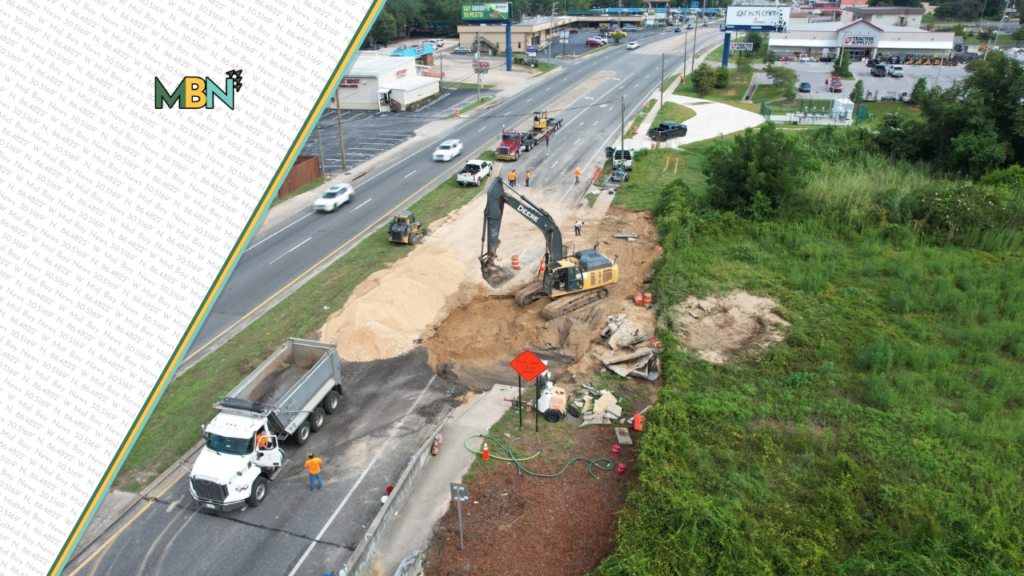
The report also points to one event in August 2025 that captured the broader risk: a drainage pipe collapse beneath State Road 189, also known as Beal Parkway, near the Gap Creek bridge.
The failure created a significant hole in the roadway, forcing lane closures. It also highlighted how aging infrastructure can fail suddenly when water stress builds over time.
Riley cited that failure as a key example of why the watershed demands attention, describing it as a “blowout” and noting the dispute over how to describe it.
“It … culminated with the recent blowout, not a sinkhole, I’ve been told over and over again, not a sinkhole, on Beal,” she said.
The NAACP argues that the collapse also reinstated a reality that residents have learned the hard way. In a watershed that crosses city, county and state lines, responsibility is shared and accountability can blur.
Residents often experience that fragmentation as a cycle of delay, the NAACP says, with one agency pointing to another as the responsible party.
In its press release, the NAACP urged agencies to move quickly on both short-term fixes and long-term planning.
The group called for an independent environmental and engineering assessment, immediate mitigation measures such as clearing blockages and stabilizing creek banks, and a long-term infrastructure improvement plan with transparent timelines and public reporting.
They also called for equitable distribution of public resources and a community oversight process that includes residents.
“Residents are entitled to transparency, investment, and respect,” Williams said. “Our advocacy will persist until effective and lasting solutions are established.”
The NAACP also sent a proposal letter calling for a community roundtable within the next 90 days. The letter was addressed to a broad group of stakeholders, including a congressional district liaison, the U.S. Army Corps of Engineers, leadership at Eglin Air Force Base, state Rep. Patt Maney, Okaloosa County Commission Chairman Trey Goodwin, and city managers in Fort Walton Beach and Cinco Bayou.
The goal, the NAACP said, is to review findings from ongoing studies, identify coordinated solutions, center the perspectives of underserved communities, and establish a timeline for implementation and monitoring.
Riley said she supports the effort and wants to see the city and county move forward together.
“It has to be a resolution,” she said. “Do we wait another 20, 30, 40 years?”
County officials have already begun laying the groundwork for a large-scale solution, at least on paper.
In September 2024, the Okaloosa County Commission unanimously approved allocating $250,000 in infrastructure surtax reserves to help fund a long-awaited planning study of the Gap Creek watershed, a project aimed at reducing flooding and improving water quality in one of the Fort Walton Beach area’s most flood-prone corridors.
The county’s contribution was structured as a 50-50 match for a state appropriation already secured for the study, following a recommendation from the Infrastructure Surtax Advisory Committee.
Public Works Director Scott Bitterman told commissioners the planning study would provide a physical assessment of the creek between Jonquil Avenue and Beal Parkway, including a stretch where the waterway disappears onto private property.
The work is expected to map the channel, document existing stormwater infrastructure and evaluate both nature-based and traditional improvements, including identifying obstructions that can worsen flooding.
“Possible recommendations from the study could be help residents clean up fallen trees that are blocking the creek flow, or identify fences that pose no problem on a nice day like today, but if it’s raining and the creek leaves its banks, perhaps the fence blocks the flow of the river,” Bitterman said.
He added that the project may also highlight the need for filtration devices on stormwater structures and identify environmental projects to improve creek flow.
County Administrator John Hofstead said Gap Creek has posed problems for decades, particularly in Lovejoy.
“I will tell you this system has been a problem for the 15 years I’ve been with the county, and it predates my time with the county when I was with the city as well,” Hofstead said. “It greatly impacts the Lovejoy community. They’ve been after this project for some time.”
Goodwin, who made the motion to approve the funding, emphasized the project’s significance.
“It’s an area of significant concern for quite a large watershed,” Goodwin said. “This is the next step in trying to do something with it. … I really hope this will help address water quantity, to help mitigate flooding … but also the water quality.”
Commissioner Carolyn Ketchel, who seconded the motion, pointed to recent infrastructure failures as evidence of the need.
“This has been a huge issue ever since we took our seats and culminated with the recent blowout, not a sinkhole, I’ve been told over and over again, not a sinkhole, on Beal,” Ketchel said. “This really affects a lot of people throughout a large neighborhood, so I thank you for bringing this forward.”
The measure passed unanimously.
Once the Florida Department of Environmental Protection finalizes the grant award, the county will move ahead with the planning study.
Riley said she hopes the new momentum leads to action — not another cycle of reports and delays.
“How long do you have to keep doing studies?” she said. “At what point do we have to do something. We have got to tackle the problem.”
As a member of the Fort Walton Beach City Council, Riley said she plans to keep pressing the issue and support efforts that bring resources into the neighborhoods most affected.
“I’d be willing to support it all the way,” she said.
We love to bring you, and all of your neighbors, the news for free – it’s a part of who we are. But just because something is free doesn’t mean it’s cheap.
Your sustaining donation of just $10 per month helps us keep the powerful accountable and make the mortgage on time. If you notice you keep coming back for more stories from us – please consider supporting our work so we can do it for the long haul (and not be homeless).

Register or login with Mid Bay News and never get another pop up on our site!