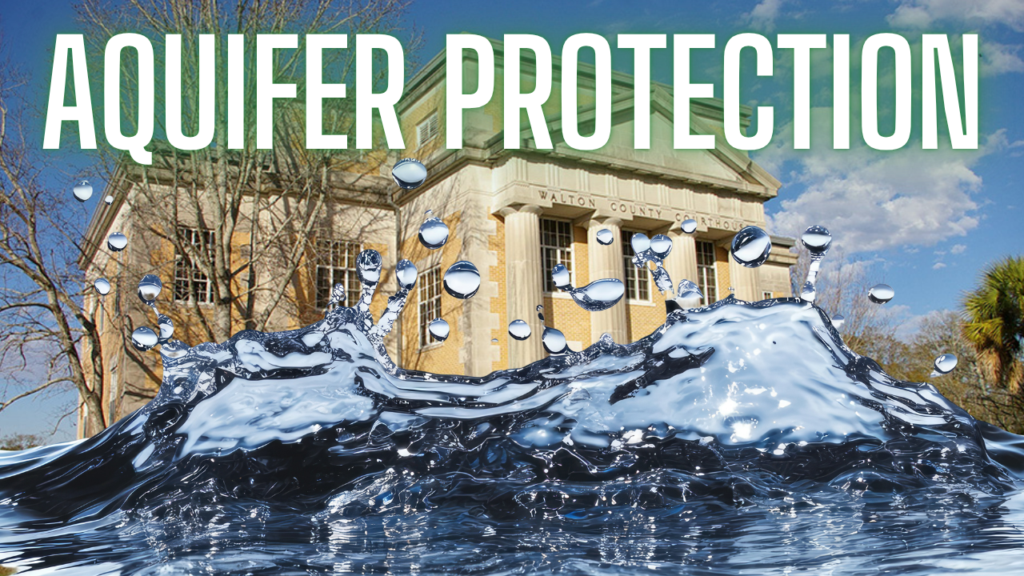
Walton County commissioners unanimously voted to establish a new committee for water and sewage oversight this month, following a passionate mid-April presentation by resident Lynn Edwards,need who stressed the urgent need to protect the county’s drinking water supply amid increasing development and population growth.
The initiative is designed to increase local accountability and public understanding of water quality reports, moving beyond simple “pass or fail” findings, with a focus on protecting the Floridian Aquifer. Edwards advocated for a comprehensive, annual meeting along with regular working group meetings of combined experts and state agencies to create an “unambiguous and ‘common language’” report on the county’s water and waste management plans. Furthermore, she recommended including Joey Rutkowski, CEO of MVM Landfill, as a public representative, highlighting his company’s over $1 million investment in implementing a Reverse Osmosis (RO) system to become the “gold standard” for waste management and drinking water protection.
Lynn Edwards, a Walton County resident with a career in the medical industry, advocated for aggressive measures to protect clean drinking water in the Emerald Coast region. “water is essential to life,” she said, arguing that stewarding or conserving water “is more than just passing the responsibility [on to those who understand the water quality reports] and hoping that all goes well when it comes to our [drinking] water.”
Edwards made a request to the BCC to have “an annual meeting of combined [experts and] local resources and in addition, invite input [and detailed reporting along with collaboration] from state environment and oversight agencies to come to the table to strategically maintain water quality and assess the areas of improvement and areas of concern.” Edwards told the BCC that the proposed outcome would be “to provide an unambiguous and ‘common language’ [easily understood] report on our county’s water and waste management and its plan for the future.” She added, “There is no room to do what we’ve always done. We must be bold and active, research, discuss, and debate. [We must] examine with new eyes our …contracts and plans [for development and waste management].”
Monitoring and Understanding Water Quality Reports – Not just “Pass” or “Fail”
In her appeal to develop an oversight process for our water, Edwards emphasized that communication, accountability, and transparency should be included in the requested annual water quality report. This would include factual reporting intended to promote understanding and raise awareness of what is at stake. In a cooperative manner, Edwards said, [One of our objectives would be, ] “an annual meeting of combined professional resources who will provide a report that ‘mere mortals’ can understand.” Edwards emphasized the need for the annual report to be easily understood by the general public. Work for creating the annual report will be developed in conjunction with a committee that is working together throughout the year to monitor and lead environmental oversight/protection, safety, and potential aquifer conservation.
“Gold Standard” Measure for Water Quality
Ms. Edwards suggested to the BCC that they appoint Billy McGee of the Walton County Environmental Department to serve as a resource and local government advocate for the public administration and oversight for water safety, quality, and security. She also recommended that Joey Rutkowski, CEO of MVM (Mohawk Valley Materials) Landfill, be given the opportunity to serve as a public representative for the annual meeting on water quality. Rutkowski and MVM are moving from a leachate system to a Reverse Osmosis (RO) system. In an effort to “gain the trust of local people,” he is “seeking the ‘gold star’ as the State of Florida’s cleanest landfill.” Edwards met with Mid Bay News and shared that she initially doubted that Rutkowski would have the best and safest intentions when it came to the MVM Landfill. But she said that her opinion quickly changed when she visited with Rutkowski and witnessed the significant changes he was already making to protect the leachate (or dangerous contaminants) that could impact the soil and the aquifer – our water supply. According to Edwards, Mr. Rutkowski has invested over $1 Million of his own money to manage a landfill with “bulletproof liners” and the implementation of a reverse osmosis system/process that will ensure our drinking water is not negatively impacted.
Water Quality Reports Need to be Easy to Read and Understand
As she addressed the BCC, Edwards acknowledged that there are officials who may say, “We already have water reports.” There are water reports, but the concern she raised is the need to relay findings annually in a way the general public can understand.
It’s no surprise that people are more reluctant now than ever when it comes to drinking from the tap. In an ASPE Pipeline article, 25% of Americans never drink tap water. As the Environmental Protection Agency (EPA) moves closer to regulations for PFAS (per – and polyfluoroalkyl substances), commonly referred to as ‘forever chemicals’, in the drinking water supply, many Americans are “just saying no to tap water…”Fixing these problems requires a significant focus on infrastructure, both to ensure water quality and to communicate with customers, showing them proof that infrastructure is well maintained and that water is safe.” But if our water is safe and measures are in place to maintain the water table, there should be minimal concern among citizens. That is the example that Edwards refers to when speaking about the current Class 3 landfill owner, Joey Rutkowski. Edwards referred to Rutkowski as an individual who desires to be “the gold standard” for managing waste and the protection of the Floridian Aquifer – our only viable source of drinking water.
A Passion for Potable Water for Generations to Come
With respect for Rutkowski, Edwards said that his vision is “for [the future of] his children and the children beyond.” She added, “He cares deeply about what he is leaving behind [for future generations.] Edwards, who spent her career in the medical industry, expressed that our essential life source, water, needs to be a focus and integral to the management and oversight of our business and living in Walton County, just as Planning, Zoning, Code Enforcement, or Tourism development are essential. Water may be everywhere, but if the aquifer isn’t safe to drink, we won’t leave anything for future generations. Edwards said, “It is essential that we monitor water and sewer for the long-term future of the County.”
Commissioners Vote to Support Formation of New Committee
The BCC unanimously supported Edwards’s recommendation to create a committee meeting (reporting annually) to monitor and work collaboratively to protect our greatest and most vulnerable resource. Mid Bay News spoke with Ryan Rutkowski and asked if he would accept the opportunity to sit on the committee. Mr. Rutkowski said he would gladly welcome the opportunity to serve.
We love to bring you, and all of your neighbors, the news for free – it’s a part of who we are. But just because something is free doesn’t mean it’s cheap.
Your sustaining donation of just $10 per month helps us keep the powerful accountable and make the mortgage on time. If you notice you keep coming back for more stories from us – please consider supporting our work so we can do it for the long haul (and not be homeless).

Register or login with Mid Bay News and never get another pop up on our site!