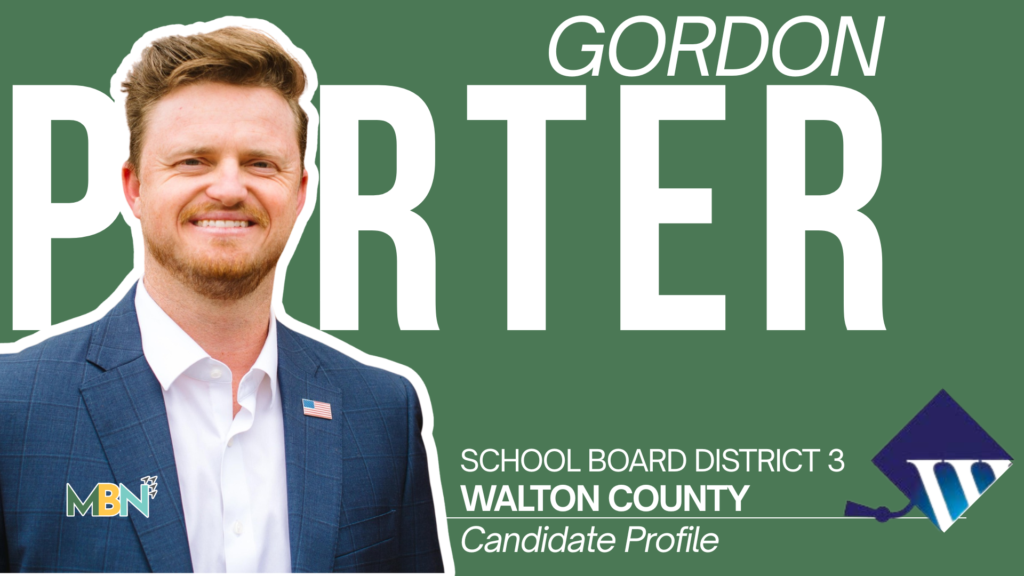
Walton County native Gordon Porter is running for the Walton County School Board, District 3 seat. He says his campaign blends fiscal oversight, conservative cultural priorities, and increased transparency in the school district’s operations.
Porter currently works as a Senior Project Manager for BE-CI in Destin, with more than six years of experience managing large construction projects. He emphasizes that while he is not an educator, he believes the role of a school board member is distinct from that of a teacher or administrator, and that his value lies in managing “large sums of money” and complex projects.
Porter lost his election to two-term incumbent Bill Eddins Junior by a razor-thin 162-vote margin. He hopes he can close the three percent gap he lost by last time to unseat Eddins, who is running for his fourth term on the board.
Porter is explicit that his campaign is ideologically driven, not technocratic. He argues that the country is at a “turning point” and that “fence straddling” and ambiguity about core values are no longer acceptable for school board members, even though the position is technically nonpartisan.
Candidates for any school board seat cannot use their political party in their advertising or otherwise declare it, lest they violate this Florida Law.
He describes school board members as “gatekeepers” — both ideologically and academically — and says he wants voters to know exactly where he stands:
Porter also pushes back against the stereotype that teachers are overwhelmingly liberal or anti-Christian, saying many Walton County teachers he knows do not fit that description. He says he wants to serve as an advocate for students, parents, and teachers who share a broadly conservative, Christian-aligned worldview.
As part of his “America First” framing, Porter says he wants a thorough review of the district’s curriculum, singling out:
He says the key questions should be:
Porter also raises concerns about diversity, equity, and inclusion (DEI) policies in the district. He cites a recent example in which a DEI policy posted on the district’s website was, he says, directly linked to the Southern Poverty Law Center via an affiliated organization that had written the policy.
He says he does not necessarily believe board members were aware of that connection, but argues that this illustrates the problem:
In his view, conservative and Christian ideas “don’t slip under the door,” while “more liberal left-wing ideology” can gradually enter through policies and external partnerships, changing the culture over time.
Porter says one of his aims on the board would be to scrutinize such policies and sources more closely.
Religion in public schools is a central, and potentially contentious, part of Porter’s platform.
In March, he posted on social media about “returning prayer to Walton County Schools”, a stance he defended and elaborated on during the interview.
Christian Foundations and Other Faiths
Porter argues that:
When asked whether his approach would also allow for, for example, a Muslim imam to lead prayer, or a Catholic rosary to be broadcast over the PA system, Porter draws a clear distinction:
He acknowledges First Amendment constraints but maintains that schools should orient students toward the values he believes the country was founded upon.
Teaching the Bible
Porter says that in his “perfect world,” theology or Bible-based classes would have a place in the school system, with some caveats:
Porter links the removal of school prayer (in the early 1960s) and the withdrawal of the Bible from classrooms to what he describes as alarming trends:
He characterizes these social problems as evidence of the consequences of omitting God and Biblical influence from education.
Anticipating Legal Challenges
Porter acknowledges that efforts to expand or formalize religious expression in schools could become litigious. He says he has considered this and points to Mississippi’s role in the overturning of Roe v. Wade as an example of how challenges to case law can be structured.
He argues:
Porter also notes he would be only one of five board members, and any such policy would have to win majority support. He believes that, given the current composition of the Florida Supreme Court and the U.S. Supreme Court, the legal environment is more favorable to his First Amendment interpretation than in the past.
Operations
While Mid Bay News Publisher and Candidate Gordon Porter spoke at length about Porter’s philosophy over school policy governance – they also spoke with some depth regarding the operations and budgeting side of Walton County School District’s School Board responsibilities.
Budgeting, Fuel Costs, and “Proactive Not Reactive” Governance
Porter’s professional background as a project manager shapes his views on district finances, particularly amid rising fuel costs linked to international crises, such as the ongoing war in Iran, which drives up diesel and gasoline prices.
He says that for a large organization like a school district, which uses “tens of thousands of gallons” of fuel annually:
Porter says government entities often respond late to such pressures, and he hopes to bring a more proactive mindset to budgeting and long-range planning.
School Construction and Design Oversight
Walton County is experiencing rapid growth, and the school district has been building and expanding facilities to keep pace. Porter describes the district as being on a kind of building boom — if not “a building spree,” then something close.
From his vantage point in commercial construction, he highlights several concerns:
According to Porter, this pattern can lead to:
Porter argues that having a board member fluent in construction and design would allow the school board to:
He says he does not accuse current contractors or architects of bad faith, but believes the board should have internal expertise, rather than relying solely on external consultants whose role is advisory, not decisive.
In his view, informed decision-making at the board level is essential to protect taxpayers, support teachers and students, and avoid expensive, long-term mistakes.
Transparency: Pushing for Live-Streamed School Board Meetings
He calls the current lack of live streaming “a little bit archaic” in the modern era and notes that neighboring counties — and even other boards within Walton County — already broadcast their public meetings.
Porter says that if elected, he would move quickly to change that:
He argues that the district already has the IT capacity to stream meetings and suggests that students in district IT classes could help run these broadcasts, turning a transparency measure into a learning opportunity.
Walton County School Board District 3 candidate Gordon Porter, a senior project manager, is running…
Register to vote, find your Walton County Polling Place and see your sample ballot here:
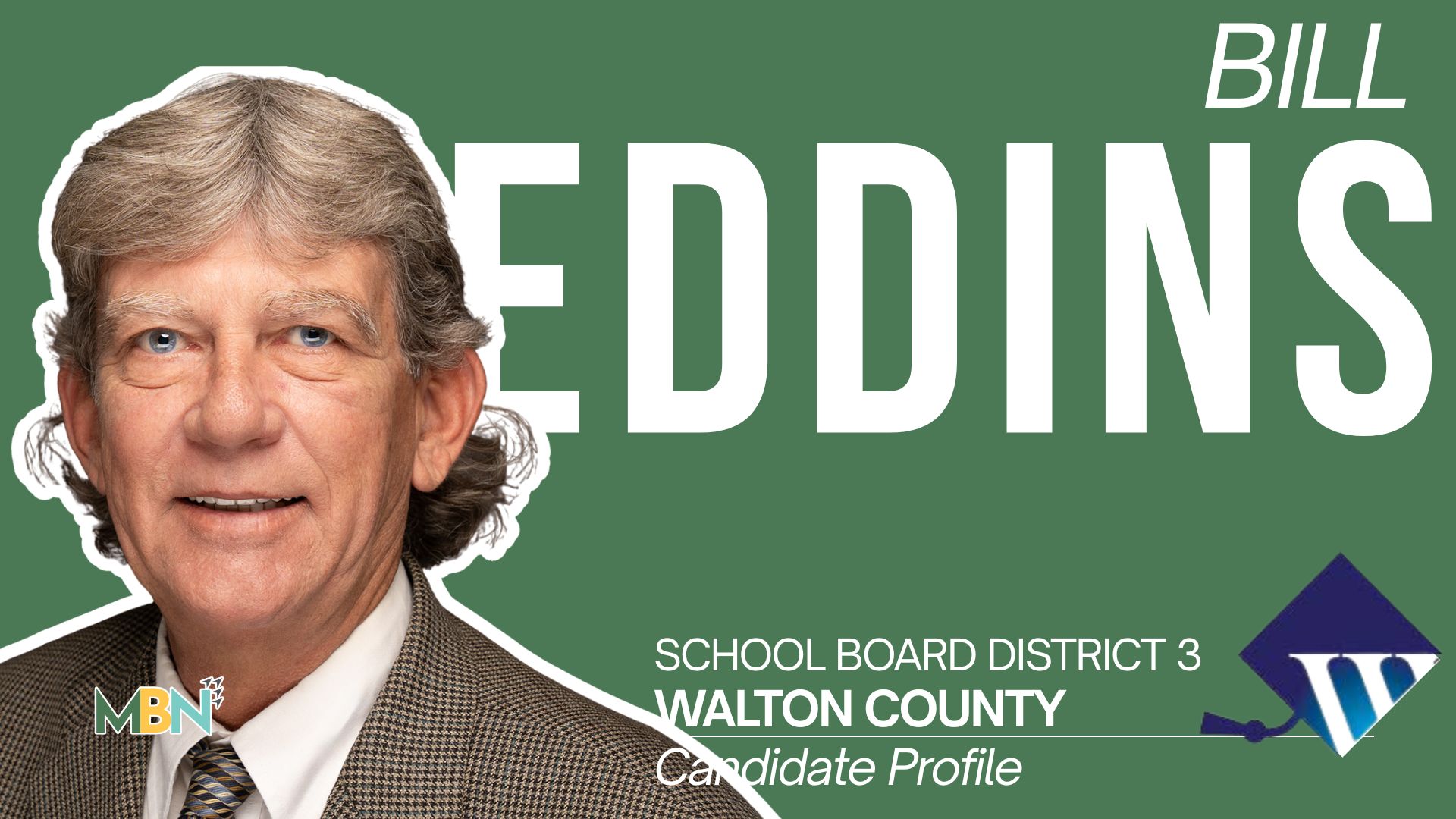
Bill Eddins is running for his fourth term as a member of the Walton County School Board. Click for more from him.
We love to bring you, and all of your neighbors, the news for free – it’s a part of who we are. But just because something is free doesn’t mean it’s cheap.
Your sustaining donation of just $10 per month helps us keep the powerful accountable and make the mortgage on time. If you notice you keep coming back for more stories from us – please consider supporting our work so we can do it for the long haul (and not be homeless).
Register or login with Mid Bay News and never get another pop up on our site!