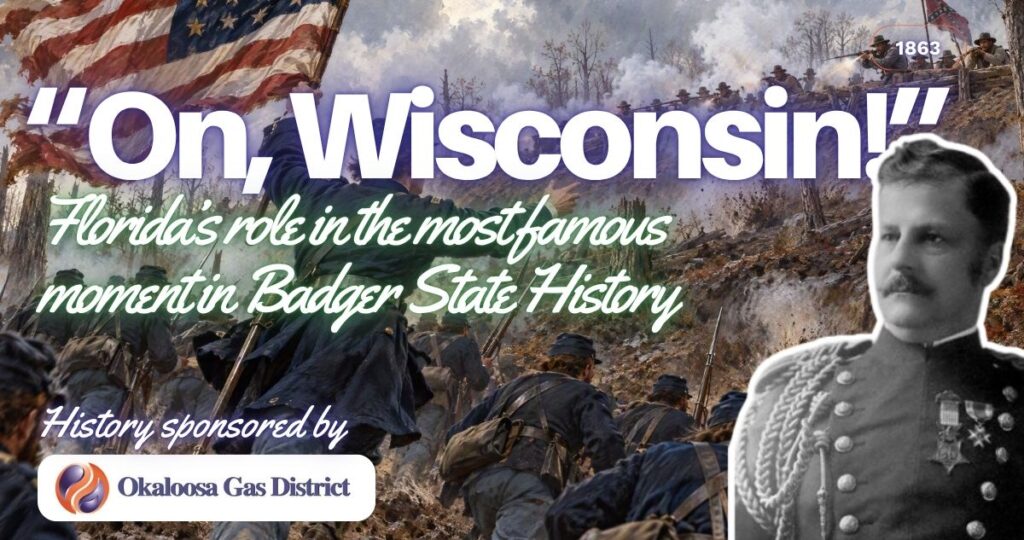

On November 25, 1863, soldiers from Walton and Santa Rosa counties fought at Missionary Ridge as part of the 6th Florida Infantry and helped to make history. Their stand put them on the losing end of a climactic Union breakthrough at Chattanooga—and set the stage for Arthur MacArthur Jr.’s famous ‘On Wisconsin!’ charge.
That day, the Battle of Missionary Ridge brought the Chattanooga Campaign to its decisive turning point. The ridge east of Chattanooga was more than a dramatic piece of high ground. It anchored the Confederate Army of Tennessee’s siege line around a vital rail-and-river center. When Union troops stormed it, they broke the Confederacy’s hold on the military situation in Tennessee and opened the way for the 1864 campaign into Georgia that would act as the death blow to the rebels hopes.
For residents of the Emerald Coast, this was not simply a faraway battle. Men from the area served in the 6th Florida Infantry, a regiment in Brig. Gen. Jesse J. Finley’s Florida Brigade. Their unit, which included the 1st, 3rd, 4th, 6th and 7th Florida infantry regiments and the dismounted 1st Florida Cavalry, stood in the Confederate center—exactly where the Union assault would hit with devastating force.
The 6th Florida also had a local connection in its commander, Angus D. McLean, an Emerald Coast native who had risen to lead the regiment after Finley’s promotion. The regiment’s ranks included men from Walton and Santa Rosa counties. In other words, when the battle reached its crisis, soldiers with direct ties to our communities were on that ridge.
The Floridians’ task was daunting from the start. Part of the brigade occupied rifle pits at the foot of Missionary Ridge, while other Florida units held the crest. As Union troops advanced, the men at the base fired their volley and tried to withdraw uphill under pressure. The movement left some wounded or exhausted men behind, where they were captured. The rest scrambled up the slope under fire to join the defenses above.
Walton County resident Washington Ives served in the Florida Brigade during the battle. He later recalled that parts of the Confederate defense “amounted to nothing more than a [very thin] skirmish line.”
The Floridians fought at close range, but the position on the summit created a fatal problem. Confederate troops were placed on the ridge’s top rather than on the crest just below it, making it difficult to see and fire effectively on the attackers climbing toward them.
Among the Union soldiers moving into that storm were the Wisconsinites of the 24th Wisconsin Infantry led by 18-year-old First Lt. Arthur MacArthur Jr.
At a critical moment, the regiment’s standard-bearer was killed. MacArthur seized the colors, drove forward, shouted “On, Wisconsin!” and planted the flag on the crest of the captured works, despite being wounded twice in the charge. That is the act preserved in his Medal of Honor citation.
MacArthur’s dash did not single-handedly win the battle, and the surviving evidence does not identify a specific, face-to-face clash between him and the 6th Florida. But his charge was part of the central Union breakthrough that overwhelmed the same Confederate position held by Finley’s Florida Brigade. As the Union line surged over the crest, the Florida regiments were forced back down the opposite side of the ridge with the rest of Bragg’s army.
That is where the national story and our local story meet. Men from Walton and Santa Rosa counties, fighting in Confederate service with the 6th Florida, took part in the desperate defense of Missionary Ridge. Across from and into that central position came Union troops that included the 24th Wisconsin, rallied around MacArthur and its colors. Their encounter belonged to a battle that cost lives on both sides and helped determine the course of the war in the Western Theater.
MacArthur later became the father of Gen. Douglas MacArthur, who also received the Medal of Honor. Together they were one of only two father-son pairs to receive the nation’s highest award for military valor; the other was Theodore Roosevelt and his son, Theodore Roosevelt Jr.