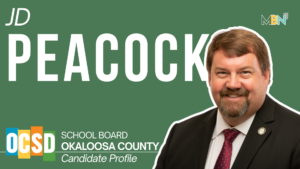
In this interview with Mid Bay News’ Christopher Saul, JD Peacock, former Okaloosa County Clerk of Court and longtime sheriff’s office administrator, lays out why he’s running for Okaloosa County School Board District 1 and how his background in public safety, finance, and oversight would shape his decisions.
Peacock describes decades of local service, including leading the sheriff’s office through accreditation and creating an inspector general’s office as clerk to increase transparency and accountability in county finances. He argues that these experiences prepared him to scrutinize the school district’s roughly $800+ million budget and seek efficiencies that push more resources into classrooms.
On policy, Peacock says his top three priorities are:
- Student and campus safety (including strong SRO programs and consistent discipline),
- Fiscal oversight (scouring budgets and understanding state mandates), and
- Supporting teachers and direct support staff (better pay and working conditions).
He supports the new state law allowing booster and alumni funds to supplement coach pay, noting it’s capped at the district’s highest‑paid administrator and can help attract quality coaches, provided there is strong transparency and oversight.
Addressing teacher pay, Peacock acknowledges that Okaloosa lags Walton County by $5,000–$10,000 per year, depending on tenure. He favors raises and says he dislikes being “last” on compensation while expecting high performance. His approach would be to first find every possible dollar within the existing budget and only consider a voter‑driven millage increase if a clear, grassroots-supported plan emerges.
On test scores, Peacock links part of the statewide decline to COVID‑era disruptions and highlights district initiatives focused on early grades (K–2, early literacy and math) that have already been presented at school board workshops. He frames improvement as a long-term, “every day” process rather than a quick fix.
When asked about the superintendent’s relationship with a subordinate, Peacock notes that the superintendent is independently elected, not hired by the board, and that an outside employment-law review requested by the board found the complaint unfounded. He says policy review is always appropriate, but he wants to stay focused on student outcomes.
Peacock supports the closures of Longwood and Mary Esther Elementary as difficult but necessary “business decisions” driven by enrollment shifts and facilities capacity. He emphasizes that recent capital investments weren’t wasted—Longwood is expected to be repurposed by the military, and Mary Esther can be sold to recoup value for other capital needs. He frames consolidation as part of responsible stewardship of taxpayer funds.
On growth in Crestview, he acknowledges concerns about overcrowding at Crestview High School but says current usage and off‑campus programs mean the school is not yet over capacity. He points to the district’s Capital Improvements Master Plan and the new Pinewood K–8 as evidence of active long‑range planning, while leaving open the likelihood that a new high school may be needed as North End growth accelerates.
Regarding school choice, Peacock supports competition and parental choice but stresses concerns about fairness and accountability when taxpayer dollars go to private and home schools with far fewer regulations than traditional public schools. He wants to learn from innovative practices in charters and private schools, but also ensure a “level playing field” on expectations, testing, and financial oversight—especially because public schools must serve every student, including those other schools can turn away.
Peacock closes by emphasizing his accessibility and community presence—attending public meetings, chambers, and civic events—and reiterates that his guiding principle on the board would be student success after graduation, whether students pursue college, the military, or the trades.