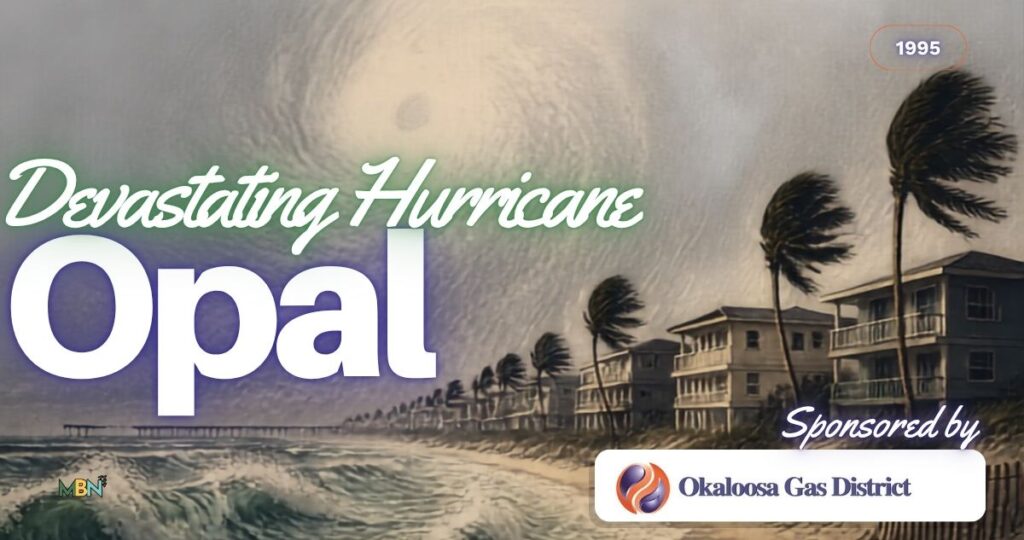

A special thanks to Okaloosa Gas for sponsoring our local history articles like this one!
When Category 4 Hurricane Opal barreled toward the Gulf Coast on October 4, 1995, residents across Okaloosa and Santa Rosa counties faced one of the region’s most severe weather disasters.
Forming north of the Yucatan Peninsula on September 27, the system initially meandered slowly through the Gulf of Mexico before undergoing a dramatic overnight transition. Rapidly intensifying from a Category 2 to a high-end Category 4 storm, Opal caught forecasters and emergency managers off guard, triggering widespread panic and immediate localized evacuations.
The swift escalation forced roughly 100,000 residents along the Emerald Coast to flee inland, causing severe traffic gridlock on main arterial roads. State Route 85 became overwhelmed with northbound vehicles as motorists sought higher ground.
Many evacuees couldn’t clear the area; families traveling from Niceville spent over three hours trying to reach the northern end of Okaloosa County, eventually turning into emergency shelters set up in public buildings.
Crestview High School quickly became a key sanctuary, taking in more than 1,000 displaced residents from around the city and neighboring coastal communities. However, safety inside the shelter was temporarily threatened when an F-2 tornado spun off from the storm cell, striking the facility and causing physical damage. Tragically, the broader severe weather outbreak associated with Opal claimed ten lives in the region.
Hurricane Opal made official landfall near Navarre Beach, positioning Okaloosa County squarely on the eastern, most powerful side of the eyewall. High-energy waves and massive storm surge battered the coastline, pushing six to eight feet of water into Choctawhatchee Bay and flooding low-lying districts across Fort Walton Beach and Niceville. National Hurricane Center Director Bob Burpee later noted the limitations of existing meteorology, observing that while track predictions had improved, predicting such extreme intensity spikes remained beyond contemporary state-of-the-art capability.
The disaster strained local infrastructure to its limits. Regional communications were bottlenecked as central routing facilities in Tallahassee were inundated with frantic calls from family members trying to confirm the safety of personnel at Eglin Air Force Base and Hurlburt Field. Telecommunications workers described the overload as relentless during the height of the crisis.
In total, Hurricane Opal caused over $1.2 billion in damage throughout the affected areas. Beyond structural destruction, the coastal environment suffered severe ecological degradation, primarily through extreme beachfront erosion. The shoreline was stripped so thoroughly that major restoration efforts were required; Navarre Beach alone needed roughly 7,000 truckloads of sand to replenish the lost beaches and re-establish the original waterline.
The physical alteration of the beach landscape initiated a complex aftermath that lingered for years. Disputes over public beach access, property boundaries, and coastal management after the storm sand replenishment projects triggered a landmark lawsuit between beachfront property owners and local and state government entities. This legal contest worked its way through the judicial system to the United States Supreme Court, remaining unresolved until well after Hurricane Ivan struck the coast nearly a decade later.