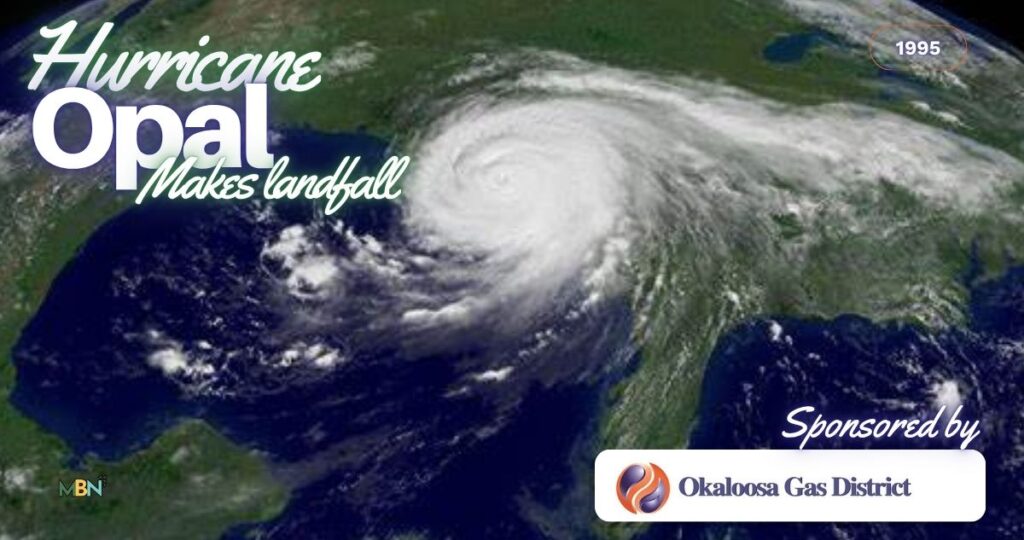

On October 4, 1995, one of the biggest storms to wreak havoc on the Emerald Coast would make landfall in Santa Rosa, Okaloosa, and Walton counties.
While the storm crippled infrastructure and flattened coastal defenses, its true legacy lay in the suddenness of its escalation and the multi-decade legal and ecological transformation it triggered across Northwest Florida.
RELATED: Why do so many hurricanes hit our area in September and October?
The Storm to Define the Future of the Beaches on the Emerald Coast
The National Weather Service tracked its first local storm on September 29, 1917, when an unnamed hurricane struck modern-day Fort Walton Beach. Nineteen years later, another storm totaled Niceville High School. Yet in October 1995, Hurricane Opal delivered a sudden, catastrophic blow that fundamentally altered the region’s physical and legal landscape.
Sign up for our newsletter here:
In the fall of 1995, life along the coast seemed centered around high school football and national headlines. The Fort Walton Beach High School Vikings were charging toward a state championship run, riding an eight-game winning streak behind quarterback Marcus Outzen. Meanwhile, much of the public’s attention was glued to news out of Los Angeles following the O.J. Simpson trial verdict and his victory celebration.
Beneath the radar, a tropical system that formed near the Yucatan Peninsula on September 27 slowly ambled north into the Gulf of Mexico. Then, disaster struck with minimal warning: Opal rapidly intensified overnight from a Category 2 into a Category 4 monster.
The sudden escalation triggered a haphazard, frantic evacuation of roughly 100,000 residents across the Gulf Coast, resulting in widespread highway gridlock. State Route 85 ground to a standstill; four families from Niceville spent three grueling hours traveling its length before abandoning their journey to seek shelter at Crestview High School.
Opal slammed ashore near Navarre, placing the worst side of the storm directly over Okaloosa County. A destructive six- to eight-foot storm surge pounded Fort Walton Beach and Niceville straight out of Choctawhatchee Bay. While meteorologists predicted the track accurately, forecasting rapid changes in strength remained elusive. As Hurricane Center Director Bob Burpee acknowledged, “our state-of-the-art is not that good.”
The human toll stretched communication networks to their limit. In Tallahassee, call centers handling routing for Eglin Air Force Base and Hurlburt Field were overwhelmed by frantic calls from mothers and grandmothers checking on military personnel. As one Sprint-Centel telephone operator put it, “It is just so sad.”
In Crestview, the high school shelter took in over 1,000 evacuees, but safety was far from guaranteed. An F-2 tornado spun up in the Hub City, damaging the shelter itself. The broader storm cell ultimately claimed ten lives.
When the winds finally receded, Opal left behind more than $1.2 billion in damage. The immediate ecological impact included severe beachfront erosion, requiring 7,000 truckloads of sand to be brought to Navarre Beach just to restore the scoured shoreline. Beyond the physical destruction, Opal sparked a fierce legal battle between local beachfront homeowners and state and local governments over coastal restoration—a lawsuit that climbed to the U.S. Supreme Court and remained unresolved until after Hurricane Ivan made landfall years later.