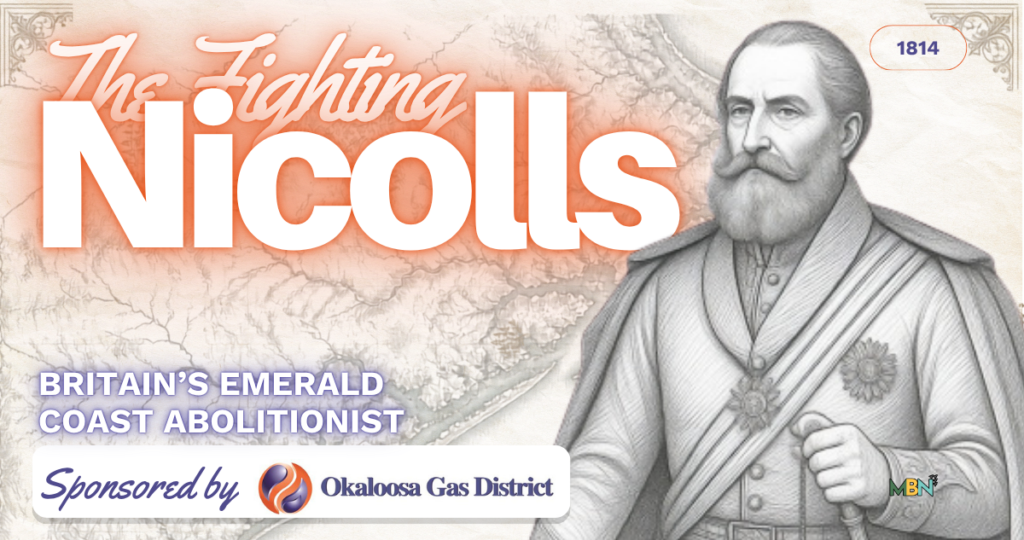


On August 13, 1814, a British warship dropped anchor in Pensacola Bay, and with it, a spark landed on the dry tinder of the Emerald Coast.
Lieutenant Colonel Edward Nicolls stepped ashore into the stifling heat of Spanish West Florida. A Protestant Irishman commissioned at sixteen, veteran of more than a hundred global engagements, and a fierce abolitionist who had spent years intercepting slave ships off West Africa, “The Fighting Nicolls” was not a man to underestimate. He immediately set to work constructing the southern slaveholders’ ultimate nightmare: a highly disciplined regiment of British Colonial Marines composed of Black men who had fled the plantations of Georgia and the Mississippi Territory for a better, free, life in Florida.
Operating with the tacit support of the Spanish Governor, Nicolls armed these men and invited Red Stick Creek refugees to join them. Together, they formed a multiracial vanguard designed to sow mayhem along the American southern borderlands. This single landing in late summer of 1814 did far more than escalate the War of 1812—it lit a slow-burning fuse that would explode into the First Seminole War by the end of the decade.
The Hunt Through the Pines
In Alabama, Major General Andrew Jackson watched the British build their Florida sanctuary with growing fury. He knew that an armed, sovereign community of Black and Indigenous warriors right on the border was an existential threat to the Southern slave economy.
In November 1814, Jackson gathered a force of 4,000 regulars, militiamen, and allied warriors. Marching south from Fort Montgomery (the supply base near the ruins of Fort Mims), Jackson’s army tracked along the Old Spanish Trail. They cut through Lake Jackson in Walton County and crossed the Yellow River near modern-day Laurel Hill, driving hard toward Pensacola.
Before he reached the city, Jackson split off a detachment under Major Uriah Blue. Jackson tasked Blue with a search-and-destroy mission: sweep the dense Florida swamps and pine barrens to flush out and destroy British-allied Creek and Maroon settlements. His ranks included a young Tennessee man named Davy Crockett, who would later become famous for the last stand at the Alamo in San Antonio, Texas, twenty years later.
Nicolls’ strategy of drawing the Americans into the Florida wilderness worked. Blue took the bait, and the hunt began.
Starvation on the Yellow River
While Jackson secured Pensacola and hurried toward his historic showdown in New Orleans, Major Blue’s men were living a nightmare in the Florida wilderness.
Traveling light and lacking supply lines, Blue’s expedition quickly ran out of food. They had expected to forage and live off captured provisions, but the Florida interior was unforgiving. On December 9, they discovered an abandoned Creek town on the Escambia River. Pushing farther east, they located a settlement near the Yellow River, killing 30 warriors and capturing 75. But the meager spoils did nothing to alleviate their starvation. Crockett would later write that the men were so desperately hungry they were “nearly ready to give up the ghost, and lie down and die.”
On Christmas Day, Blue’s scouts pushed deep into the piney forests of modern-day Washington County, targeting Holmes Village near present-day Vernon. Once again, they found the village abandoned and stripped of supplies. Broken by hunger, Blue aborted the march toward Prospect Bluff and turned back to Pensacola. By the time they arrived in January 1815, nearly 90 percent of his indigenous allies had deserted the starving force.
Though Blue’s expedition was plagued by misery, Pensacola State College history lecturer Brian Rucker notes its strategic value: “Blue’s expedition into West Florida was important. American forces may have prevented the British from launching a rear-guard action with their Red Stick allies. They freed Jackson from a threat (real or imagined) to his flank by traipsing through the woods of the Emerald Coast.”
With the War of 1812 wrapping up, Blue was dispatched to defend Mobile, where his depleted, exhausted forces surrendered on February 8, 1815. But the stage for a much larger, uglier war had already been set.
The “Negro Fort” and the Red-Hot Shot
The War of 1812 officially ended, and the British withdrew from Florida. But when Colonel Edward Nicolls departed Prospect Bluff, he did something that horrified American plantation owners: he left the massive, fully armed fort, its artillery, and its deep store of gunpowder in the hands of his trained Maroon and Creek allies.
To Southern slaveholders, Prospect Bluff—which Americans dubbed “The Negro Fort”—was an intolerable beacon of Black autonomy. It was a well-defended sanctuary where runaway slaves could live in freedom, fully armed and trained in British military tactics. Under the leadership of a free Black man named Garçon and a Choctaw chief, the fort represented a direct threat to the plantation economy of the American South.
In July 1816, the U.S. Army decided to neutralize the threat. Under Jackson’s orders, Colonel Duncan Clinch marched south from Alabama with a force of regulars and allied Creek warriors under William McIntosh, while gunboats commanded by Sailing Master Jarius Loomis moved up the Apalachicola River.
On July 20, 1816, Clinch demanded the fort’s surrender. Garçon defiantly refused, raising the red flag of no quarter and declaring he would blow up the fort before surrendering it.
The siege culminated in a single, catastrophic instant on July 27, 1816. Loomis’s gunboats began heating iron cannonballs over fires until they glowed red. On the eighth shot, one of these “hot-shots” tore through the air, ricocheted off a tree, and landed directly inside the fort’s open powder magazine.
The resulting explosion was deafening, reportedly heard a hundred miles away. In a blinding flash, the fort was obliterated. Out of some 320 men, women, and children inside, more than 250 died instantly. Surgeon Marcus Buck described the horrific aftermath, noting how “lifeless bodies were stretched upon the plain, buried in sand and rubbish, or suspended from the tops of the surrounding pines.” Garçon survived the blast but was captured and executed by an American firing squad, while the Choctaw chief was handed over to Clinch’s Creek allies to be killed and scalped.
The Match That Lit the Seminole War
Though the stronghold at Prospect Bluff was reduced to ash, the survivors fled deeper into the Florida peninsula, carrying their rage with them. Among the few who escaped the blast was the Red Stick Creek spiritual leader, Josiah Francis (known as Francis the Prophet).
In 1818, during Andrew Jackson’s subsequent illegal invasion of Florida, Francis was lured onto an American warship flying a false British flag, captured, and summarily hanged on Jackson’s orders. His teenage daughter, Milly Francis—often called the “Creek Pocahontas” for saving the life of a captured Georgia militia officer named Duncan McKrimmon—later surrendered to the Americans. McKrimmon, out of gratitude and infatuation, traveled to Fort Gadsden (built by Jackson on the ruins of Prospect Bluff) to offer her marriage. Milly steadfastly refused, stating she had saved his life out of simple humanity, not to buy a husband.
The destruction of the Negro Fort did not secure the border; it merely accelerated a cycle of bloody, cross-border reprisal.
The flashpoint came in 1817. U.S. troops repeatedly crossed into Spanish territory to hunt runaways and attack Creek towns. In southern Georgia, a small Creek raiding party crossed the border in retaliation for the killing of a Creek hunter. They came upon the homestead of the Garrett family. Finding a brass kettle in the cabin that they believed had belonged to their murdered comrade, the warriors took swift, brutal revenge. Mrs. Garrett and her two young children, an infant and a toddler, were killed and scalped.
The Garrett massacre provided the ultimate political ammunition for the U.S. military. In November 1817, General Edmund P. Gaines ordered an attack on Fowltown, a Mikasuki Seminole village near the Georgia-Florida border, to arrest its chief, Neamathla, whom they blamed for the border violence. Neamathla’s warriors fought back, and the resulting skirmish at Fowltown officially marked the opening shots of the First Seminole War.
The wildfire that Edward Nicolls had lit on the beaches of Pensacola in August 1814 had finally consumed the borderlands. By arming the Maroons and uniting them with the Creek refugees, the “Fighting Nicolls” had constructed a geopolitical powder keg. The destruction of that powder keg did not bring peace; instead, it dragged the United States, Spain, and the Seminole Nation into a decades-long war that would eventually strip Spain of Florida and change the face of the American South forever.