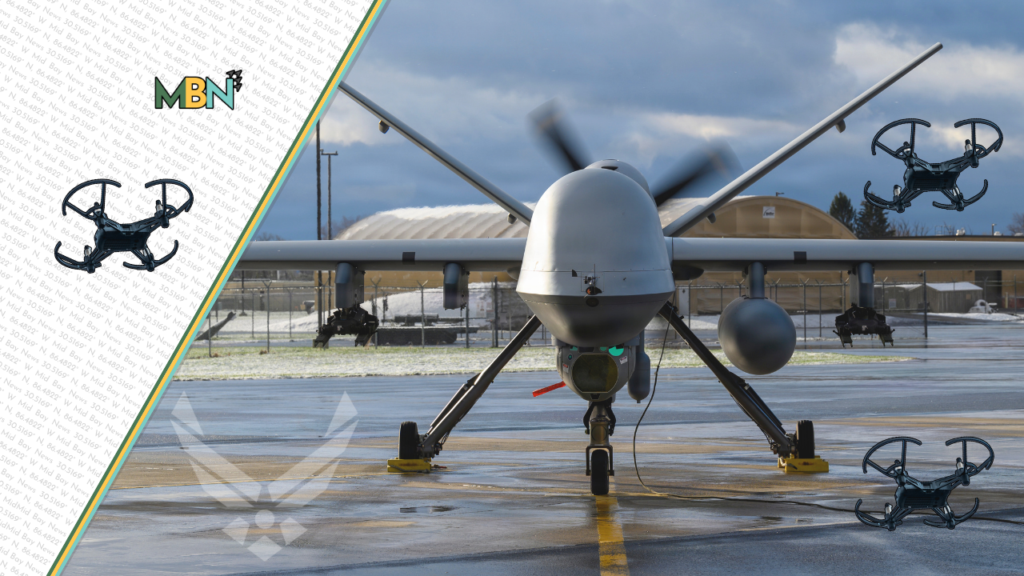
The MQ-9 Reaper, built by General Atomics, has long been used for intelligence, surveillance, reconnaissance (ISR), and strike missions. But under this new concept, the aircraft would act as an airborne command hub, launching and coordinating smaller drones deep into contested airspace.
🔄 Strategic Shift
The move reflects a broader transition away from counterinsurgency operations toward more complex environments, particularly in the Indo-Pacific region, where airspace is expected to be heavily contested.
SOCOM originally selected the OA-1K in 2022, based on L3Harris’ AT-802U Sky Warden, as part of its Armed Overwatch program. That $3 billion effort aimed to consolidate multiple mission roles, including close air support and ISR.
Now, that fleet is being scaled back as unmanned systems take center stage.
🚁 Building a Drone Network
Under the new plan, the MQ-9 would serve as a “mothership,” deploying and managing a network of drones in flight.
The fiscal 2027 request includes:
- 93 Group 2 drones
- 10 Group 3 drones
- 16 swarm carrier pods
- 5 ground-system interfaces
These drones would support a mix of ISR and potential strike missions, with larger Group 3 drones expected to include stealth capabilities for higher-risk operations.
In November, Anduril Industries secured a $50 million contract to supply ALTIUS-600 drone systems, further advancing the Pentagon’s push toward human-machine teaming.
⚙️ What It Means
The proposal highlights a growing emphasis on distributed, networked warfare, in which a single aircraft can coordinate multiple unmanned systems over vast distances.
If approved, the shift could reshape how U.S. special operations forces conduct missions in future conflicts, prioritizing flexibility, survivability, and advanced drone integration.
Photo courtesy of the U.S. Department of Defense.