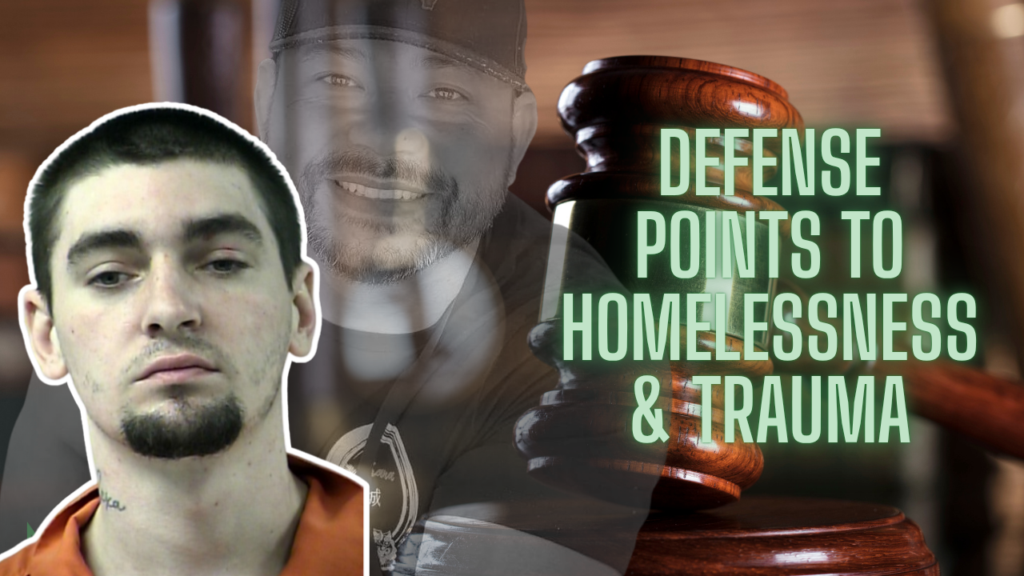

It’s been over two years since Niceville police arrested Dylan Deschaine for the second degree murder of Mike Ledford, and a lengthy process of hearings with atypical events— including Deschaine’s firing of his attorney and a failed self-defense argument where the defendant himself testified— followed.
Deschaine’s most recent pretrial conference on Oct. 14 offered insight into the defense’s next argument, and sheds light on an often-taboo topic: men’s mental health.
On Oct. 12, the Okaloosa County Court authorized a defense motion to incur costs for a mental health expert, Dr. Randi McDonald, to testify about Deschaine’s mental health and how it could’ve led to him stabbing Ledford.
According to the motion, Deschaine’s attorney, Jason Cobb, recently learned that “the Defendant in this case has [a] history of abuse, trauma, or cognitive impairments that provide context for the offense. Based upon the foregoing, defense counsel believes the Defendant requires specialized treatment for an undiagnosed mental disorder, possibly PTSD, that is unrelated to substance abuse or addiction but is related to long periods of homelessness and severe abuse at the hands of others.”
McDonald will perform a mental health evaluation on Deschaine and testify about his findings, likely in defense of Deschaine’s actions.
The motion to incur costs said the defense will use McDonald’s testimony for “mitigation/departure purposes,” meaning Deschaine’s counsel will likely seek a less severe sentence rather than complete acquittal.
Currently, court records do not reflect evidence that the defense will seek a verdict of not guilty by reason of insanity (NGI).
Mental health as a defense: How has it been used before?
Florida courts acquitted several defendants of murder over the last few years for insanity arguments, including, but not limited to:
- Luke Ingram, Flagler County: 21-year-old who sexually battered and killed his grandfather but was found not guilty based on his schizophrenia diagnosis
- Earleen Tucker, Leon County: 58-year-old who killed her mother in Tallahassee using sharp-force trauma but was found NGI after court decided she suffered from major mental illness
- Anthony Kaptzan, Hillsborough County: Stabbed his mother and father, killing his father and seriously injuring his mother, but was found NGI and ordered to a lifetime of mental health treatment
However, it’s less often we see court cases reduced or dismissed on the basis of mental health issues that don’t classify the defendant as insane.
One recent case may offer some insight, as it happened in Okaloosa County.
In March 2020, Maria Rodriguez discovered her husband wanted a divorce. She then drove to The Boardwalk at Okaloosa Island with her five-month-old son, where she shot and killed the child before shooting herself in the chest. Rodriguez survived and was transported to a Baker Act hospital ward. She was arrested and charged with first-degree murder upon her release.
Rodriguez pleaded not guilty but did not raise an insanity defense, according to court records. Instead, “Her testimony was limited to her claim that she had no recollection about what happened on the day she shot her five-month-old child and tried to commit suicide.”
Eventually, a juror found her guilty and sentenced her to life in prison. Court records state they determined, based on jury instructions and case precedents, “that evidence of an abnormal mental condition cannot be used to prove that the defendant could not or did not form the necessary specific intent or state of mind to commit the charged offense.”
Chestnut v. State of Florida
Chestnut v. State of Florida set a precedent regarding mental health issues that fall short of insanity in murder cases, asking whether “evidence of an abnormal mental condition not constituting legal insanity [is] admissible for the purpose of proving either that the accused could not or did not entertain the specific intent or state of mind essential to proof of the offense, in order to determine whether the crime charged, or a lesser degree thereof, was in fact committed.”
In 1987, Adam Blaine Chestnut, along with co-defendents Jack Bolesta and Gary German, robbed and killed Carl Brown. For immunity, German testified against Chestnut, and Chestnut was charged with first-degree premeditated murder and felony murder.
According to case information, “At trial, counsel proffered expert testimony seeking to establish that Chestnut did not have the mental state required for premeditated first-degree murder. The proffered testimony revealed that Chestnut’s intelligence was in the lowest five percent of the general population. Further, it showed that, several years earlier, appellant was kicked in the head by a bull, sustaining a fractured skull and brain damage which caused a posttraumatic seizure disorder that required medication.”
However, this argument did not hold up. The Florida Supreme Court decided in 1989 that Chestnut’s “diminished mental capacity was inadmissible to negate the specific intent required to convict of first-degree premeditated murder,” setting a precedent.
It’s worth noting that Deschaine, unlike Chestnut, is charged with second-degree murder, which already establishes a lack of premeditation. His counsel would likely seek a reduction of charges to third-degree murder, classified as “the unlawful killing of a human being when perpetrated without any design to effect death,” by someone engaging in certain felonies, according to Online Sunshine, or manslaughter, “the killing of a human being by the act, procurement, or culpable negligence of another.”
Deschaine was not charged with any other crimes regarding the killing of Mike Ledford. However, he faces battery charges he obtained beforehand and while incarcerated.
An expert’s commentary on homelessness & mental health
Editor’s note: Stephanie Gagliano serves as an outside, impartial source to this story. She was not asked to comment on Deschaine’s case or briefed on its specific details.
Stephanie Gagliano, director of the Treatment for Individuals Experiencing Homelessness Project at Bridgeway Center, provides free mental health treatment to homeless individuals around Okaloosa County, focusing on “the barriers that have caused the homelessness [and] what they have endured while being homeless.”
In an Oct. 12 motion for continuance in Deschaine’s trial, it states that “defense counsel learned the Defendant has a harrowing history of chronic homelessness, particularly during an extended period in New York City where he was repeatedly assaulted and sustained severe, documented injuries.”
Gagliano said it isn’t uncommon for homeless individuals to suffer abuse at the hands of others.
“I’ve heard countless stories from my clients about the violence that they’ve endured while being homeless,” she said. “I had a lady that I worked with that was just completely black and blue in her face, and I asked her, ‘What happened?’ And she said, ‘Well, I had a piece of pizza, and someone else wanted it, so they beat me up to get the pizza,’ so in that community there is a lot of violence.”
Gagliano described how prolonged mistreatment of homeless individuals can put them in “fight mode.”
“It goes back to the fear of what’s going to happen to them,” she said. “You know, not trusting, thinking everybody’s out to get them because in that world, they are. You constantly have to be ready for a battle, so I think that’s where that PTSD would come in. … A lot of them, they just get so acclimated to that lifestyle, and so when we try to take them out of that lifestyle, all the things that have happened to them kind of come back.”
Gagliano said the trauma of homelessness is unique to mental health issues someone with a stable home would face.
“It’s prolonged,” she said. “You could have anxiety, and I’m sure that you have friends, you have family, your employer— you have a support system. You have someone you can talk to to lessen that anxiety. … For someone who doesn’t, that anxiety will grow and grow and grow, and it does change the brain and does change those chemical responses.”
However, Gagliano said homeless individuals suffering from PTSD typically engage in “self-injurious behavior,” like substance abuse or suicidal thoughts, rather than hurting others.
“I’ve been in this job for almost two years and all the people I’ve encountered, I’ve never felt threatened. I’ve never felt unsafe. My staff and I, we walk through encampments. A lot of times we have law enforcement with us— not to trespass them, but as support. I’ve never had any experience of that [outward violence]. … I don’t know how often it does happen, but I don’t think it happens often.”
Deschaine’s counsel, in its motion to hire a mental health expert, said Deschaine is “amenable to treatment.”
Gagliano said homeless individuals often can seek treatment and rehabilitate.
“When you take away all those barriers of homelessness, and they have a safe and stable place to sleep, some ownership of what they have, those things will go away,” Gagliano said. “They may not go away totally, and there will be some PTSD from all the trauma, but if they have the right support system and they have the right environment, it’s a healthy environment, I do feel like any person can recover from it.”
Gagliano said it’s still possible, though, that a homeless individual would engage in crime with the hope of getting arrested to have a roof over their head.
“Especially during the cold months and the hot months, people will try to get themselves arrested to have a safe place to stay or to get medication, to get the services they need, because a lot of times it’s safer in jail than it is on the streets.”
However, Gagliano usually sees these individuals commit minor crimes, which doesn’t align with Deschaine’s charges.
“More like knowingly trespassing, or it could be like a petty theft, you know?” Gagliano said. “Something minor. Because most of the time, they don’t want to be there long term. They just want to be there either for the weekend or for a week.”
Gagliano urged anyone experiencing homelessness to reach out, and said the TIEH Project will help.
“We want to help and support and be a comfortable space for them, and to help them find those resources, whatever they are,” Gagliano said.
What’s next in Deschaine’s trial?
The Okaloosa County Court website has not listed a date for Deschaine’s next hearing. However, they’re typically scheduled for every two months.
Deschaine will likely have another pretrial conference around Dec. 14, and Mid Bay News will continue to report as the trial progresses.