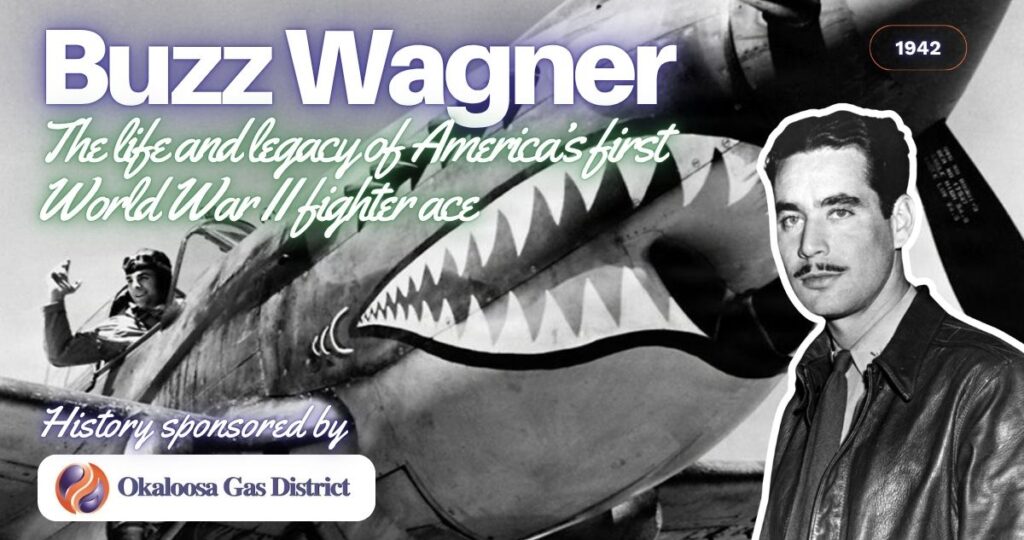

On Nov. 29, 1942, Lt. Col. Boyd D. “Buzz” Wagner—America’s first U.S. Army Air Forces ace of World War II—departed Eglin Field for Maxwell Field in Montgomery, Alabama. It was a routine flight for Buzz Wagner in a Curtiss P-40 Warhawk – America’s workhorse fighter plane. He never arrived.
This history article is presented by Okaloosa Gas
Desperate fighting in the Pacific create fighter ace Buzz Wagner
At 26, Wagner had already become one of the early symbols of America’s air war in the Pacific. As commander of the 17th Pursuit Squadron in the Philippines, he flew P-40s against Japanese forces during the desperate opening days of the war. Those were the days when the United States military was very much on its heels, retreating from the Japanese onslaught immediately unleashed after Pearl Harbor. By mid-December 1941, he had shot down the five enemy planes needed to earn the title of Ace.
The National Museum of the U.S. Air Force credits him with two victories on Dec. 12 and three more six days later.
During the action that earned him the Distinguished Service Cross near Vigan, Wagner led a reconnaissance strike through heavy antiaircraft fire. The official citation says he and a companion attacked an enemy airfield, dropped six fragmentation bombs, made repeated strafing passes and set the fuel supply ablaze. His companion aircraft was lost, but Wagner returned with vital information about the Japanese force.
Wagner went on to New Guinea, where he downed three additional Japanese aircraft while flying a P-39 Airacobra from Port Moresby. In all, he was credited with eight aerial victories.
Although he wanted to remain in combat, Army Air Forces leaders believed his experience could better serve the expanding war effort at home. They sent him back to the United States to help train new fighter pilots and share combat knowledge with Curtiss, the company building the P-40.
RELATED: Who is Eglin Air Force Base named after?
That is the context for his final flight. Wagner was not on a combat mission when he departed Eglin on Nov. 29; official flight records listed the trip as a routine flight to Maxwell Field. When Wagner did not arrive, Army aircraft and ground parties searched across western Florida and Alabama. The search ended more than five weeks later, when the wreckage of his P-40 was found near Freeport. The crash was listed near Freeport, roughly 25 miles north of Eglin Field. Experts couldn’t determine what happened that caused the flight to go wrong.