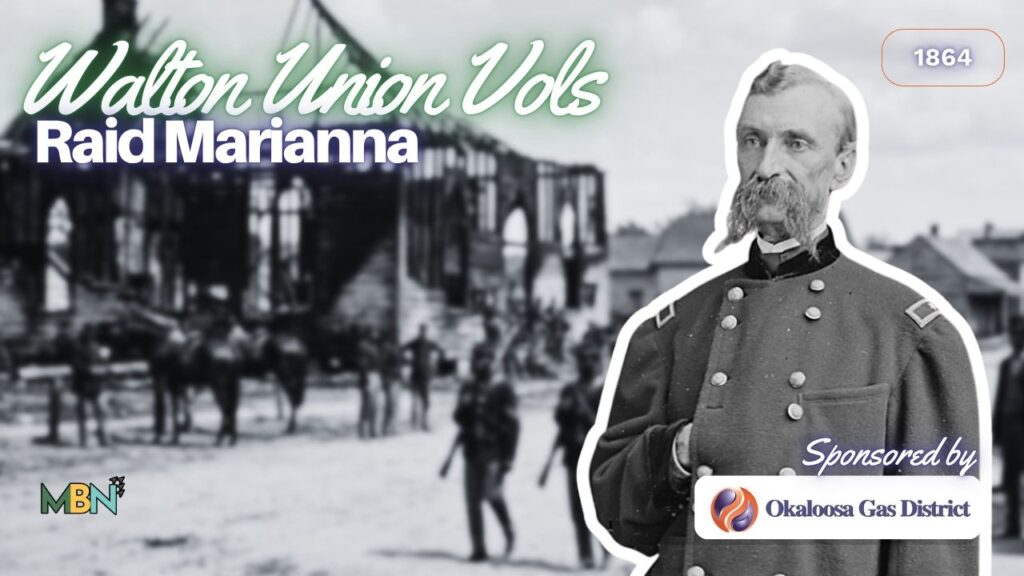

General Alexander Asboth finally got his way – he’d be authorized to form the 1st Florida Cavalry, Union Volunteers (FCUV) after months of lobbying on October 29, 1863.
Asboth was stationed at the Federal positions in Pensacola, Florida, but was far from home. He had started his career as a military cadet in a Hungarian Military Academy decades before. After an unsuccessful attempt to expel the Austrians from Hungary in the European Revolutions of 1848, He and other senior Hungarian rebel officers fled initially to Turkey before moving on to the United States.
The next decade was devoid of military activity for Asboth, who settled into Chicago, Illinois,s in the years before the war. But when Southern States began to secede from the Union, Asboth and other ex-revolutionaries from across what is now Hungary, Austria, Germany, and Poland offered their services to the Union.
Asboth and his former revolutionary commander, Lajos Kossuth, were sent immediately to the Western Front to fight in Missouri and Arkansas. After succeeding there, Asboth was promoted to General and was sent south to support the Union’s war efforts in Pensacola.
But at first, it seemed Asboth would not be stuck in the fighting in the area. He was expressly forbidden, even after the formation of the 1st FCUV, to initiate raids on nominally Confederate territory in the wilds of Northwest Florida and Southeast Alabama.
But, like most revolutionary spirits, Asboth understood that it was easier to ask for forgiveness than to beg for permission. When he received information from an unreliable but conveniently timely source, he decided to act aggressively. He and the 1st FCUV made their way into the interior of the state to liberate a POW camp that supposedly existed in Marianna. The members of the FCUV would link up in the Marianna area with units made up of African Americans to liberate camps and possibly make a move on Tallahassee – should the situation permit.
Most senior officers, except for one local and one Northerner, were from Europe. The officer corps differed significantly from the rank and file. The officers had decades of military experience. The men were mostly Confederate deserters and draft dodgers who did not want to leave their home state to fight for another man’s right to enslave people. A plurality of the men came from what is now Santa Rosa, Okaloosa, Walton, and Holmes counties. Though their upbringings may have initially contrasted sharply, the two groups made an effective fighting pair.
The men set out to Marianna at the beginning of the summer and successfully overwhelmed a small Confederate militia of a couple dozen men at Eucheeanna in July. As the unit moved closer to Marianna, the picture of the coming conflict for both sides sharpened.
West Point graduate and Confederate Militia Colonel A.B. Montgomery commanded roughly 100 men. Though the Federal officers believed rebel numbers to be closer to 300, they held an overwhelming advantage in reality and in their own minds in terms of manpower. Montgomery fortified the city of Marianna against the coming assault: he built various impediments to cavalry and deployed them in the city’s main streets. Militiamen barricaded the main thoroughfare entering the city from the west, and Montgomery deployed his entire force to the road, ignoring his flanks, because he believed his only chance at victory was a stupid or prideful Union commander’s decision to launch a lazy frontal assault. If the Union forces deployed from the flank, they would be lost no matter what.
The Vanguard of the Union cavalry force would reach the militia’s defenses on September 27th. After a quick fight and initial charge of the rebel lines, the Union forces fell back to preserve their strength and pursue a flanking maneuver.
Asboth led the flanking maneuver himself. Horses charged down the road to the militia’s right, quickly dismantling the defensive positions and sending the rebels running. The militia fled east to the safety of the far bank of the Chipola River. But the Union victory would come at a cost: Asboth would receive a grievous wound in the face – complications that would lead to his death in 1868. In all, 32 Union soldiers would die on the field that day.