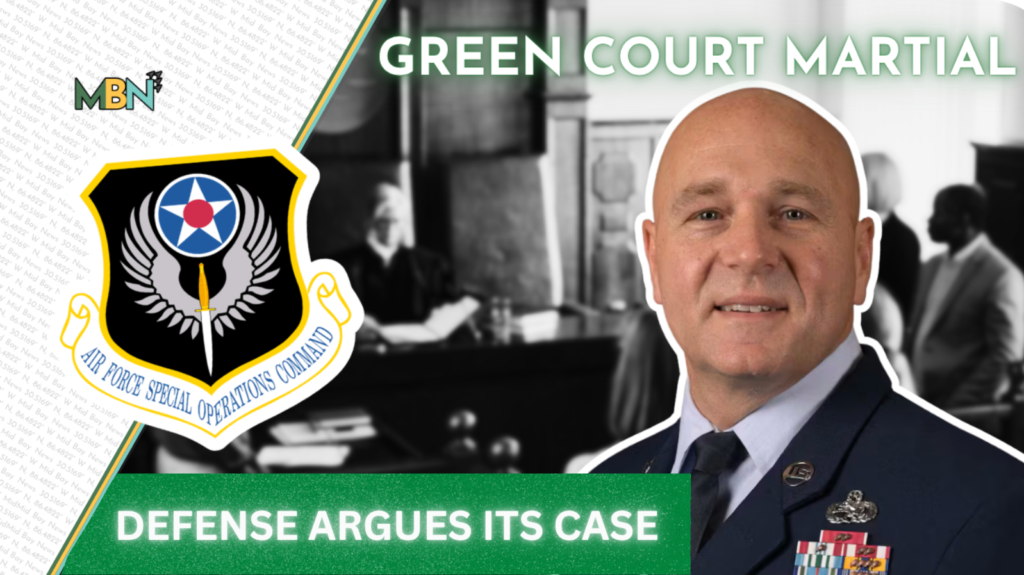

Chief Master Sergeant Anthony Green’s trial continued today, with both the prosecution and defense councils resting their cases.
Green faces charges for producing, posessing, receiving and reviewing child sexual abuse material (CSAM), as well as obstruction of justice and indecent recording.
READ MORE: TRIAL OF CHIEF MASTER SERGEANT ANTHONY GREEN: DAY 1 & 2
Prosecution concludes its case
To begin today’s proceedings, the prosecution recalled witnesses, including the alleged victim, as well as Josiah Roloff, President of Roloff Digital Forensics.
Roloff offered clarification on the metadata of Green’s devices in the days leading up to their seizure. According to his testimony:
- Metadata and activity from Green’s iPhone suggests explicit photos/videos were, in fact, created by the user of the phone.
- Notifications from the Tuya app (the app showing live feed from a hidden camera), which alerted the user to detected motion in the victim’s bedroom, were consistent with times Green opened the app.
During cross examination, the defense questioned the reliability of the technology used to extract/analyze Green’s digital activity. Specifically, they hoped to determine whether Green’s phone could have automatically recorded certain contraband footage for historical viewing.
However, Roloff said the relevant recordings/photos were in the user’s in-app gallery.
“If it’s auto-recorded, it’s not in the user gallery,” he testified.
Following Roloff’s testimony, prosecution rested its case at 11:56 a.m.
Defense’s opening
Green’s defense counsel presented its opening argument at 1 p.m. today. It argued that:
- The Government’s case against Green is based almost entirely on assumptions regarding his intentions for secretly recording the alleged victim.
- The evidence presented is not consistent with a typical CSAM case.
- Green was exercising his right to parent and secretly recording the alleged victim to “protect her” after she’d exhibited “behavioral issues”
- The hidden cameras served as an aid to help Green parent since his busy schedule required him to be away from home often.
Defense’s witnesses
The defense first called Lieutenant General Michael Conley to the stand, who is the AFSOC Commander at Hurlburt Field. Conley said previously, while serving as an AFSOC A3, he developed a close working relationship with Green, who served as his Command Chief at the time.
According to Conley’s testimony:
- Green spent 70-80 nights per year away from home due to his busy work schedule.
- He has always known Green to have great military character.
- In the time he worked with Green, he had no reason to suspect Green had hidden cameras anywhere in his family home.
Defense then called a Master Sergeant at AFSOC Headquarters to the stand, who previously worked closely under Green. She said a main component of her job at that time was to manage Green’s calendar, corroborating his demanding work schedule.
She said Green was often on the road “three quarters of the month” and she never saw him exhibit suspicious behavior on his phone at work. However, during cross examination, the witness admitted she could not testify regarding Green’s phone usage outside of work hours, or during specific times metadata appeared to show a user viewing/saving contraband media.
Next, defense recalled the alleged victim’s mother to question her about her daughter’s behavioral issues.
The victim’s mother testified that she was not aware of behavioral issues beyond potentially “inappropriate conversations with her peers” from the time of the alleged crime.
With their final two witnesses, defense aimed to solidify its argument for Green’s right to parent.
Green’s mother testified that he had once confided in her about the alleged victim’s “behavioral issues.” She said during the conversation, Green seemed anxious and distraught.
Finally, former AFSOC Command Chief Cory Olson took the stand. He said in the 15-plus years he’s known Green professionally, he’s demonstrated “impeccable” military character.
Following its witness testimony, the defense presented the judge with several character affidavits to submit as evidence. These serve as sworn-in, third party vouchers for the accused’s moral conduct and professional character.
Green’s defense counsel rested its case.
Affirmative defense?
To conclude the day in court, the presiding Military Judge asked the defense whether they had an affirmative defense, meaning the accused admits to allegations but presents evidence to excuse the behavior.
Defense said yes, that Green’s “right to parent” the victim is protected under the Constitution and caselaw.
Prosecutors objected to this claim. They argued the Constitution does not protect parental rights in the context of this case and that even if it did, the protection wouldn’t apply to stepparents.
After deliberation, the judge ruled that defense has no reasonable affirmative defense. This means that:
- Prosecution retains the full burden of proving beyond a reasonable doubt that Green committed the relevant crimes.
- The defense’s argument must simply establish that the prosecution hasn’t proved its case in order for Green to be found not guilty.
Recessed until tomorrow
Green’s trial resumes at 7:30 a.m. tomorrow, and the court expects to hear the prosecution and defense’s closing arguments.
Mid Bay News will be present for the remainder of the trial and will continue to report accordingly.