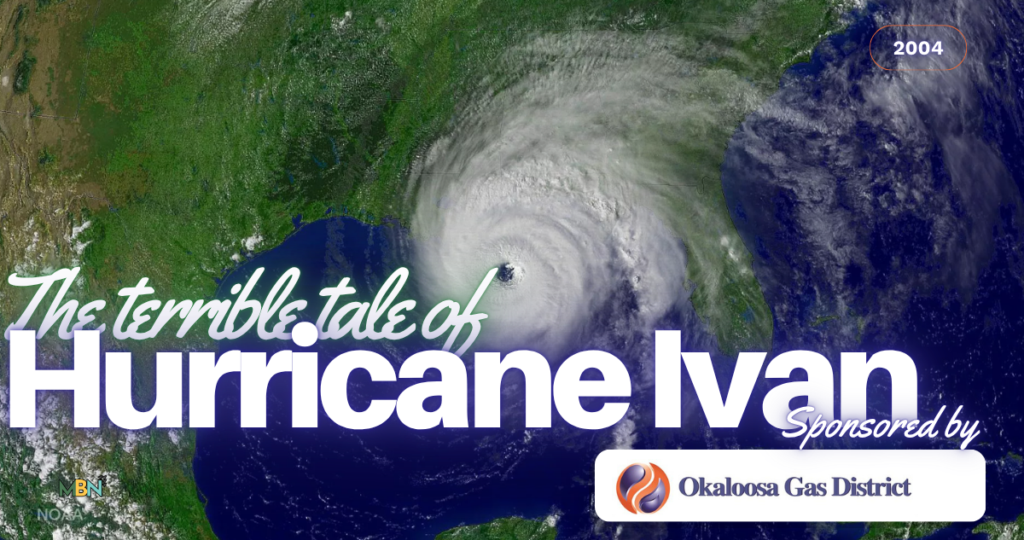

This piece of Emerald Coast History is brought to you by Okaloosa Gas!
When the 10 to 15-foot stormwater surge receded, Hurricane Ivan entered the record books as the second most destructive tropical storm in American history by dollar cost. It would far outstrip the damage of Hurricane Sally, which would hit the Emerald Coast 14 years later to the day.
Ivan also had a dubious record: the most number of landfalls in the United States by a single storm.
Ivan originated to the southeast of the Caribbean in early September of 2004. He was, according to National Weather Service of Mobile meteorologist Gary Beeler in an interview with the Pensacola News-Journal before the storm hit, “one of the strongest storms that far south ever.”
Ivan would eviscerate the small island nation of Grenada before turning to the north. Early models predicted that the storm would head north through Cuba and into the Florida Peninsula. Most Floridians had had enough of storms at that point already. By the time Ivan made his debut on the stage of the Gulf of Mexico, Florida had suffered through three Hurricanes in a month. Charley had hit the Gulf Coast in August – as did Bonnie. Frances, a much larger storm than the previous two, had devastated the Gainesville area at the beginning of September.
By September 11, though, wary eyes on the Emerald Coast began to leer at the storm track on cable news and in print. The Home Depot, which had sent all of its generators for sale down to South Florida in the wake of the hurricane damage there, took to the News Journal to alert customers they were getting restocked as soon as possible. Generators, the paper said, were restocked in Pensacola locations four days before landfall.
As the storm moved north, it jogged to the west – at one point, forecasters posited that the eye of the now Category 5 storm could make landfall near Destin.
Gulf Power, then the main electricity provider for the Gulf area, told people staying behind that they needed to prepare for the power in the area to be out for at least three weeks. Newspapers and television stations produced stories telling people exactly what they needed to have in their homes if they were going to stay. Others called the stayers “crazy” on their way out of town.
Ivan Makes Landfall
The storm continued to move to the West as landfall on the Gulf Coast approached. It would make landfall on September 16, 2004, but had drastic effects more than 100 miles to the east in Destin and Walton County.
59 beachfront buildings in Okaloosa County and another 7 in Walton County were declared totally or substantially destroyed by the Florida Department of Environmental Protection. The DEP also declared that the storm had created “major beach and dune erosion and structural damage” on its way out of town.
Legal fallout from Ivan
The National Weather Service determined the storm cost more than $14 billion in damage across the Gulf Coast from Mobile Bay to Panama City Beach. Highway 98 in Okaloosa County partially washed away on Okaloosa Island and Destin. Neighbors helped one another remove downed trees from homes and wrangle floating furniture. Power crews from out of state took up the task of clearing downed lines from streets and subdivisions.
But the destruction Ivan wrought would not stop with the cleanup. It would advance and accelerate the conflict between beachfront property owners and local and state governments. After Hurricane Opal made landfall in 1995, the Florida Department of Environmental Protection – in an effort to protect the Panhandle’s beach tourism- began an effort to replace the sand that had been lost due to erosion from the storm. As a consequence of that process, called renourishment, the State argued that they now owned the land closest to the water. Beachfront owners argued that, no, the state did not. The additional erosion caused by Ivan increased the case’s urgency – and the Supreme Court would eventually decide it in favor of the State’s Department of Environmental Protection.
Though the decision clearly decided that land created by the beach renourishment process became property of the State of Florida, the “sand wars” have only escalated. Beachfront property owners have rejected efforts by the state to renourish beaches in front of their homes and have worked within the state legislature to restrict public access to sand in front of their beaches. To this day, it could be considered the single-largest local issue in Walton County politics.