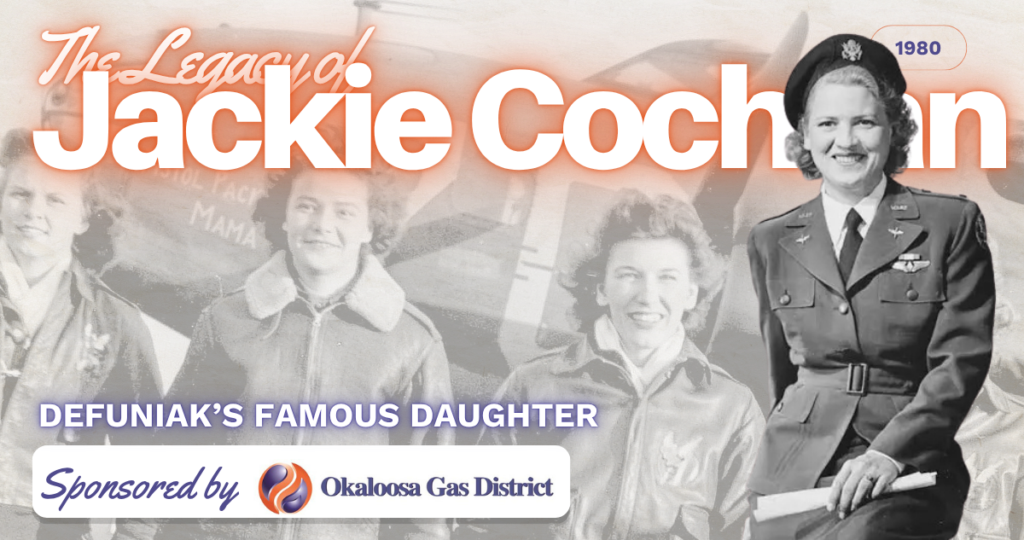

On this day in history, August 9, 1980, the aviation world lost one of its fiercest pioneers – and an Emerald Coast local.
Jacqueline Cochran, a woman who rose from the poverty of the Florida Panhandle to break the sound barrier and lead a wartime fleet of pilots, passed away at her home in California.
Before she was Jacqueline Cochran, she was Bessie Lee Pittman, born in 1906. Her early life was defined by the harsh realities of the early 20th-century rural South. By just eight years old, she was working in a Panhandle cotton mill. At fourteen, she married an aircraft mechanic named Robert Cochran—a brief union that ended in divorce by the time she was twenty, but gave her two things that would alter her trajectory forever: a new last name and her first introduction to aviation.
Determined to escape her lot in life, she remade herself. She moved to Pensacola to work as a beautician, later migrating to New York City to style hair for Manhattan’s elite at Saks Fifth Avenue. It was during this transformation that she began going by “Jacqueline.”
Her life shifted gears permanently when she met and married Floyd Odlum, one of the wealthiest men in the world and the head of the Atlas Corporation. Odlum shared her emerging passion for flight. Cochran initially learned to fly as a practical way to market her own cosmetics line, earning her pilot’s license after only a few weeks of training.
That pragmatic business move sparked an obsession. While her cosmetics company flourished, her feats in the cockpit truly defined her. On the eve of World War II, Cochran was shattering aeronautical records and winning international flying trophies.
RELATED: Why is Eglin Air Force Base named Eglin Air Force Base
When global conflict erupted in the early 1940s, Cochran weaponized her influence to advocate for female pilots. She organized dozens of women to ferry newly manufactured aircraft from American factories to the front lines. Her relentless lobbying led to the 1942 creation of the Women Airforce Service Pilots (WASPs). Under Cochran’s leadership, these women flew bombers across the globe to prepare them for combat staging, a vital contribution to the war effort that Cochran later successfully fought to have officially recognized with full military veteran status.
Cochran’s thirst for speed didn’t end with the war. In 1953, she became the first woman to break the sound barrier, piloting an F-86 Sabre fighter jet through the Mach 1 threshold.
Cochran’s radical evolution from a subsistence farm worker to a high-flying military innovator mirrored the mid-century transformation of her home region. During her lifetime, the Emerald Coast took a definitive step away from its quiet, agrarian roots and transformed into a technology-driven, aviation-driven, and military-industrial powerhouse. Hardship gave way to defense contracts, test flights, and economic abundance.
Today, Cochran’s legacy is permanently anchored to the local landscape. Her likeness stands in bronze at the Okaloosa Island Women Veterans’ Memorial—a reminder of the Panhandle native who refused to be grounded by her circumstances, changing the face of American aviation forever.