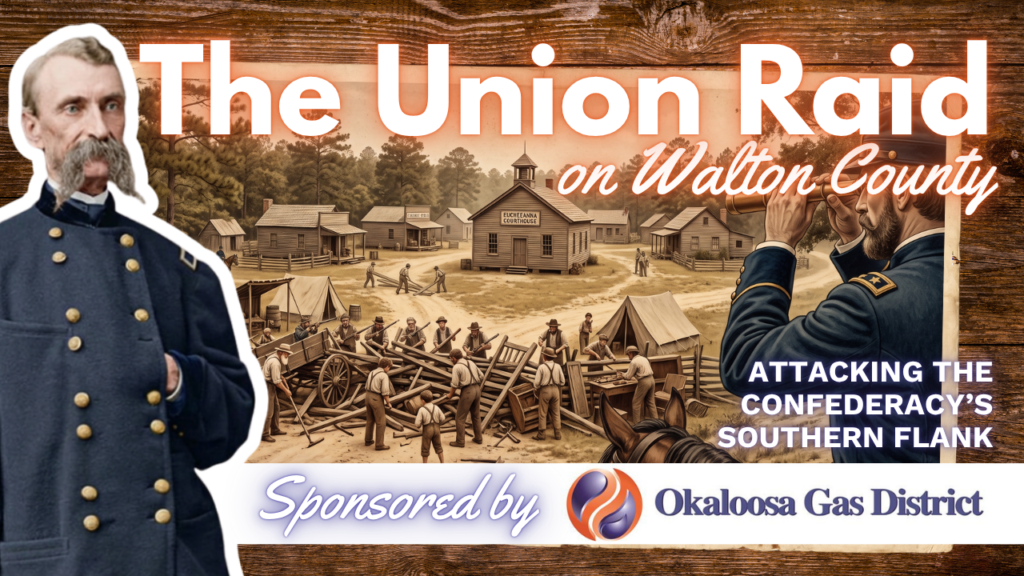


Several dozen men finished piling the barricades to block the main roads to the County Courthouse in Walton’s, Eucheeanna, on a hot summer day in 1864. The preparations had begun soon after a runner came into town to tell them that the Union Army was on its way to the settlement from Pensacola.
The Command, about 900 cavalrymen under a Hungarian-born general, Alexander Asboth, was on the march. The troop had made its way east along the shorelines of Santa Rosa and Walton Counties until it reached Point Washington, then turned north. Asboth was an experienced cavalry officer and had the battles to prove it. He first saw combat as a revolutionary against the Habsburg monarch in the revolutions of 1848. After he and his Hungarian forces lost the war and fled to Turkey, they made their way to Chicago and worked on behalf of Hungarian patriotic causes, to no avail.
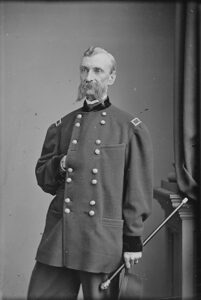
But then the American Civil War came and thrust Asboth back into command. He would lead units at the Battle of Pea Ridge in Northwest Arkansas and at Corinth, Mississippi. His abilities during those battles got him promoted – and sent to the almost silent Gulf Coast front.
RELATED: Walton County’s Rebel Colonel Angus McLean dies on the battlefield in Georgia.
Asboth was not one to sit around, but his orders from Washington had him more or less sitting on his hands like an overstimulated fourth grader watching everyone else go to recess.
As 1863 turned to 1864, he decided that he would be able to bend the rules a little bit – so long as he provided his own troops. With the help of Pensacolians who hailed from or were loyal to the Union, Asboth and a small company of European officers were able to rally about 1,000 men to create the 1st Florida Cavalry, Union Volunteers (FCUV).
Many of the soldiers in the unit, who had received a $300 sign-on bonus (roughly $ 6,500 today) to volunteer, had not long ago worn the butternut grey of the Confederacy. The roster of soldiers in the 1st FCUV provided by S.D. March, in her book about the Regiment, shows that the balance of them had previously enlisted at some point in the war as rebels. Many had their fill of war, and returned home after their enlistment only to find the Confederate Government was attempting to force them back into service. Many of the men fled to union-occupied Pensacola where they took shelter under the shadow of their former enemies.
While Asboth gathered his forces, a successful strike on the Confederate hub of Mobile gave him the onus to become more aggressive with his new force. Asboth would send out raiding forces into the interior, including Northwest Florida and Southeast Alabama, with some success.
RELATED: The South Abandons Florida to the Union.
By early 1864, Asboth had received questionable intelligence from scouts that told him Union prisoners were being held in Marianna (they weren’t) and that they could be freed by a raid on what happened to be the Confederate Governor of the state’s, John Milton’s, hometown.
Paradise Lost, indeed.
After a couple of weeks’ riding through the wilds of Walton and Santa Rosa County, the force reached the outskirts of Eucheeanna and laid a brief siege against 30 or so militiamen, consisting of boys still too young to be drafted and old men. By 1864 the Confederacy had drafted or run off most every able-bodied man worth less than a planter’s sum – so this militia unit would have truly been made of children, the old and the broken men left behind by the Confederacy.
With the brief siege of Eucheeanna and 30:1 manpower ratio, Asboth had secured his first victory of his campaign through the pine forests of West Florida. It was time to move to Marianna, which wouldprovee hisundoingm.
But alas – it’s a story for September. Check back then – we will have more!
RELATED: The US Navy and Army bombard Camp Walton during the Civil War.