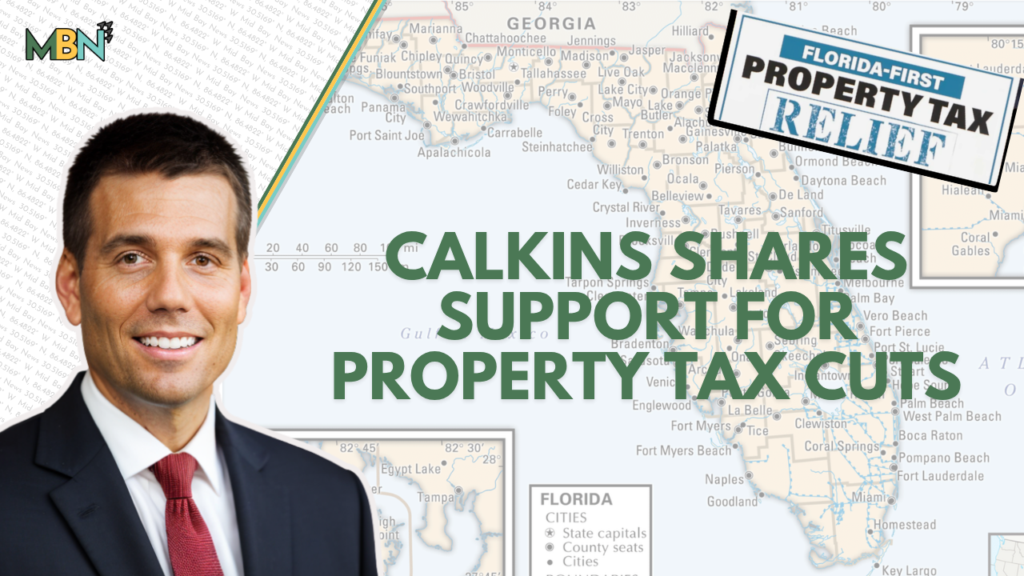

James Calkins, Republican candidate for Walton County Commissioner, voiced his support for Governor Ron DeSantis’ “Save Our Homes” proposal, which would increase Florida’s homestead exemption and eliminate property taxes for qualifying properties over a two-year schedule.
Speaking to Mid Bay News on Wednesday, Calkins said the proposal’s passing would be “the best thing ever to happen to the state of Florida.”
“According to the Florida Association of Counties, the money that comes out of the budget from homestead properties [in Walton County] is 4.05%. That’s very small when you look at the entire budget. We are the one county in the state of Florida that can absolutely afford Governor DeSantis’ tax plan.”
The FAC reports Walton County could lose millions of dollars annually in property tax revenue. Calkins said the county’s budget will cover this loss.
“Walton County; It’d cost us 7 million the first year, and then it costs us around 12 million the second year, but our annual increase in our budget is 14 million, so our budget would just stay the same the next year.”
City officials in Okaloosa County, where property tax accounts for up to 35% of annual revenue, opposed the property tax cut.
“Just here in Okaloosa County, we’re going to lose hundreds of jobs, and then multiply that by 67 counties,” Niceville City Manager David Deitch told Mid Bay News last week.
However, Calkins said the loss of revenue would be a lesson in efficient spending for panhandle counties.
RELATED: This could ‘destroy the state of Florida,’ says local official
“The reason why Governor DeSantis is doing this, I believe, is because there is massive waste going on in all the other 67 counties in the state,” Calkins said. “I served as commissioner for Santa Rosa County, and I just saw massive waste. … [DeSantis is] going to make sure to hold these counties accountable for wasting our money, and so it’s a great thing.”
Calkins said counties concerned by a property tax reduction should make up lost revenue by cutting costs.
“Walton County is going to be set, you know. We’re pretty lucky, but like Okaloosa County, Santa Rosa County — I mean it’s [property tax] around 20-30% of their budgets; huge, huge amount, but I can tell you that probably there is that much in waste in their budget.”
Calkins said he’d also support using dollars from tourism to fund services affected by the homestead exemption increase.
“We have a [Tourist Development Council] in Walton County; it’s about $60 million in our TDC budget,” Calkins said. “In Santa Rosa it’s $7 million. I think that those funds could be used; a certain percentage could be used to offset any issues. I mean, let’s make the tourists pay for all our stuff, you know? Alaska’s got oil, North Dakota’s got oil. The oil revenue benefits the citizens that live there. The tourist revenue should benefit the citizens that live here.”
Calkins suggests the state should help local governments by legislating more practical uses for tourism revenue.
“We’re restricted, with TDC funds, on where we can spend our money,” he said. “That’s where the state could help with unrestricted [funds], a certain percentage. And I know the Tourist Development Councils, they waste massive amounts of money. I mean, they hire marketing companies that are millions of dollars, where you just got a person in the office that makes media content, you know?”
At the Defuniak Springs City Council meeting on Monday, Jennifer Green, President of Liberty Partners of Tallahassee, the city’s lobbyist in the Capitol building, presented the city’s 2026 Legislative Overview. She addressed DeSantis’ property tax proposal and said he is prepared to help counties that would face budget cuts if the bill passes.
“The legislation that did pass didn’t have a piece of it the Governor wanted, and that was basically a pool of money, a trust fund, for fiscally constrained cities and counties,” Green said. “That wasn’t included; that didn’t end up on the final bill.”
Green said summary word limits prevented the Governor from including this trust fund in the original proposal, but additions could change the bill on the November ballot.
Calkins would implement a hiring freeze in Walton County to cut revenue loss if the bill passes, he said.
RELATED: Everything you need to know about the November property tax proposal before you vote.
“That’s what the other counties need to do, they need a hiring freeze, which will stop the growth, take care of the people you have already here,” he said. “They got to feed their families, you know?And so, how do we handle it at a state level? We freeze hiring, stop the growth of the government.”
Calkins addressed common concerns about the property tax proposal.
Education
An amendment to DeSantis’ original proposal added an education carve-out to protect schools.
“The schools are going to be unaffected because they pulled the schools out of the final bill, which is going to be great for our schools, so you know public education in the state with this whole property tax is not going to be affected,” Calkins said.
Public safety
Calkins said the budget for law enforcement in Walton County won’t be affected.
“Our state is very pro-law enforcement, and I can tell you, in Walton County, if my sheriff, Mike Adkinson, says we need something, I’m gonna be there for them. I trust my sheriff, and I believe that it’s like that in most counties. And if the sheriffs go up to the capital and say, ‘Hey, we need help,’ they’re going to get help.”
Trickle-down effects
Some Floridians worry a homestead exemption increase would only benefit those who own homes.
“There’s going to be a negative economic impact on those who are least-able to pay for their housing, because the property owner of a rental property, an apartment complex, whatever — They’re not going to absorb that cost, and so they’re going to pass it on to the renters.”
Calkins said, however, the tax relief would incentivize landlords to provide more affordable housing.
“I’m a landlord. I have 10 rental properties, and now I’m going to get this big savings. I have no incentive to raise rents, because I’m doing great, because I’m saving all this money. I believe there’ll be a lot of landlords that think like that.”
Calkins also noted the homestead exemption would not apply to non-homesteaded property, including rental properties and vacation homes.
What usually causes rent to go up is everything else going up, and it’s the market, supply and demand,” Calkins said. “But, if all these homeowners that live in Florida are paying less money for their own home, and you’re talking big money when you’re talking about big homes, as far as you know, the rental property itself, there’s no effective change. I mean, the rents won’t go up because the taxes will remain the same on non-homesteaded properties.”
Staffing cuts
Calkins said revenue loss from property tax would affect those in local government positions that are “unneeded.”
“I think the government bureaucracies should be worried, because they hire all these people that they shouldn’t hire to solve problems. Private industry does not do that. Local governments do that. They hire unnecessary positions. That’s why government always grows. So, that’s why city managers, administrators, people in those categories are worried.”
What’s next?
The property tax reduction on the ballot needs a 60% vote to pass in November, per the Florida Constitution.
“I’m going to fight to remove it completely in Walton County anyway, no matter what the state does, because Walton County can afford it,” Calkins said. “… All our counties, they’ll speak doom and gloom. They will put a bunch of mistruth, a bunch of things that don’t make sense. They’ll spend a lot of money trying to convince the voters to vote no on that, right? I would tell the voters of the state of Florida, do not listen to the rhetoric. Just vote yes.”