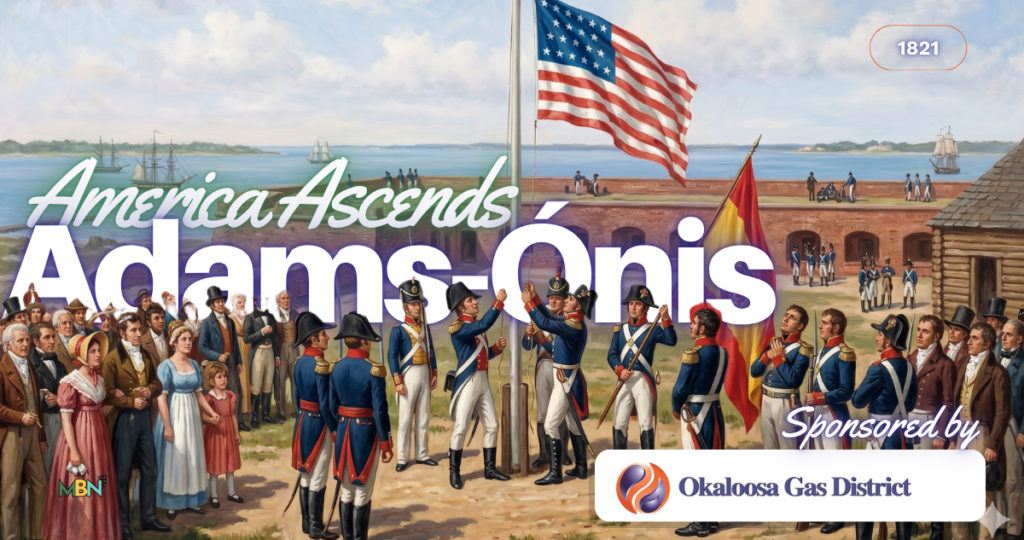


The Adams-Onís Treaty of 1819, which was ratified on July 17, 1821, served as the pivotal turning point for the Emerald Coast in the 19th century, marking the transition from Spanish-controlled territory to American frontier. By formally ceding Florida to the United States, the treaty ended Spanish rule and unleashed a wave of American migration into the Panhandle, significantly altering the region’s demographic, economic, and political landscape.
The Treaty and Regional Stability
Before the treaty, the Emerald Coast was a lawless borderland characterized by a “mix of cultures and ethnicities”. The Spanish government, struggling with the Napoleonic Wars and a manpower shortage, found it impossible to adequately control or defend the region. They relied on a delicate balance of trade and gift distribution to maintain peace with Native American tribes, intending to use them as a buffer against American expansion through the use of settlers of Scots-Irish descent.
The Adams-Onís Treaty resolved the ambiguity of ownership that had long fueled tensions. In exchange for the U.S. promising not to pursue claims to Texas, Spain transferred East and West Florida. For settlers already in the region—many of whom had crossed the border from Alabama and Georgia seeking fertile farmland—the treaty provided a critical legal safeguard. Provisions within the treaty “grandfathered” existing land claims, allowing these early pioneers to retain the properties they had already established. Impact on the Emerald Coast
Results of the Adams-Onis Treaty of 1821
Stories of early settlement from John McKinnon’s History of Walton County reveal that the settlement of Florida by Americans and Immigrants of Scots-Irish heritage took place before East and West Florida were ceded to the burgeoning American Empire. While the East portion of Florida had Americans moving in earlier – Scots pioneers like Neill McLendon and John McKinnon began to put down roots in the area that was to become Okaloosa and Walton Counties as early as 1820.
As American Hegemony in the Deep South began to intensify with the expulsion of the Spanish, the Louisiana Purchase some 20 years prior, and the Seminole Wars underway in 1817, more and more people would move to the area despite the proclivity for tropical diseases that would rear their ugly heads. As more and more Creek Indians and their Seminole cousins were forced into the center of the modern state of Florida and then onto ships to the Oklahoma Territory, white Scots-Irish settlers, called ‘Crackers,’ moved into the area to farm for subsistence in the northern reaches of the state. Their richer ‘Planter’ brethren also moved in with enslaved men and women as labor to grow cotton and other cash crops as the Natives were forced to the south.
The Adams-Onís Treaty was not merely a diplomatic resolution between empires; for the Emerald Coast, it was the formal mechanism that dismantled the existing Spanish and Native American systems, creating the framework for the American territory to emerge.