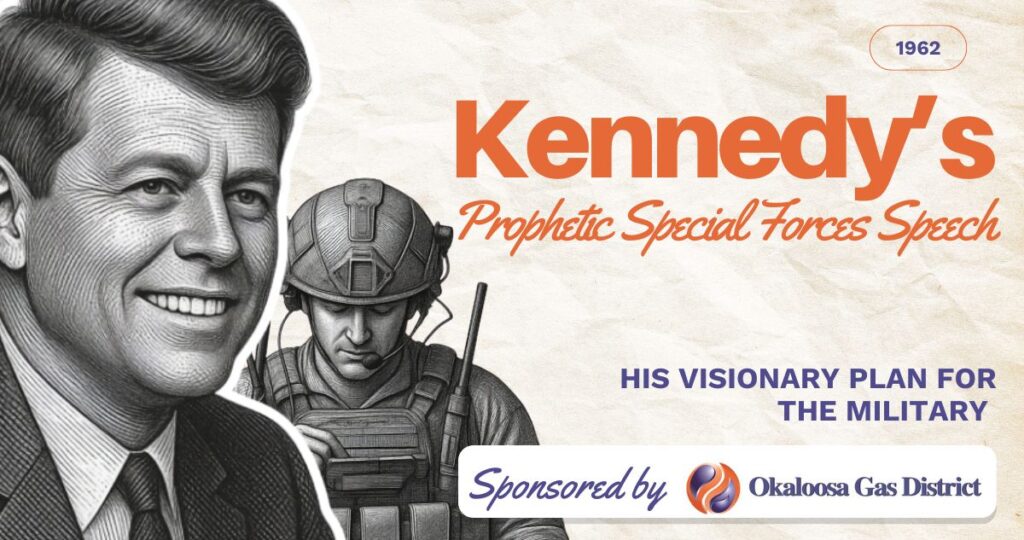
A beautiful June 6 in Upstate New York greeted President John F. Kennedy with mild weather as he stepped out of Marine One, the presidential helicopter, and onto the campus of the United States Military Academy.
President Kennedy had arrived to give the commencement speech and swear in the newest cadre of second lieutenants. Many of the cadets, including Kevin Renaghan, welcomed the president to the Nation’s oldest redoubt in times of peril. Renaghan had received a nomination from Kennedy when the President was still a Senator from Massachusetts and would graduate that day.
But the reason we’re tagging along in this vignette took place when Kennedy rose and walked to the podium at 10:01 in the morning. It was here he gave a speech that would define the mission, vision and values of Army Special Forces – including the 7th Special Forces group that would come to be based out of the Emerald Coast after a base realignment in 2005.
The speech was the upward slope to the peak of what Dr. Samuel Kero Ward called in his book With an Eye on the Horizon “the boom and bust cycle” of special warfare training, readiness, and funding.
By the time Kennedy’s successor, Lyndon Baines Johnson, left office, the Special Operations world was back in the bust part of the cycle – and American Prestige, civilians, and military personnel would pay the price.
In his speech, he talked about the misnomer of the Nuclear Age. Instead, he argued, we’d been in many conflicts around the world that required not nuclear power – but the scalpel-like precision of the Special Forces operator. “This is another type of warfare, new in its intensity, ancient in its origins, war by guerrillas, subversives, insurgents, assassins, war by ambush instead of by combat; by infiltration instead of aggression, seeking victory by eroding and exhausting the enemy instead of engaging him,” Kennedy said.
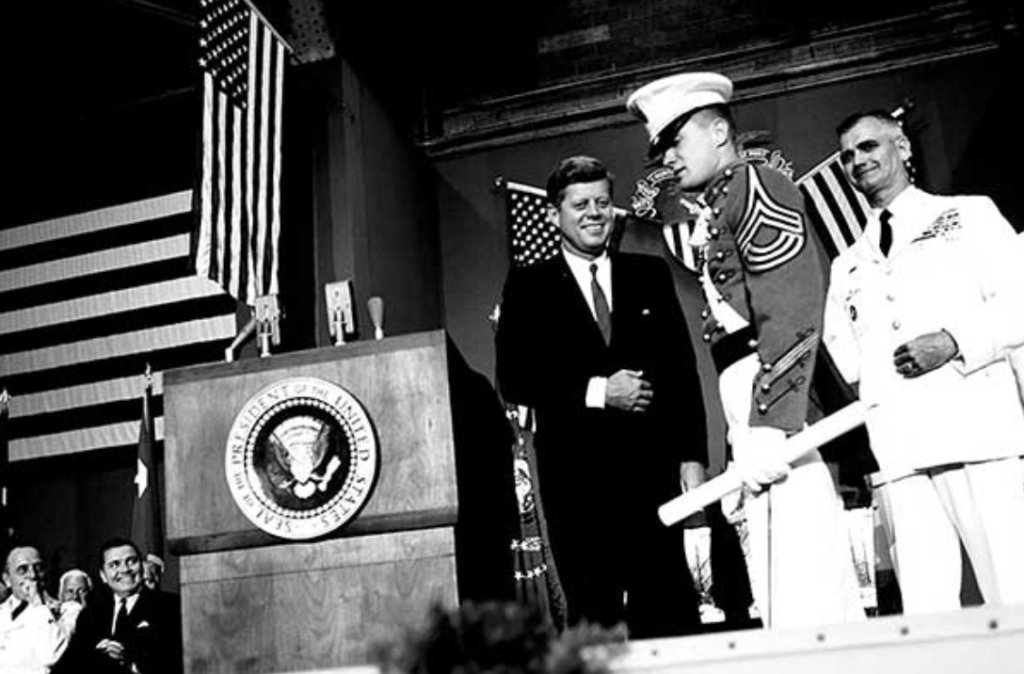
He remarked that the type of war he described didn’t stop at the end of a kinetic strike. Officers in these special units would have to understand international diplomacy, economics, psychology, and more to become the men (no women were admitted into USMA at this point) the United States needed to counter Comintern forces from the Soviet Union and its allies around the globe.
“You will need to understand the importance of military power and also the limits of military power,” Kennedy continued, “to decide what arms should be used to fight and when they should be used to prevent a fight, to determine what represents our vital interests and what interests are only marginal. Above all, you will have a responsibility to deter war as well as to fight it. The basic problems facing the world today are not susceptible to a final military solution.“
Kennedy’s words, whether he meant them to or not, became a lodestone for the mission of Special Forces operations across all branches of the military. “While not intended to be prophetic, President John F. Kennedy’s remarks have, in many respects, remained timeless, as evident in America’s present-day Great Power Competition with its former Cold War adversaries, China and Russia,” Jared Tracy wrote in the Army Special Forces Journal of History.
Immediately after this speech came a short Golden Age for the special forces. The Vietnam Conflict had begun to heat up. Down at an Eglin outlying field called Hurlburt Field, the men and women of the Air Force’s Special Operations unit stood up the Special Air Warfare Center. In the single year between 1962 and 1963, the Center had grown from “a few small detachments to a robust organization of over 3,000 airmen,” According to D.J. Dean’s book The Air Force in Low-Intensity Conflict.
The North Vietnamese Army had success in shooting down American pilots over North Vietnam as the war on the ground intensified. As the number of American POWs increased, the brass decided that something needed to be done to rescue them, or at least make a show of force to make sure the pilots knew the military would do whatever was possible to get them back.
This is when military leadership would authorize a prison camp in North Vietnam, miles away from the enemy capital of Hanoi at Son Tay.
Intelligence reports gleaned from various sources in the US military apparatus had American Military leaders believing as many as 55 POWs were held in the prison, less than the distance between Destin and DeFuniak Springs.
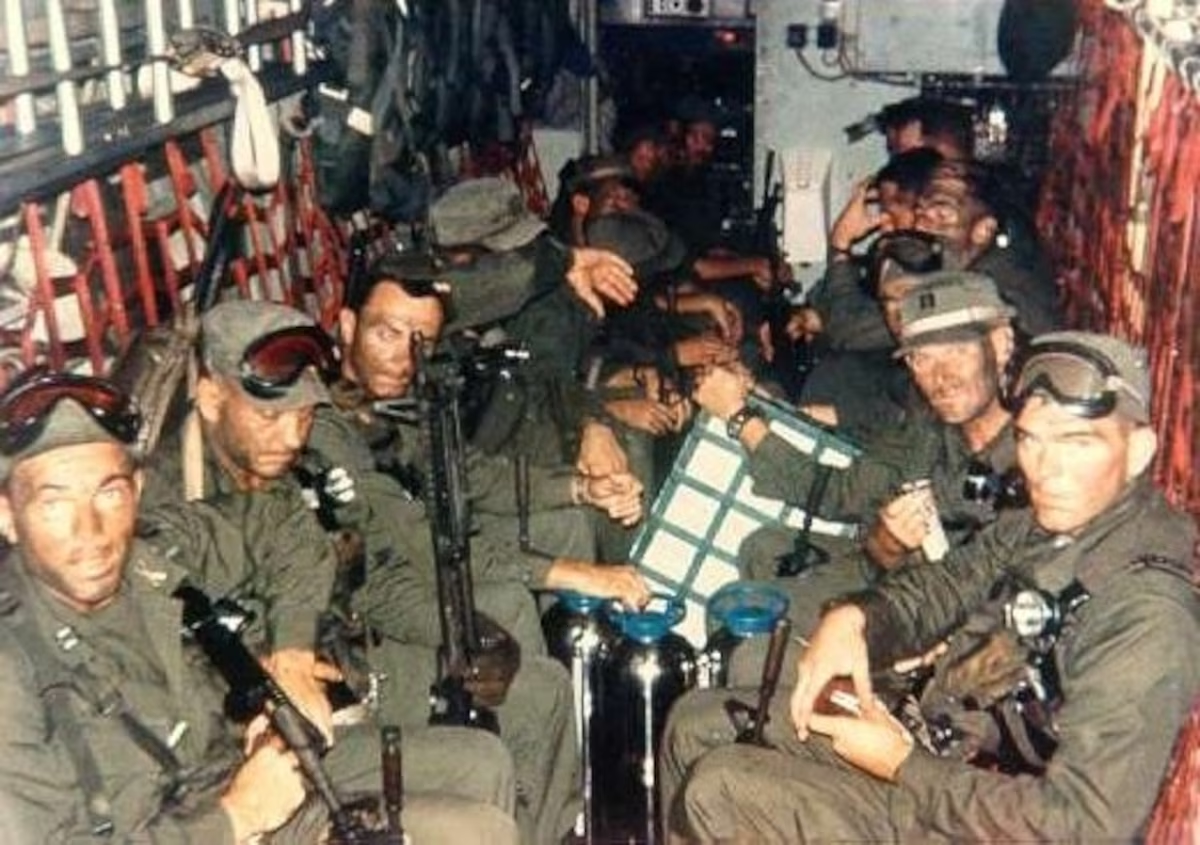
According to the Air Force’s official accounting of the event, the Air Force would provide an assault group to “land at Son Tay under the cover of darkness, rescue the POWs, and leave. The Navy, meanwhile, would create a diversion by flying over Haiphong Harbor on the coast northeast of Hanoi and drop flares to simulate an attack.”
Before the go order was issued, painstaking planning and dress rehearsals at Duke Field in Okaloosa County, between Niceville and Crestview, helped the teams prepare for the audacious mission.
On November 20, 1970, a host of helicopters, support aircraft,t and attack planes left their base in Thailand and made their way toward Hanoi.
At the same time, Navy pilots launched from their carrier and headed to Haiphong Harbor.
In the early morning, the Air Force Raiders, led by Lt. Colonel Bull Simons, entered the airspace around Son Tay and began their mission – to free the POWs they believed were stuck in Son Tay. As you might have guessed, the Army’s Camp Bull Simons (also in between Crestview and Niceville on the Eglin Air Force Base range) was named after the Son Tay ground forces commander.
After a brief but stifling assault by the Americans, which included crash landing a helicopter inside the perimeter of the camp (why is it that all famous American special forces missions seem to require at least one controlled crash landing of a helicopter?).
After a search of the facility, the special forces unit on the ground reported that no one was in the camp. The team quickly broke camp and made their way back to Thailand. On the way, a Soviet-made Surface to Air missile scored a hit on an American F-105 fighter jet and sent it into the jungle below. Helicopters from the raiding party promptly picked up the pilots and kept moving. With the exception of a few minor injuries, there were no casualties among the United States forces.
Although the mission did not rescue any POWs, the balance of military scientists and historians considers the mission a strategic victory for the Americans. At the expense of a broken ankle and one F-105, the United States was able to bolster the morale of the POWs, who would soon hear about the raid and the morale of the public. In addition, the raid forced the North Vietnamese to take increased security measures with their captives. “It caused North Vietnam to gather POWs in fewer locations to prevent similar raids, making POW communication and organization easier,” The National Museum of the United States Air Force explained.
It also showed the benefit that well-equipped, organized, and led special forces can do in wartime and made the case that investment in the maintenance of this ability was prudent. Unfortunately for the special operators, those who would need their help and the United States’ prestige upon entering the 70s, the lesson was promptly ignored.
By 1975, just five years after the Son Tay raid, the muscle memory to pull off daring raids had atrophied on the bone. The atrophy would cost American lives, the American taxpayer, and American military prestige dearly.
The weakness in the special forces muscle meant a disaster when the Mayaguez was taken over by Pol Pot’s Khmer Rouge regime on the open seas near what is today called Cambodia.
The Cambodian communists impounded the US-Flagged SS Mayaguez, a month after Saigon fell to the Vietnamese Communists. They took 38 merchant mariners hostage on the island of Koh Tang, about 30 miles from mainland Cambodia.
A gaggle of hastily assembled special forces units attacked the island of Koh Tang while various air assets attacked the Cambodian mainland in retaliation. The attack, it should be noted, came after the United States recovered the mariners. The communists let them go on a fishing trawler after a brief interrogation on Koh Tang, in hopes the Americans would see this as a win and leave the Khmer Rouge alone. Regardless, the order came down for the American Force to assault the island and teach the communists a lesson: America might look bad after Vietnam, but she won’t look weak on the international stage at any cost.
The last 41 names on the Vietnam War Memorial in Washington, D.C, would come from this battle. High command sent a contingent, 121 marines and another 5 airmen, to attack the Island, which had an unknown detachment of Khmer Rouge. Turns out – reconnaissance failed the Marines completely, and there was a force of some 300 Cambodians on the island, waiting on their arrival. Things got bad, fast. To effect a hasty retreat off the island, the Americans landed another 130 men to shore up battle lines and stabilize the front. However, fighting was heavy on the ground and claimed the lives of 14 Marines. The highest casualty event of the battle took place back in Thailand, where 23 Air Force members died in a helicopter crash. The personnel were on their way to Koh Tang to support the Marines on the ground.
Though the deaths, which were attributed to the situation on the ground, could have taught the military a lesson about the importance of what President Kennedy said to newly minted 2nd Lieutenants at West Point 13 years earlier, it would take two more SNAFUs for the water to boil the frog and force Congress to make a change.
A further two incidents, in 1980 and 1983, would tip the balance and force congressional action to mandate reform in the military and force it to prioritize the development of Special Forces assets.
The first came at the end of the Carter Presidency – an end that was very likely, accidentally, ushered in, in part, by the abject failure of Special Forces. In 1979, student protestors led by Ayatollah XXX overthrew the Shah of Iran. The revolution was, as all revolutions are, a somewhat unorganized affair, gratuitous in violence, and destabilizing for the region.
In the immediate aftermath of the Shah’s flight from Tehran, protestors stormed the US Embassy – for a myriad of reasons that we won’t get into here, the protestors saw the physical plant of the Embassy as the spawning point of great evil in Iran. After all, Kermit Roosevelt and other CIA operatives had planned the overthrow of Mohammed Mossadeq in that very building.
Long story short, they took American Citizens prisoner and started a standoff with Uncle Sam for more than a year. In an attempt to resolve the issue by force, President Carter authorized special forces units to attack Tehran and recover the Americans held hostage. The operation, called Eagle Claw, called for an attack force to fly helicopters into Iran, land in the desert for refit and refuel, and then fly on to rescue the hostages. After a litany of errors, the final straw came when a hovering helicopter collided with a C-130 transport aircraft. The mission was abandoned and left a stain on the ballots next to Carter’s name in the election later that year.
Despite the deaths of aircrew and the failure of the mission, it was Carter’s heir, Ronald Reagan, who would not move to fix the problem in the military that likely gave him the last push he needed to win his race in November of 1980.
It would take a final, poor performance in the Caribbean to force Congress’s hand. In 1983, President Reagan announced the American invasion of the tiny island nation of Grenada. The invaders would sear the island nation with bullet holes and rockets as they slashed their way through the Grenadian (and Cuban) defenses. To the outside world, it looked like a major success – but the after-action report told a different story.
Navy Seals had drowned off the coast of the island because of the poor insertion planning. Most of the military was reduced to using widely available, inaccurate tourist maps of the island to plan the invasion and orient themselves. The American forces lost nine helicopters against a ragtag force that had almost no anti-air or anti-tank capabilities and very little formal military training. The Air Force planned to pawn special operations aviation off to the Army – but for Congressmen bent on accountability and reform in the Air Force.
“The Air Force did not want to make the necessary adjustments to special operations aviation. It took direct reform from Congress through legislation for cultural change to occur,” writes Dr. Kero Ward. This work contends that Congress should not hesitate to enact reform if the military is dragging its feet on meeting strategic imperatives, and that civilian leadership represents one of the few means through which cultural change can be enacted quickly,” Dr. Kero Ward writes, “The successful Air Force special operations forces we see today are a result of direct Congressional intervention to enact cultural change at the institutional level. Once the institutional culture became more supportive of the culture developed in Air Force special operations, the force was able to leverage the skills they developed throughout the 1980s to bring about key strategic victories.”
Though it took an additional 20 years to realize the President’s vision for Special Forces in the United States Military, Kennedy’s legacy is stamped on the successes of the special operators and the missions they undertake.
The results of the efforts in reform after the Mayaguez Incident, Operation Eagle Claw, and the invasion of Grenada – namely the creation of SOCOM and the congressional requirement that the military fund its various special operations forces and have them coordinate with one another – paid significant dividends in Operation Just Cause in Panama, Desert Storm in Kuwait and Iraq, and the Global War on Terror.
The successes would be seen in the dominant nature in which the United States was able to overwhelm its enemies in Panama, Iraq,q and Afghanistan through the use of non-conventional forces to stick the United States’ enemies in quicksand. Horse soldiers in Afghanistan would aid the Northern Alliance to end a war they’d fought for years in a matter of weeks. Manuel Norriega’s troops were cast aside as the special operators descended upon Panama City, Panama, in the dead of night with few casualties. Desert Storm saw special operations forces combat controllers combine with stealth bombers to destroy Iraqi strongpoints. They became the difference between a protracted war with armies and a swift dispatch of another state’s entire military.
In short, Kennedy’s speech served as the Special Forces community’s Book of Isaiah, prophesying a future in which the United States Military’s Special Forces contingent would play an outsized role in conflict, in peace and in America’s relations with her friends, neighbors and adversaries.
We love to bring you, and all of your neighbors, the news for free – it’s a part of who we are. But just because something is free doesn’t mean it’s cheap.
Your sustaining donation of just $10 per month helps us keep the powerful accountable and make the mortgage on time. If you notice you keep coming back for more stories from us – please consider supporting our work so we can do it for the long haul (and not be homeless).

Register or login with Mid Bay News and never get another pop up on our site!