Today’s Emerald Coast History Article is brought to you by the folks at Okaloosa Gas District.
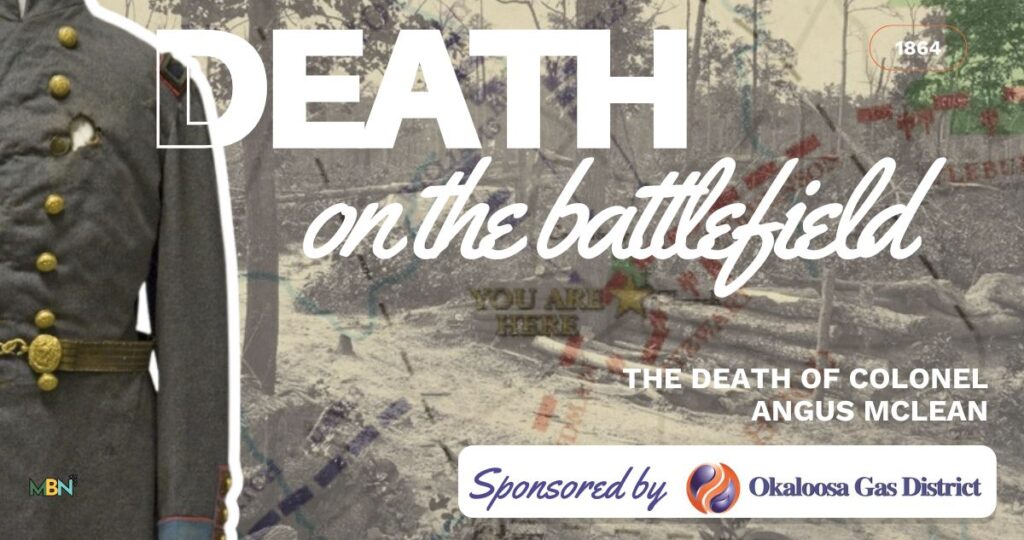
With a minie ball launched from a rifled musket from a tree line in Dallas, Georgia, a lone Union sharpshooter shot and killed the highest-ranking soldier from Walton County in the Civil War on May 28, 1864.
Colonel Angus McLean was born in Walton County in 1836. 26 years old when the conflict began, he had many relations and personal friends in the newly formed 6th Florida Rifles, who voted him their regimental Lt. Colonel.
Many changes occurred in 1862, when McLean took his commission in the Confederate Army. Because General Braxton Bragg’s army had abandoned Pensacola, after failing to root out Union army and naval presence in the Gulf South, to move north in a bid to aid the rebel invasion of Kentucky, the organization of the bulk of Florida’s regiments would take place in Middle Florida instead. McLean and other Walton County residents would muster in around Marianna before heading north to Tennessee to meet up with Bragg’s forces after their defeat in the Kentucky Campaign.
RELATED: Braxton Bragg Abandon’s Pensacola
McLean was a lawyer by training and attended the Knox Hill School in EucheeAnna, where he was instructed in liberal arts and sciences by a well-regarded schoolmaster and Presbyterian Minister, the Reverend John Newton. After his matriculation from the Knox Hill School, which was considered the best educational facility in the Florida Panhandle and Southeastern Alabama, he moved on to Lebanon, Tennessee, where he studied for and earned his law degree. Many others in his cohort did the same. Stetson Law School, Florida’s first law school, wouldn’t open for another 39 years.
McLean and his fellow northwest Floridians would enter the line of battle under Braxton Bragg’s command during the Battle of Chickamauga in southeast Tennessee, though they would not participate in the grueling maw at the center of the action.
Despite the victory at Chickamauga, not all was well within the army command. Though recently victorious, the body of troops was significantly outnumbered and hopelessly outclassed in generalship. Bragg was a notoriously difficult man to work with. His only saving grace after a string of defeats that would make an amateur boxer blush consisted of his personal friendship with Jefferson Davis, the Confederate President and former US Secretary of War. Davis had to visit the Army of Tennessee to personally sort out personality conflicts galore in the army. The result was a jettisoning of the army’s most capable commanders, Forrest and Longstreet, to other commands.
This decision led to the promotion of JJ Finley, the Sixth Florida Infantry’s commander, to General. The move up for Finley, in turn, led to the promotion of McLean to full colonel at the end of 1863. Unlike in the modern military, the Confederate regiments voted for their officers to represent them – which made McLean’s elevation all the more unlikely. Most of the 6th Florida hailed from Middle Florida – the area of the state with the most rich plantation owners who had plenty of enslaved people to exploit. McLean came from a part of Florida that had decidedly fewer enslaved people and had actually voted for a candidate who wanted to keep the union together, John Bell.
McLean’s men fought tooth and nail at Missionary Ridge – a battle just outside of Chattanooga, Tennessee along with the rest of the newly-formed Florida Brigade. The regiments around the brigade soon began to falter as the Union troops moved up the ridge. But, the Florida brigades proved suprisingly resilient considering their comparatively-fewer engagements to the rest of the army.
But, like many things in the Army of Tennessee, the effort would be for naught – as Confederate forces would retreat from the area back into Georgia, near Dalton.