Today’s Emerald Coast History Article is brought to you by the folks at Okaloosa Gas District.
On May 4, 1975, the first of 20,000 refugees from Vietnam arrived on the confines of Eglin Air Force Base. Those refugees, some of whom had evacuated Saigon on the last day of the South Vietnamese Republic on April 26, 1975, would stay in the camps quickly constructed on Eglin’s reservation for about three months before the US Government moved them to permanent homes around the country.
The end of the Vietnam War brings disaster, and flight to America, for 150,000 Vietnamese.
Many of these refugees had been rich in their homeland – part of the professional class that had held up the South Vietnamese Republic’s government for the previous 15 years. But the collapse of their government radically changed their previously comfortable lives.
The Ford Administration decided to use this crisis to its advantage to restore some goodwill around the world and among voters in the United States who’d head to the polls next year to pick a president. Immediately before the fall of Saigon, the Ford administration lobbied Congress successfully to pass an aid package, called the Indochina Migration and Refugee Assistance Act, to support those who would be killed or persecuted by the communist regime if they were to stay in their homeland. Ford argued to Congress that “the United States has a long-standing reputation for assisting the oppressed and the less fortunate,” University of Southern Mississippi History Professor Heather Stur wrote on the issue. She added in her article for the Journal for Diplomatic Historythat “due to misguided policy decisions, atrocities committed by American troops during the Vietnam War, and the postwar embargo. Images of Americans embracing Vietnamese refugees served as a form of damage control as the United States sought to reclaim its moral authority.”
The decision to fund members of the republican government in Vietnam’s escape almost certainly saved those people from a dark future. 30,000 people were executed in the years following the North’s victory through the use of ad-hoc killings, re-education camps and famine associated with forced relocations. In addition to getting the refugees out of a potentially life-threatening situation, the plan set aside $455 million to resettle them in the United States.
All told, the 150,000 total refugees were split amongst four different camps, including Eglin Air Force Base.
The Eglin Air Force Base Community Welcomes the Refugees
The residents of Okaloosa County were aware of the coming of the Vietnamese refugees long before they arrived. An article in the Playground Daily News from May 2, 1975, quotes Fort Walton Beach Mayor Maurice McLaughlin condemning the edit of a WEAR-TV interview he gave earlier. The interview, which aired his concerns about the influx of refugees, did not also air his positive comments about those about to land at Eglin.
But the concern of the Mayor was far from the worst treatment refugees would experience – and would show Eglin to be the more welcoming destination of the camps. In the same article, a Fort Smith, Arkansas woman, Mrs. Johnnie Calhoun, was quoted explaining that she did not want the Vietnamese in her community at Fort Chaffee – calling them a slur and telling a reporter they were not wanted by locals.
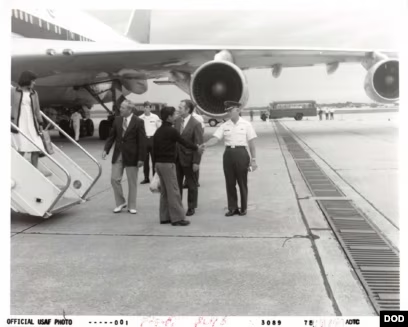
This Voice of America archived photo from the United States Defense Department shows a group of Vietnamese refugees deplaning at Eglin Air Force Base on May 4, 1975 - nine days after being spirited out of Saigon as the communist forces beseiged the city.
Air Force Personnel constructed a tent city on Eglin in a matter of days to host the refugees. The facility would host about 2,500 people at a time as ‘friends of the government’ until they were processed through the immigration and naturalization process.
After leaving the camps, some refugees found homes in Fort Walton Beach and other Emerald Coast cities, thanks to the kindness of locals like Jan and Mel Kessler. The Kesslers and their two sons fled Saigon three weeks before the city fell and set up their new home in Fort Walton Beach. Just a month after they arrived, Vietnamese refugees showed up at the Eglin community’s collective doorstep. The Kesslers knew they needed to help – and brought five members of the refugee community into their four-bedroom apartment in The Camelia City. Jan, a nurse, volunteered at the camp to help meet the needs of the population there, while still recovering from the traumatic flight from Vietnam, they made it just a couple of weeks ahead of the flood of asylum seekers. “Just imagine having your husband call you one day and say that you only have a couple of hours to pack and move,” Jan Kessler recounted to the Playground Daily News about their retreat from the country they called home for almost two years.
It would not be the last time Eglin would serve as a staging point for refugees fleeing communist regimes. Five years later, in 1980, the United States government would use Eglin again to ferry Cuban refugees through the process of seeking asylum in the United States.
More History of the Emerald Coast, brought to you by the folks at Okaloosa Gas District!