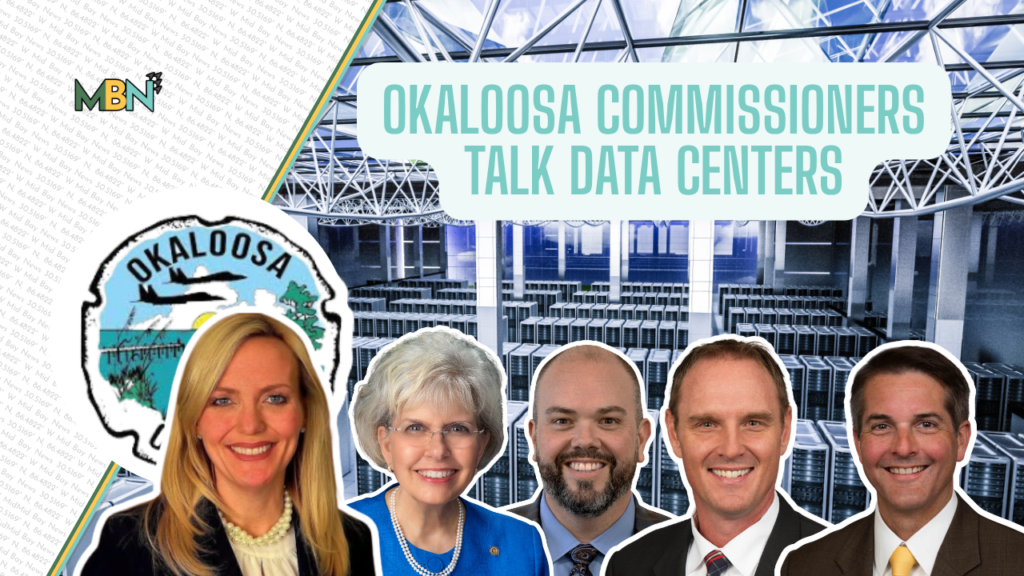

The Okaloosa Board of County Commissioners approved a motion to hold a public hearing and develop an ordinance issuing a 12-month moratorium on data centers at November 3rd’s BCC meeting.
The BCC discussed future measures and concerns about the potential construction of a “hyper-scale” data center in Okaloosa County, including restrictions on its construction, heard from Strategic Planning & Development Manager Elliot Kampert, and took public comments.
Data-center downsides
The decision to move forward with a potential moratorium stemmed from five main concerns that Kampert presented from his research on data centers.
Water consumption
Large-scale data centers, loosely classified as data centers consuming over 50-100 megawatts or more monthly, require cooling technology to keep servers and equipment inside the centers at optimal temperatures to operate.
“The biggest culprit there in wasting, frankly, a lot of water is the use of evaporative cooling towers, which require a continuously refreshed supply of water so that the water evaporates when sprayed on the coils,” Kampert said to the BCC. “It evaporates off; depending on the type of system, water is returned, and in some cases, fresh water has to be added to keep the capacity where it needs to be.”
This “evaporative cooling” process, Kampert said, produces water that cannot be reused.
“Over time, of course, when you continually reduce and condense down water like that on the media used in these cooling towers, concentrations of various metals and things like that can build up inside,” he said. “These become wastewater, which also needs to be disposed, so you’re talking about a serious amount of water that is not only being consumed directly to a cool plant, but also producing some wastewater.”
Noise pollution
Data centers constantly produce both high and low-frequency sound pollution due to the whirring of fans, humming of cooling technology and use of powerful generators.
According to Environmental Noise Control, humans have multiple systems for measuring sound. DBA (A-weighted decibels) measures sound as the human ear perceives it, while dBC (C-weighted decibels) measures low frequencies that may not be heard by the human ear.
Kampert said many governments use the dBA system to measure noise, which doesn’t accurately measure the sound frequencies emitted by large-scale data centers.
“When you’re looking at regulating noise and data centers, you do need to look at the entire frequencies of sounds that are being produced, not just what you’re navigating.”
Kampert said data centers often produce noise that cannot be dampened with barriers or shields.
“It is true that low frequency and infrasound travels much further and is able to carry a lot farther due to the nature of the wave itself, being able to bend around or go through things,” Kampert said. “Your typical buffers like these plants and trees and things like that are not going to address low-level sound. You need much denser forms of buffering in order to reduce sound.”
During public comment, Phil Davis, chairman of the Libertarian Party of Okaloosa County, expressed concern that data center noise pollution could affect wildlife in the area.
“Anything below 20 hertz is considered infrasound,” Davis said to the BCC. “Anything over 20,000 hertz is considered ultrasound, and dogs can veer slightly into the ultrasound range. Bats use ultrasound so they can fly around and see radar, so these are important things you have to think about. It’s not just some simple, ‘Oh, it’s a business in a warehouse.’ You have to take into account the environment has an effect on deer and otters, beavers, everything you can think of.”
Power consumption
Florida’s Senate Bill 484 requires public utility companies to develop minimum tariff and clearance requirements for large-scale data centers. Though the bill does not directly address the amount of power data centers can consume, it ensures the centers are independently responsible for the costs of that consumption, without passing it on to taxpayers.
Earlier this year, Kampert said, Florida Power and Light submitted its rate structure to the Public Service Commission for review, but the commission has not yet approved it.
In a news release on October 1, FPL promised its proposed rate structure “already satisfies the customer protection requirements established by Florida’s new data center laws.”
“We’ll be watching very closely to see what happens with Florida Power and Light and the Public Service Commission [to see] if their new rate structure, which is from 2026 to 2029, has actually met the requirements of the statutes,” Kampert said.
Thermal pollution
Data centers generate heat, Kampert said, which is often transferred into the air around them, heating up the atmosphere around the buildings themselves.
“You can also dissipate heat in water,” he said. “You can dissipate it even in the ground. It depends on how the system is designed, how much heat it’s producing, the type of equipment and what the performance outcome is.”
Kampert said there isn’t much information available about the thermal impacts of data centers.
“This is a relatively new area. I’ve only been able to find exactly one actual peer-reviewed study showing what the localized heat thermal is on a surrounding area [near a data center], and it is a measurable amount. Should the board decide that they want to address thermal pollution as well as the other aspects of data centers, that is something that we can work on and bring back to you [the BCC].”
Hazardous waste
Besides waste from the use and reuse of water, data centers can also accumulate potentially hazardous chemicals.
“The data centers themselves also will have uninterrupted service powers; the batteries, all of their thermal server racks, and all kinds of chemicals they may use for their coolants, not just using a direct water system. So there is a possibility that you have an accumulation of large amounts of hazardous waste — for a hyper-center, certainly.”
Though the Department of Environmental Protection and the Environmental Protection Agency have their own regulations, Kampert said Okaloosa County should take its own measures to protect residents against hazardous chemicals from potential data centers.
“Okaloosa County needs to look at that to say, ‘Okay, what are you bringing on the site?’” Kampert said. “What is your plan if, you know, something happens, an accident happens? So, what is your plan to contain a spill or to dispose of this stuff properly? What’s its residence time? And what is the danger to the people who are in the plant as well as the surrounding area?”
The BCC’s thoughts
After hearing Kampert’s presentation, the BCC moved into discussion amongst themselves regarding future regulations on data centers.
Vice Chairman Drew Palmer said the term “data center” is too broad to be subject to an outright ban, because a data center could be something as small as a server closet in an office building.
“If you just do an outright ban or moratorium on data centers, you really could be doing harm to the local economy,” Palmer said. “Like, it could be a software company that’s trying to stand up, and they want to stand up to data farming. If you just ban data centers, well, you know, they’re left in this gray area, right? How can they operate?”
He also said banning data centers that operate at or above a specific power level leaves room for companies to find loopholes.
“The large-scale data center, large load, or hyperscale, or however we term it, the state defines it as 50 megawatts and above,” Palmer said. “And so, if we do a moratorium on that, then we create — effectively through regulation, we create a loophole whereby they can build a 49 megawatt data center, and that’s an enormous capacity.”
Commissioner Sherri Cox spoke up in favor of a 12-month moratorium on data centers, and said the county should “let the technology catch up with the demand.”
“If there is the opportunity to go to a much cleaner model that has a much smaller ecological and economical impact on our citizens, I think it’s worth exploring,” Cox said.
A 12-month moratorium on data centers would allow for research and development of systems that could mitigate the negative impacts of large-scale data centers, Cox said, such as micro nuclear reactors, which researchers are piloting around the nation.
“Understand that I’m not saying this as a permanent thing, with the understanding that the board is able to reverse that decision later on down the road, if we found an economically feasible option, you know, that has a smaller ecological footprint as well.”
Protections today
Commissioner Paul Mixon, who originally proposed a data-center moratorium in September but was shot down in a 3-2 vote, asked Kampert what would happen if a company came before the county today, before a moratorium has been approved, and asked to build a large-scale data center?
“What are our protections for today?” Mixon said. “… One item to address; it would not come before this board. It would come before county staff, and they follow the written rule that we have. If a company were to approach us tomorrow and say, ‘We’d like to build this, and we are already funded, we don’t need Triumph, we don’t need alternative sources,’ what could we do?”
Kampert said county code does not contain official regulations on large-scale data centers.
“When our zoning code and our comprehensive plan was written, data centers were the closet back there where you kept the servers,” he said. “The idea of a big standalone campus that does nothing but that is not addressed specifically in our conference of planning or zoning. So at that point, we would have to make a decision as to whether or not we have the ability to process that application. … Unfortunately, right now it is kind of an unknown because our code simply does not exist.”
Moving forward
To conclude, the BCC decided its main focus should be deciding what constitutes a “good” or “bad” data center before enacting any permanent regulations.
“If we want to move forward, the board would have to authorize staff to schedule a public hearing and to bring back a draft ordinance [for a moratorium], and to do that, it seems like you probably have to nail down a pretty clearly definable scope of what is being stayed —not banned, but stayed,” Chairman Trey Goodwin said.
Goodwin volunteered Palmer to work with Kampert and staff on a more concise definition for what facilities a moratorium would apply to, based on Palmer’s concerns.
Cox then made a motion to reconsider Mixon’s previous moratorium proposal, which Goodwin restated.
“The motion is to authorize staff to proceed in scheduling a public hearing on an ordinance to create a temporary stay for 12 months on development orders related to what will be defined as data centers, and to proceed in crafting the proposed ordinance, and in that regard, to confer with Commissioner Palmer as you work through that detailed definition on what exactly is going to be stayed.”
The BCC passed the motion with a 4-1 vote, with Palmer opposing it. The board plans to hold a public hearing on a data center moratorium on December 8.
Destin on data centers
The BCC isn’t the only local entity looking into the effects of large-scale data centers. The Destin City Council read an ordinance at its meeting on November 2 establishing a temporary moratorium on data centers until a concise definition of large-scale data centers is established.
City Attorney Kimberly Kopp read the ordinance, and said it refers to data centers operating at 50 mw and above.
“The intent is that when they [city staff] do their studies, they’re going to look at the smaller ones because the thought was not to include them initially because we don’t want to have unintended consequences and do away with a data center that we might want to have in the city.”
After discussion, the council voted unanimously to pass the ordinance.
Hebert said the city should, though, look at future regulations on smaller data centers, being careful not to “cripple some folks in town that already are under the small data center title.”