I’m missingTucked into a tiny neighborhood just across Highway 20 from the Boggy Bayou Convenience Store in Villa Tasso, sits a large steel-frame building. Most of the sliding garage-like doors are open on this cool April afternoon as I pull into the parking lot of what RadioActive Roaches Coach Ben Shuman says is “an anomaly.”
This structure is one of fewer than half a dozen in the country – a building dedicated to the use of local robotics teams for the FIRST Robotics competition, thanks to a local businessman and defense contractor, Christopher and Anne Marie Neiger.
RELATED: Roaches Qualify for FRC Worlds
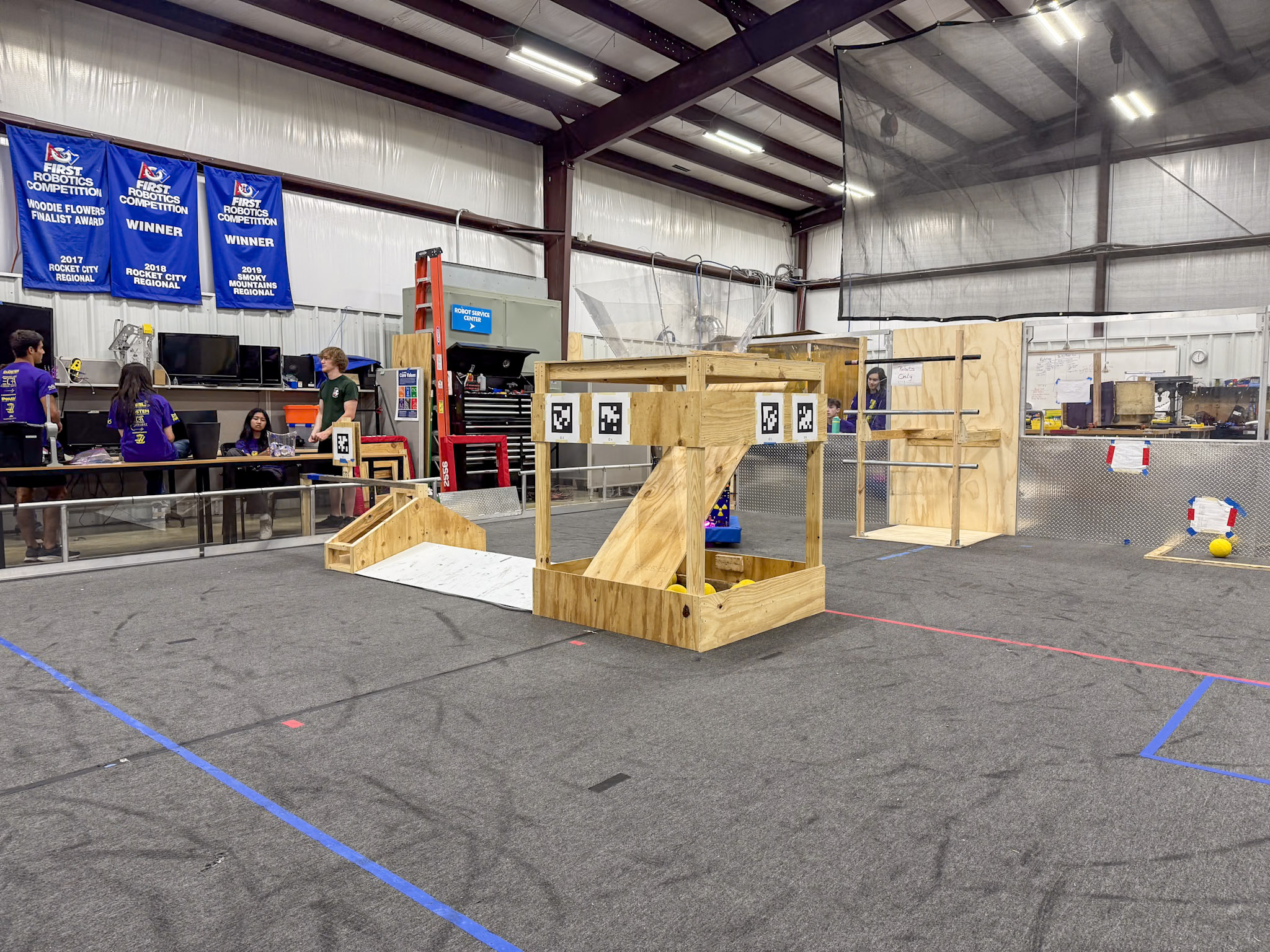
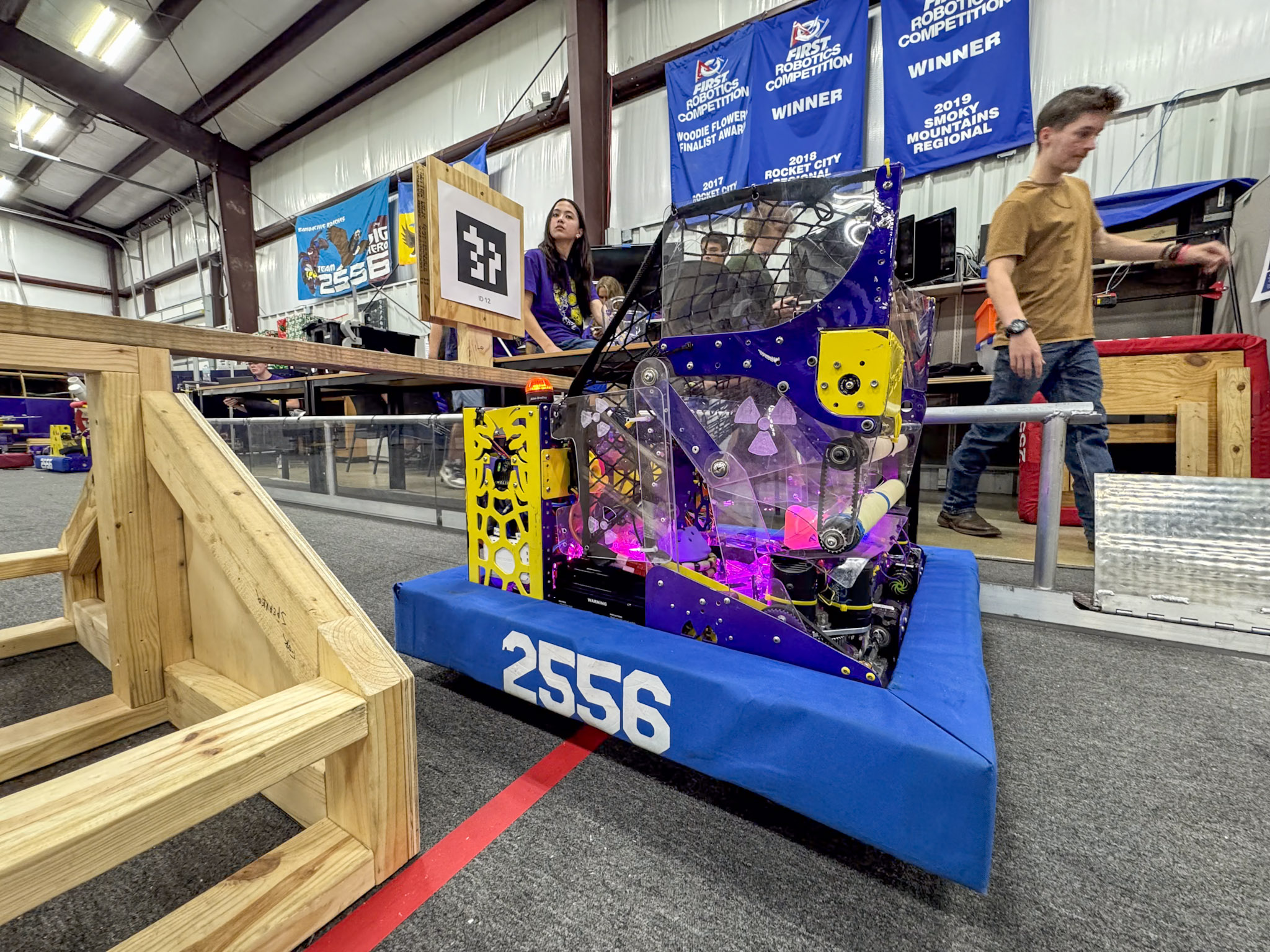
Inside, about two dozen high schoolers and mentors buzz around a small arena with what appears to be a fabricated wooden-and-plastic goblet in the middle. They are all wearing the purple and yellow colors of the Niceville High School Robotics Team: the RadioActive Roaches.
The Roaches started in 2008 under the tutelage of then-NHS Teacher Ben Shuman. From its humble beginnings, the team named after one of the only animals that can survive anything, has made it and stayed at the top level of competition in the FIRST Robotics world.
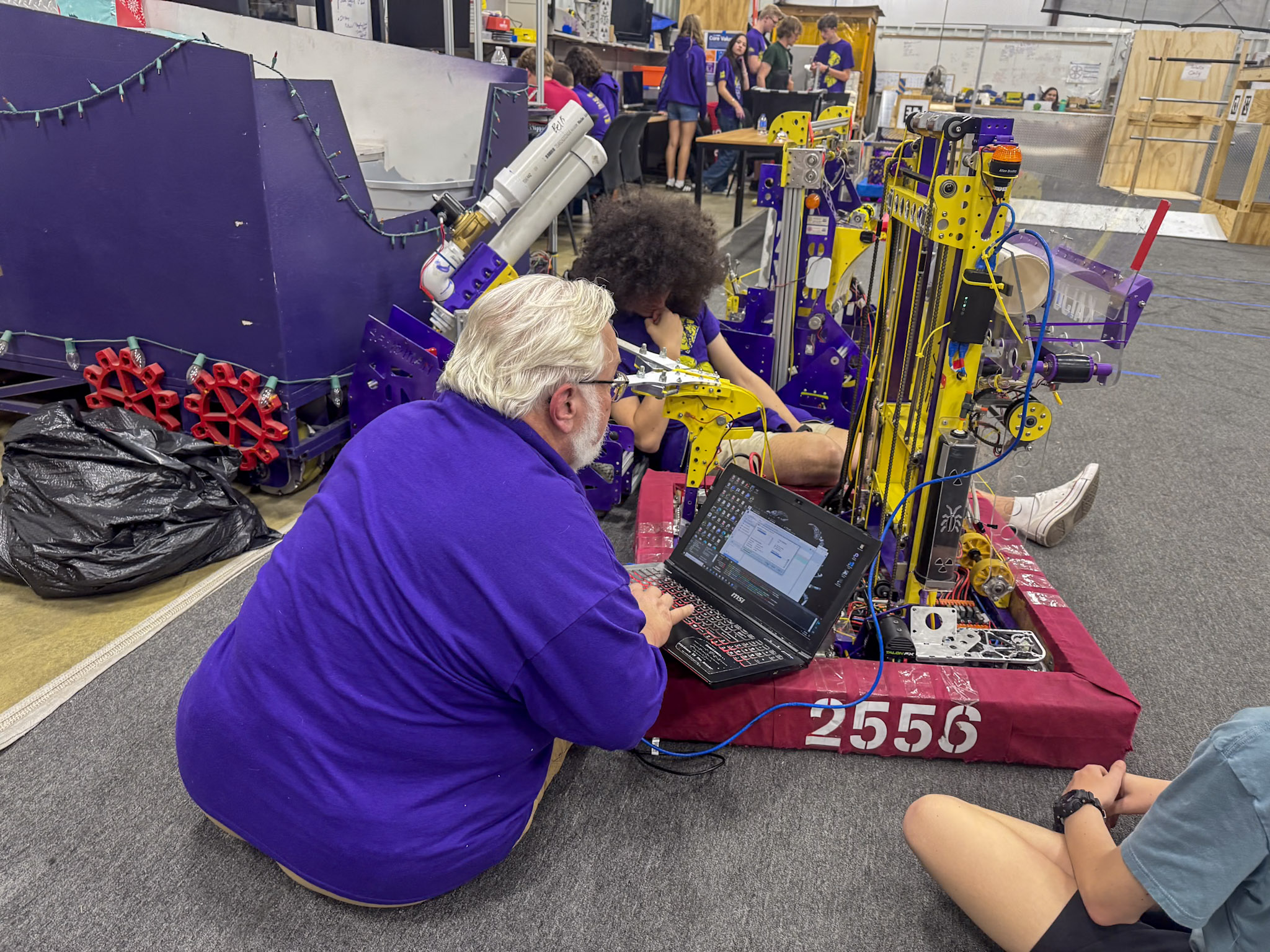
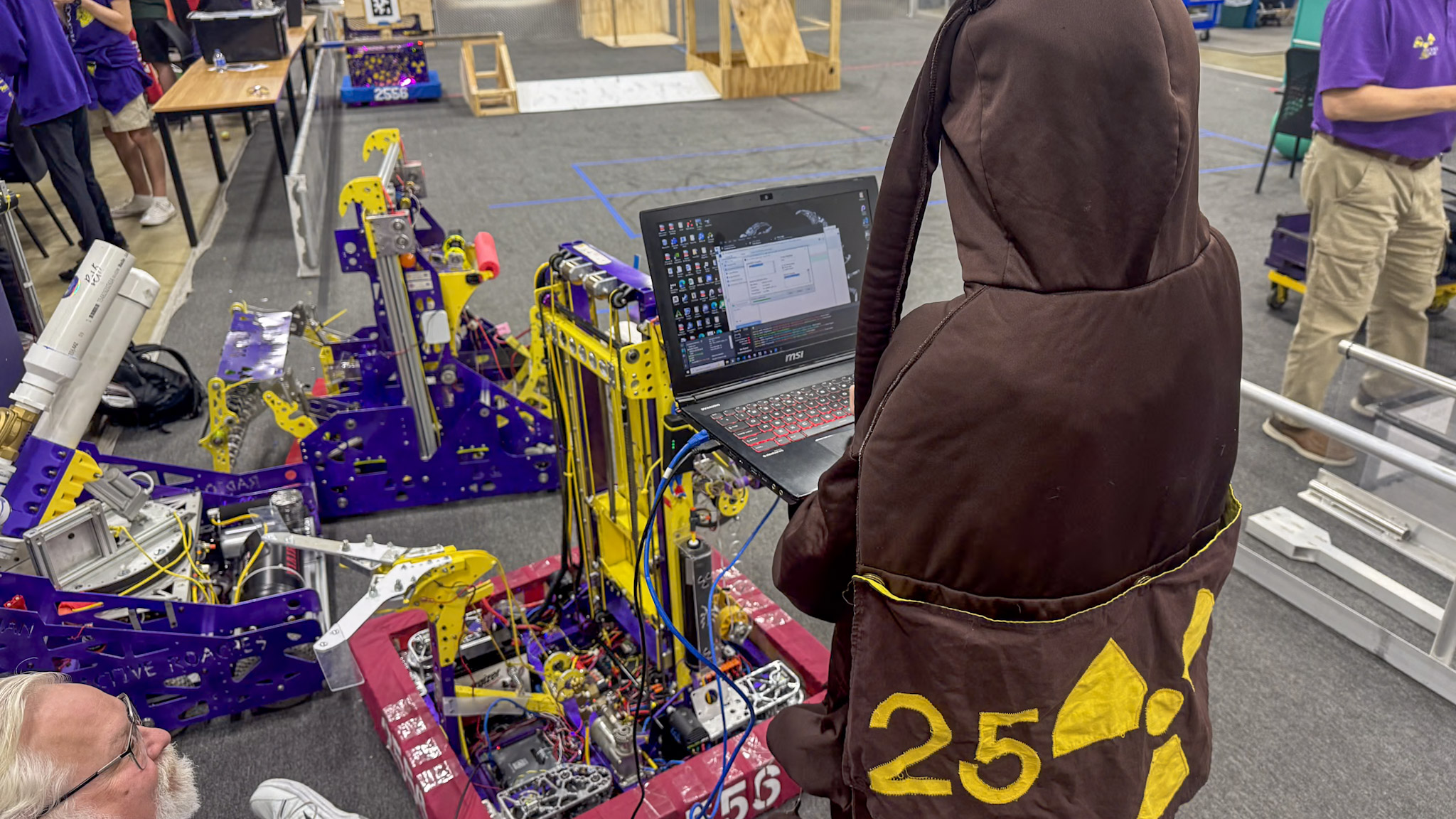
When I get there, the remaining students are huddled around what I later learn is the programming space. There is an air of focused exuberance as the students look at readouts on their computers and discuss next steps as they repair their robot for the grandaddy of them all – the FIRST World Championships in Houston. They leave on April 28 for the competition and will be there for less than a week. They are currently ranked 497 in the world out of almost 4,000 teams.
What Is A First Robotics Competition?
The FIRST Robotics Competition was founded more than 30 years ago to foster excitement and passion for building the next generation of robotics engineers and technicians through games and competitions.
Schools from across the United States and the World field teams. The usual suspects, including American cities like San Francisco or Detroit, as well as powerhouse countries in robotics like China, Japan, England, and the Czech Republic, are on there. But, so are small towns like Elko, Nevada, or the Eastern European country of Azerbaijan.
The FIRST annual competition season begins on the first Saturday of January with all teams receiving the game manual that includes the rules and competition field specifications. Teams will use this information to design their robots. Rules will be applied through regional, national, and international competitions. The teams iterate robot design ideas to solve the problem they’re given (this year’s challenge includes scooping up 5.91in (15.0cm) diameter, high density foam ball and shooting them into the aforementioned goblet), develop, build, and program their robot before taking it to their competition.
Unlike other sports, where there are two defined teams. FIRST pairs teams up with other teams to challenge another group of teams for points. The team with the most points at the end of the day wins.
But the competition doesn’t just rely on what happens on the field. Team members also score points by explaining how their robots work to the judges, preventing teams known derisively as ‘dad’s garages’ from using adult mentors to win the competition. “We are not using kids to build robots, we are using robots to build kids,” notes mentor Schmitz. We’ll come back to him later.
Winners of regional competitions get invited to compete at Worlds, which takes place every year in Houston. The best teams compete and learn from one another to secure victory.
More than Robots Built at RadioActive Roaches HQ
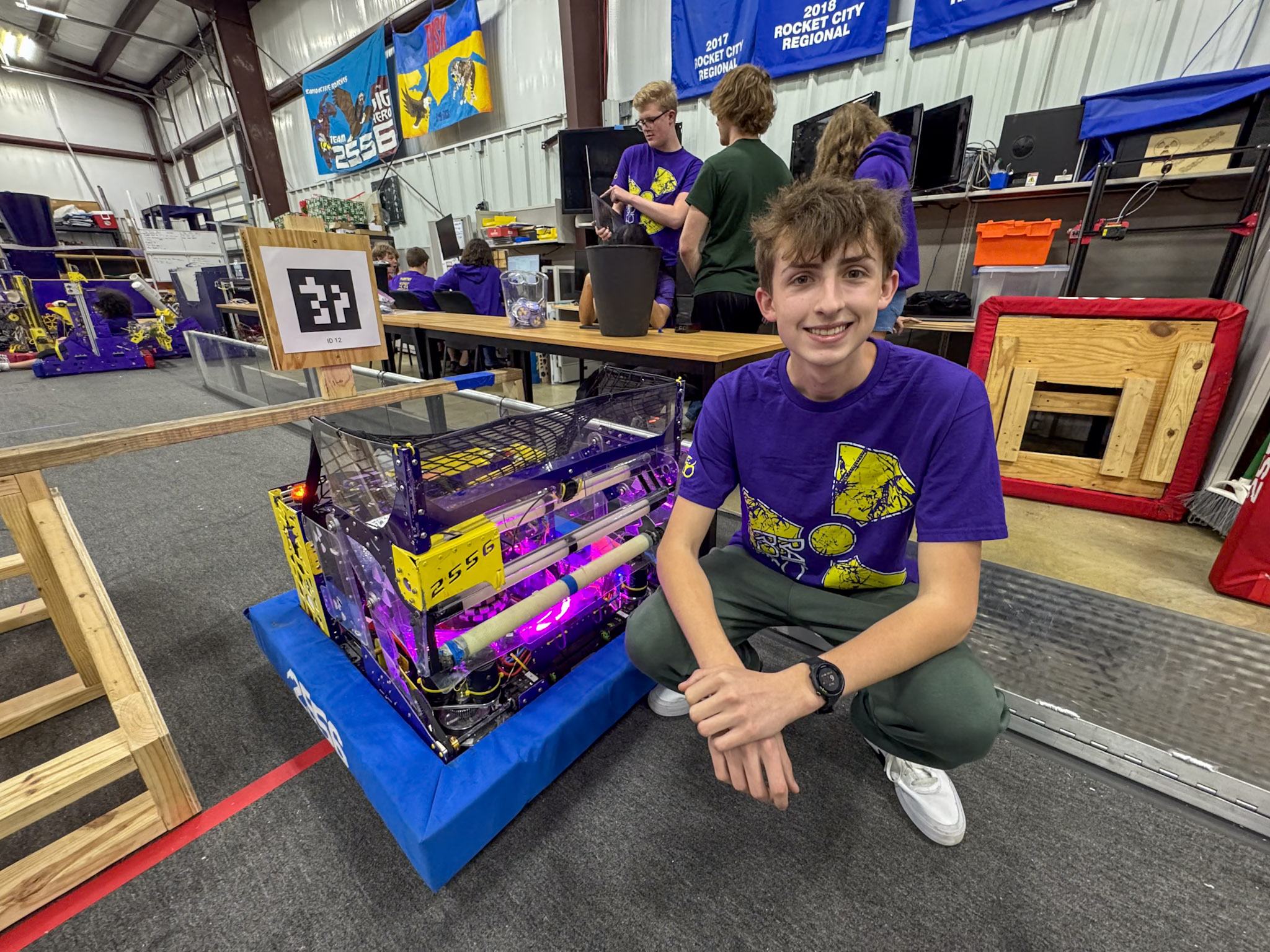
I make my way around the 6,000 square foot building that hosts the Roaches, and several other teams from as far away as Panama City, before I see a student named Chase Robbins on the side of the arena – in what I’ll call the programming alley on the north side of the building. He steps over the ankle-high barrier next to the Roaches robot “Gravedigger” to speak with me. He’s a tall kid with a friendly demeanor who loves programming. It’s a good thing, because he’s in charge of the software for the robot this year. He’s a junior who has stepped into a leadership role on the team after two years as an underclassman.
“I just really like how the code has come together,” Chase Robbins notes, “I think that’s one of our strengths at competition.” The robot’s programming is indeed impressive. It meets FIRST requirements that it operates autonomously for the first 20 seconds of each game. It uses a $200 IMU (that’s cheap compared to the six or seven-figure IMUs available) to make a map of where the robot is on the field at any given split-second so that I can move, pick up balls, and then figure out where it is before it shoots those balls into the zone up top for points.
It’s a huge learning experience for Chase. ‘I had some experience going into this. I’ve been programming since what might be considered a young age, and that’s really got me jump-started,” Robbins explained, “But in respect to decoding this robot, I had no clue what I was doing freshman year. I started off [at] ground zero, and over the years, I’ve gained the skills through trial and error.”
In addition to software, Robbins has had the chance to work on the mechanical aspects of building the robot and on other experiences you might not have guessed a robotics team would need in the future. In addition to building, programming, and leading teams, the RadioActive Roaches build skills in communications, public relations, sales, and marketing. In fact, it’s what Robbins is most excited about going to FIRST Worlds for. There, the Roaches will get dinner with one of the top teams in Michigan. Sure, they will talk shop – but they will also discuss how to fundraise and market their team to local businesses for sponsorships. “They have a really strong culture when it comes to getting funds,” Robbins explained, “While we have a couple of big sponsors, they have almost 100 sponsors every year.” Each team member is responsible for raising a certain amount of money, which means a lot of cold calling and persuasion. It’s a tactic Robbins hopes to implement on the Roaches next year. “It’s not just about building a good robot and competing,” he adds, “It’s about how you can have lasting impacts on your community.”
For every Chase, there is an Iggy. While Chase came to the FIRST Robotics Team at Niceville with some programming experience, Iggy Galaraza didn’t have much experience in mechanical engineering or metal fabrication as an incoming freshman.
I mean, who does?
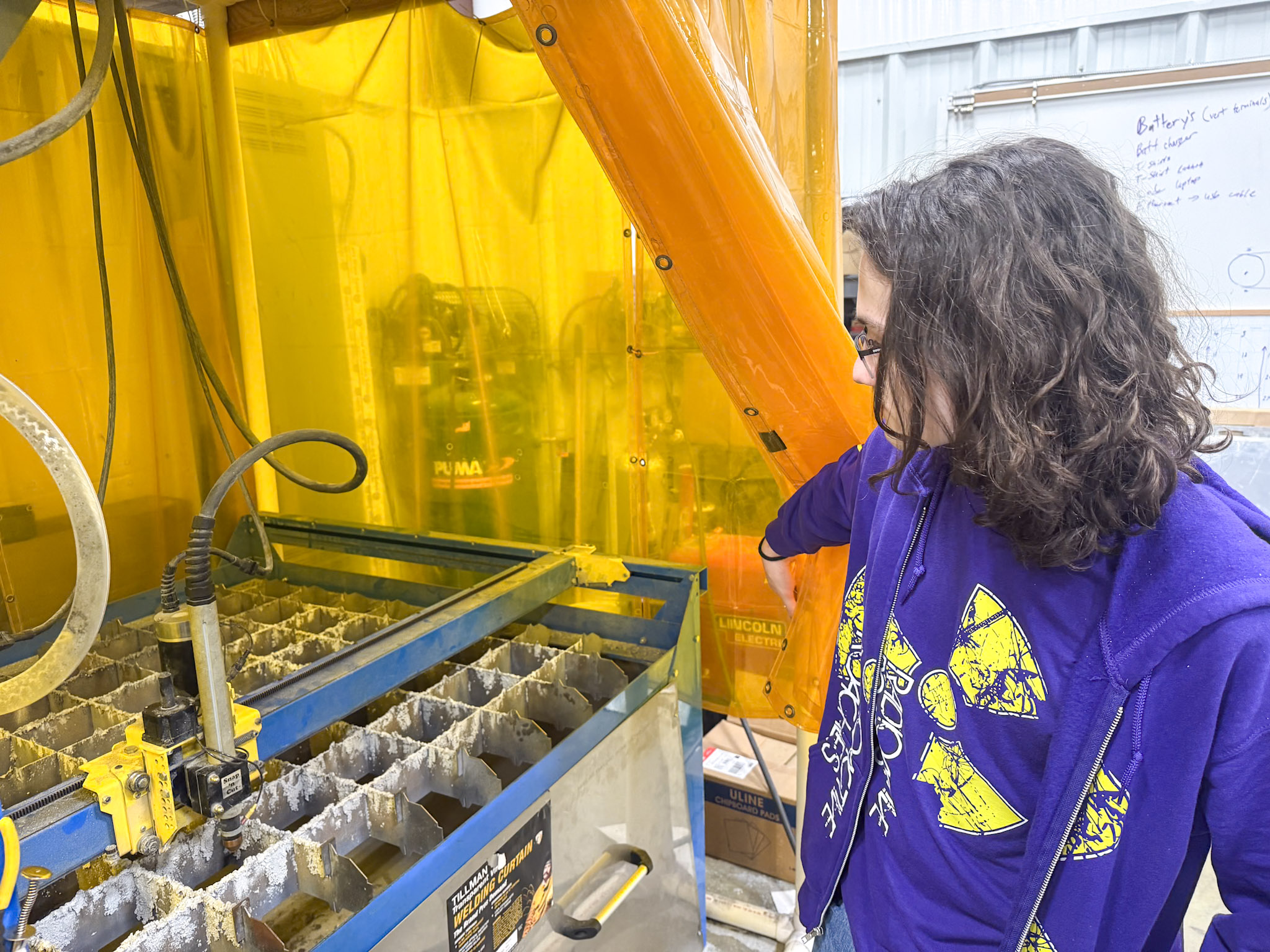
No matter, he’s spent the last couple of years learning how to use the many fabrication machines and tools throughout the warehouse. After all, the robot uses everything from aluminum to 3d printed parts to operate. Now he has skills in Computer Numerical Control (CNC) machines, Plasma Cutters, and Computer-Aided Design (CAD) to make the parts the Roaches’ robots require. He’s also learned the limits of the tools available and that just because it can be designed doesn’t mean it can be fabricated – good lessons for a young engineer that he can’t get in classroom settings, even in college.
The free learning atmosphere extends across team lines in the FIRST world. Instead of guarding information as trade secrets, teams are encouraged to share what they learn and use other teams’ ideas to make their robots better. “If someone needs help learning a skill, or they need a part, there will be four teams ready to help them at a moment’s notice.”
Galaraza says he got lucky and just kind of ended up on the robotics team. He was passing by the teacher-sponsor’s room one day and noticed his friends inside. They were on the robotics team. “I showed up, and I loved it ever since,” He said with a smile, “I really like the community and the effort that everyone puts in to make cool stuff and help each other improve. There’s no hatred in the community.”
The Robotics Team at Niceville High School is an intense time commitment. “It’s like any other sport,” comments Shuman, who notes that the students will put in around 10-12 hours per week. But those 10-12 hours give these competitors a major leg up – because they take their learning outside of the classroom and apply it to real-world situations.
“This is a bold statement, and I say it every time, ‘There is nothing else that will prepare students better for post-secondary life, whether that’s job or education in this program, because we hit it all,’” Shuman said.
James Barnes, another mentor and parent of a FIRST grad who is now an engineer, added, “[FIRST grads] are so far ahead of their peers at college. They’re there. They’re doing it. They’ve seen it. They do it, and whereas a lot of their peers are just learning it for the first time.”
“These kids, high school students, are doing things here that engineering students in their senior projects don’t even get to do,” Shuman concluded.
RadioActive Roaches advance science
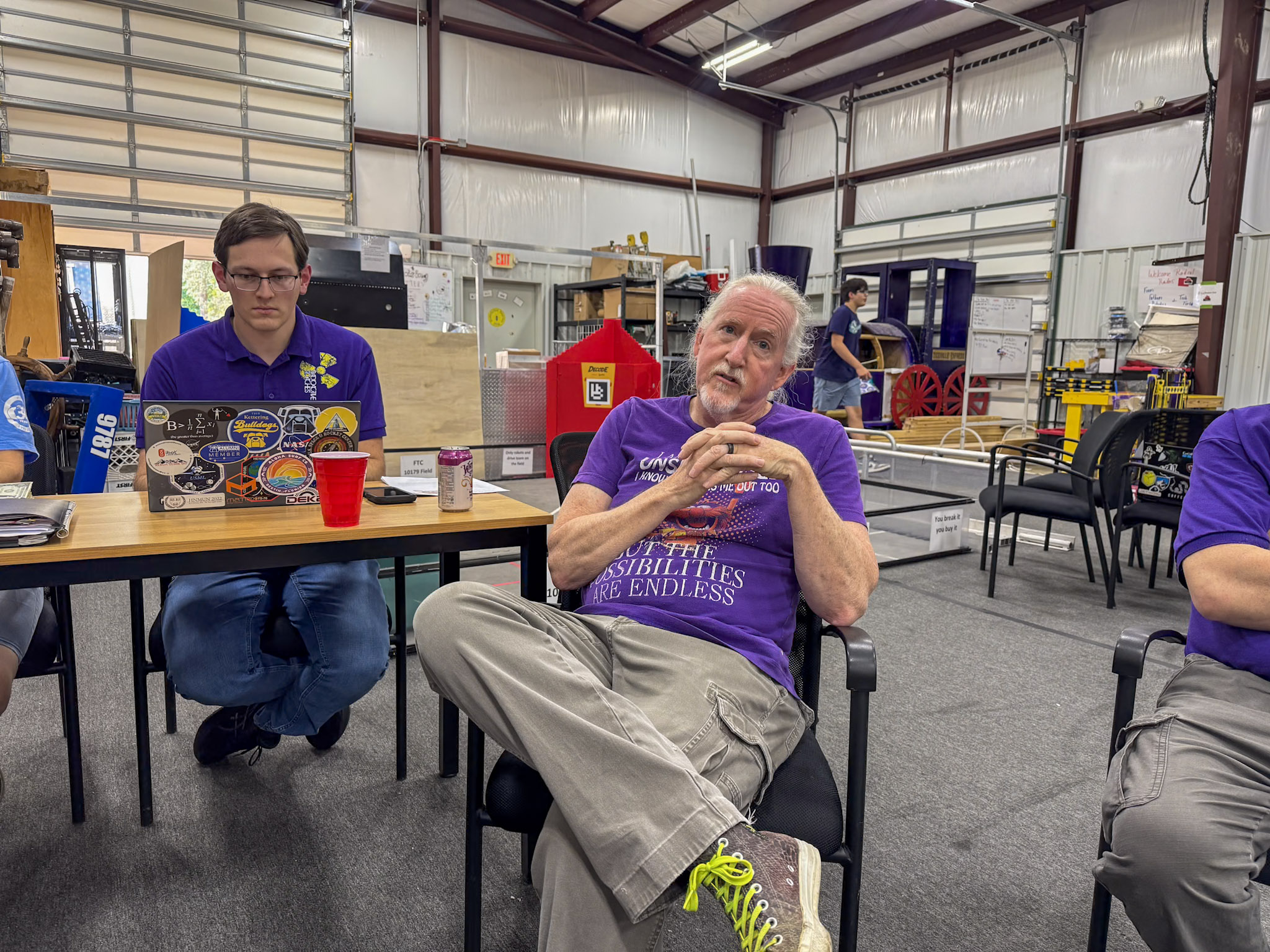
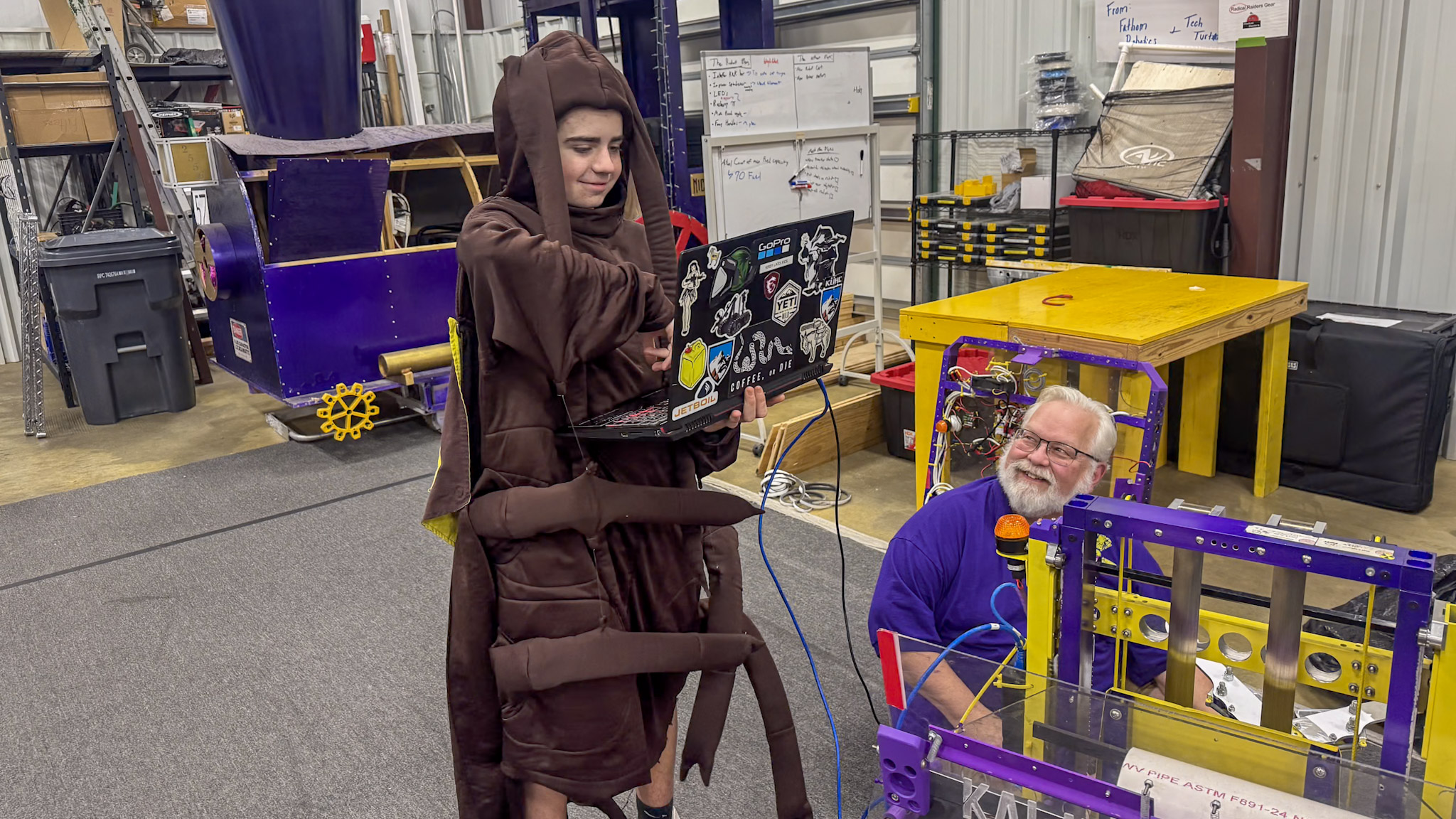
Typing away on his well-stickered computer sits a tall, bespectacled man. He would look at home on any Air Force Base in America. Austin Schmitz is one of the newer members of the RadioActive Roaches mentor team. The Kettering Alumnus chose the school specifically because of the hands-on learning the co-op program provided him during his undergraduate studies. He participated in FIRST robotics in his home state of Michigan, which has more than 600 teams, compared to Florida’s 90.
He hopes to see the level of competition increase as more businesses view it as an investment in the next generation of engineers who will work for them. In Michigan, he notes, there are Ford, GM, and Chrysler-backed teams competing for bragging rights as the top robotics teams in an already competitive business environment. He hopes to build an ecosystem of ‘coopertition’ amongst the teams down here in Florida. After all, the goal is to build technically capable, ethical adults. “When it comes to the Roaches specifically, it’s being of sound moral character,” Schmitz explained, “they’re looking to improve everything around them, trying to make the world a better place and be [of] service.”
“All of us, mentors, have some technical skill that [sic] otherwise to give the students,” Schmitz explained, “And a big thing with FIRST is beyond just going to robotics, communication, professionalism, cooperation is another word that they use, being able to both compete while also cooperating with other people at the same time,” Schmitz said.
The FIRST Competition has roughly 3.4 million alumni since its founding in 1989 by Dean Kamen. Schmitz says roughly five out of six students involved in FIRST go on to earn a STEM degree in college.
“It’s a great investment,” Shuman said.
Obstacles for the RadioActive Roaches
There are more than just obstacles on the field of play that the team needs to overcome to be successful. Funding, but not money, is one of the problems. The RadioActive Roaches are funded entirely by grants and donations from private companies or individuals. While that means they can pay for most everything, it also means they are not able to incentivize teachers, either at Niceville High School or at other schools, to join up readily. The task is a difficult one with long hours, and no stipends, like the ones provided for sports coaches, are available from the school district. That means expansion, to other schools especially, is difficult in Okaloosa County. Fort Walton Beach started a new team this year, but the new calendar brought the dormancy of the Crestview High School team.
Additionally, state-level initiatives to ease some of the financial constraints on the 90-ish FIRST teams in Florida have encountered headwinds in Tallahassee. In 2019 and 2020, funding for FIRST Robotics entry fees, teams or other similar funding was line-item vetoed by the Governor. Two appropriations requests, one in South Florida and another for the Crestview-area robotics teams, filed by Representative Nathan Boyles, are in play for the 2026-7 state fiscal budget. Those requests total $1 Million.
Finally, the team, though it is relatively well-funded according to its mentors, is looking for donations to help it make it to Houston for Worlds. You can donate to them here.
What’s Next for FIRST and Niceville’s RadioActive Roaches
As technology advances, it’s safe to assume that the FIRST challenges will advance as well. Ben Shuman believes that the next step for the competition will involve sight. “ I think what we think should happen is that the drivers should not have a first-person view on the field, so they should be put under the hood or something, so that all the information they’re getting is either coming from their teammates, like NASCAR has spotters, or they’re getting the telemetry straight from the IMU.”
But the second change is more profound. “[Public Schools] do a good job of preparing our students for post-secondary education, right? But we don’t do a good job of teaching them, ‘hey, what’s the relevance of what we’re teaching,’” Shuman began.
He hopes that FIRST could serve as a catalyst for a new wave, or experiential teaching where students see how to apply what they learn in the classroom, instead of becoming a databank for a bunch of interesting information. “We can teach a kid about circles, right?” Shuman pointed out, “And we can teach them about radiuses and diameters and circumference. But where’s the application for that? – “Well, if I tell you that you need to know how fast your wheel needs to spin in order to get 15 feet per second – you need to know the circumference of a wheel… You need to calculate how to calculate that angular velocity, and then take an angular velocity and translate it into a linear velocity. Okay, so wouldn’t it be cool if you had project-based learning in your classrooms, that while you’re teaching them about circles and radius and diameters… You take that math, and you embed that into a project?”
He says that a FIRST-method-taught teaching program is in some ways in the future because of the expense of training or retraining teachers, but the hoped-for future is possible.
But that will also mean paying teachers’ wages that are competitive with other STEM jobs, which can offer multiples of a teacher’s monthly wages, to keep them in the classroom.
We love to bring you, and all of your neighbors, the news for free – it’s a part of who we are. But just because something is free doesn’t mean it’s cheap.
Your sustaining donation of just $10 per month helps us keep the powerful accountable and make the mortgage on time. If you notice you keep coming back for more stories from us – please consider supporting our work so we can do it for the long haul (and not be homeless).
Register or login with Mid Bay News and never get another pop up on our site!