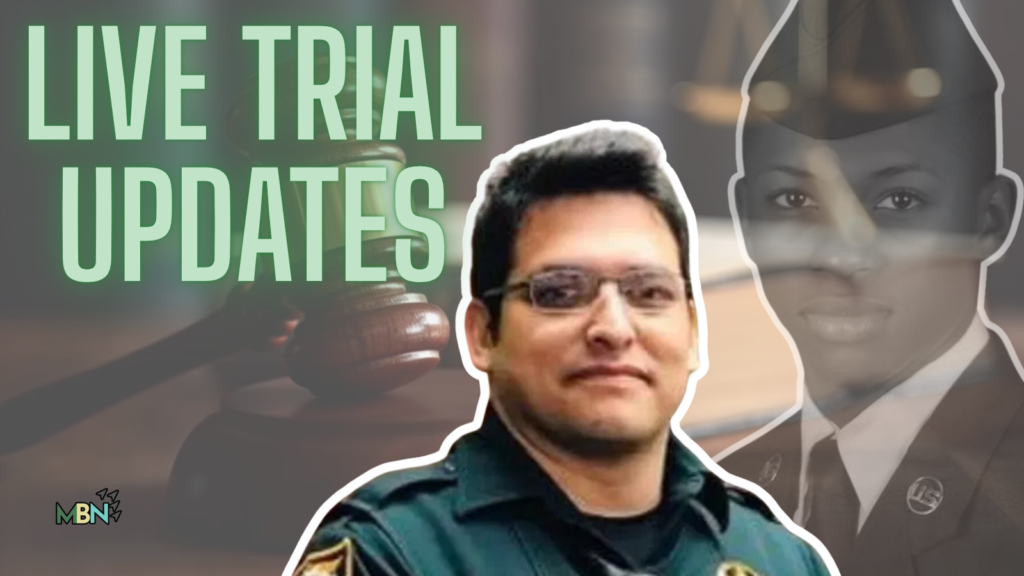

The trial of former Okaloosa County Sheriff’s Deputy Eddie Duran began Tuesday, regarding the killing of Senior Airman Roger Fortson inside Fortson’s apartment. Duran is charged with manslaughter for the 23-year-old’s death, which occurred in 2024.
Duran pleaded not guilty by reason of self defense to the charge, so the prosecution must attempt to prove beyond a reasonable doubt that Duran was not justified in shooting Fortson.
October 1, 2026
Closing Arguments
The third day of trial began with closing arguments from both counsels.
Prosecution
Prosecutor Mark Alderman began his closing argument reminding the jury what’s not up for debate:
- Fortson is dead.
- Fortson was killed by Duran.
He reminded jurors that they must only decide whether Duran was justified in shooting Fortson. The definition of “justified,” Alderman said, is especially important. In order for one to be justified in using lethal force, they must reasonably believe that they are in imminent danger.
Alderman said the key words here are “reasonably believe.” In his closing argument, he told the jury that:
- The jury should base their verdict only on the legal definition of self-defense, not Duran’s possible perceptions.
- Jurors should consider both what Duran knew when he arrived at Fortson’s apartment, and what he did not know.
- Following one’s training is not a legal defense for manslaughter.
- Fortson’s finger was outside the trigger chamber and his firearm was pointed downward at the time he was shot, “ready to use it, if it becomes necessary.”
- One cannot assume what Fortson heard or knew inside his apartment while Duran was knocking.
- Duran was acting based on fourth-party information that changed as it was passed from one person to another.
- Duran’s intentions don’t matter to his charge, and jurors should reach a verdict without sympathy.
- Duran was outside Fortson’s door for around one minute and six seconds, but waited over 50 seconds before announcing himself as law enforcement.
- Fortson did not step forward after opening the door, as Duran claimed. The bodycam footage shows him stepping backward slightly with his left leg.
- The bodycam footage does not support Duran’s claim that Fortson opened his door with his gun aimed at Duran.
Finally, Alderman reminded jurors that their verdict should hinge on one question:
“Would a reasonably cautious and prudent person, under these circumstances, believe it was necessary to shoot Roger five times?”
Defense
Defense attorney Michael Flowers opened his closing argument discussing requirements for a homicide in self defense.
“The danger may need not have been actual,” he said.
Since the burden of proving Duran guilty rests on the prosecution, Flowers told jurors they must reach a not-guilty verdict if they’ve “got a doubt, and a reason to believe that doubt.”
Regarding Alderman’s request for the jury to consider what Duran did and did not know, Flowers said what he did not know makes the self-defense argument more profound.
As Flowers delivered his closing argument, his speech became increasingly louder, higher and faster, as he pleaded with jurors not to believe everything the prosecution’s witnesses said.
He suggested Tytiana Hendrix, Fortson’s girlfriend who was on FaceTime with him at the time of the shooting, was “never telling [jurors] the truth.”
The defense does not bear the burden of proving Duran’s actions on the day he killed Fortson were right, only that the State’s argument against Fortson is not reason to convict him of manslaughter. As he reminded the jury of this, Flowers asked them to rule with “common sense” and reach a not-guilty verdict, “because it’s the right verdict.”
“Don’t turn this into an injustice,” Flowers said.
Deliberations Begin
After a brief rebuttal by the prosecution, Judge William F. Stone released the two alternate jurors — one man and one woman — and instructed the jury that they could begin deliberations in private.
Jury deliberation is currently underway, and Judge Stone closed the courtroom to the public.
Mid Bay News will update when the jury announces a verdict.
September 30, 2026
Defense’s argument: Day 2 begins
The second day of the trial began with Duran’s own testimony about the day he shot Fortson. He recounted his military and law enforcement experience and training, which included 12 years in the Army Military Police force, graduating from the Police Academy and continuous training throughout his time with Okaloosa County.
Testimony from the Accused
Throughout Duran’s training, he said, he’s always been taught that domestic violence situations are one of the most dangerous types of calls for deputies to respond to. Knowing this and believing he was responding to a potential domestic violence case, Duran said he heightened his awareness arriving at the scene.
According to his testimony:
- Duran was patrolling Okaloosa County zone 17 when he received the dispatch to Elan Apartments on May 3, 2024.
- Dispatch informed him he’d be responding to a possible physical disturbance, possibly between one male and one female. Dispatch never used the word “domestic.”
- He deduced he could be responding to a domestic violence call, but knew as a deputy he needed to verify any claims before taking them as fact.
- Duran did not use police lights or sirens en route to the scene.
- As soon as he arrived at the scene, Duran activated his bodycam.
- Upon arrival, he made contact with Rodriguez, who told him the original caller, Simms, had sounded scared over the phone. Rodriguez also mentioned yelling and a possible slap she’d heard two weeks prior. She said at the time she didn’t know what apartment it was coming from, but believed it could’ve been Fortson’s. Rodriguez then directed Duran to Fortson’s apartment.
- Duran didn’t wait for backup before approaching the apartment because his training emphasized a “direct to threat” method in a situation where a victim may be in danger.
- As he went up the elevator and approached the apartment door, Duran attempted to contact his supervisor over police radio and analyzed the area for potential escape options.
- Since he was on the fourth floor with a wall to one side and a steep drop to the other, Duran deduced he had no potential escape options.
- Once he reached Fortson’s apartment door, he first listened for any voices but heard none. The silence made him suspicious because he previously responded to a domestic violence call where a man was forcibly silencing a woman.
- After knocking, Duran ducked behind a wall to maximize his safety, not to conceal himself.
- He didn’t identify himself as law enforcement on the first knock because he wanted to further assess the situation before doing anything that could aggravate a potential assailant.
- He had no idea Fortson was alone inside the apartment because the information dispatch gave him indicated otherwise.
- At one point, he heard a male voice inside the apartment say something including the words “fuck” and “police.”
- On the second and third knocks, Duran shouted, “Sheriff’s office, open the door.”
- Around a second after Duran’s third knock, Fortson opened the door. Duran immediately reverted to his training and looked to Fortson’s eyes, waist and hand to assess any threat.
- In a few seconds, between the time Fortson’s door opened and when he was shot, Duran looked at Fortson’s eyes and said his expression made it “clear to [him] that [he] was not welcome.” Duran said Fortson looked aggressive and frustrated.
- Duran said when Fortson first opened the door, Fortson’s firearm was “slightly canted upward” toward Duran, which isn’t apparent on bodycam footage.
Duran said Fortson’s expression, combined with his active grip on the handgun, led Duran to believe he was at genuine risk of death. He felt he “came within a fraction of a second of never seeing [his] family again.”
According to Duran’s bodycam footage, Fortson collapsed instantly after Duran shot him. Duran then repeatedly instructed Fortson to “drop the gun.”
Duran testified today that he repeated this command because he couldn’t see the firearm once Fortson fell, and his training taught him that a wounded person holding a gun still poses a threat.
Once the scene was secure and Duran confirmed Fortson did not have his firearm, Duran said he described the situation over police radio and called for EMS.
After describing his perception of the shooting, Duran testified as to what went through his mind after Fortson collapsed. He said he was “feeling every emotion,” as a situation necessitating lethal force is “the worst thing any officer could imagine” going through.
Duran’s Cross Examination
During cross examination, Alderman questioned Duran about his state-of-mind as he prepared to arrive on scene. According to Duran’s testimony during cross examination:
- He understood that deputies must investigate any scenario before taking witness statements as fact.
- Duran felt the information he received from dispatch was vague.
- He understood the details he received from dispatch were based on third-party information.
Alderman asked Duran what he would’ve done if he arrived at Fortson’s apartment and heard a victim call for help inside. Duran said he wouldn’t have kicked down the door or breached entry without first getting approval from his supervisor.
“I just do what I’m directed to do from a supervisor,” he said.
Duran also said he couldn’t be certain what the male voice said when he heard “fuck” and “police” inside the apartment.
Alderman continued cross-examinating Duran, who testified that:
- He understood Floridians have a right to own firearms to defend themselves.
- A person holding a gun could be a victim, holding the weapon in self-defense.
- He thought Fortson stepped forward after Duran yelled at him to “step back.”
- Fortson’s positioning of his firearm when he first opened the door led Duran to shoot.
- He would classify Fortson as an assailant because he “didn’t comply with a firearm in his hand.”
- In the bodycam footage, Fortson’s firearm is pointed downward when he is shot.
Defense’s Expert Witnesses
Once Duran finished testifying, the defense called Detective Peter Hernandez to the stand. Hernandez works in the audio/video enhancements department for the Orange County Sheriff’s Office.
Hernandez said in 2024, the FDLE requested audio/video enhancement services from him pertaining to their investigation of Duran’s use of lethal force. He used iZotope to extract and enhance audio from Duran’s bodycam footage.
The enhanced video picked up a faint male voice inside Fortson’s apartment, which Duran referenced in his testimony when he said he heard Fortson use the words “fuck” and “police.”
The defense played the video, which included both the original and enhanced audio versions, for the court.
While sitting in the gallery, spectators and Fortson’s family members speculated Fortson might’ve said “Knocking on my door like the fucking police.” This expression is a common colloquialism in Black culture, popularized by the 1997 film “Jackie Brown.” This theory was not addressed during the trial.
Next, the defense called Massad Ayoob, president of the Massad Ayoob Group, to the stand.
Ayoob is an expert in judicious use of deadly force and self-defense. He testified that law enforcement does train officers not to wait for backup in a domestic violence situation. He also explained that a “low-ready position” and “firing grasp” indicate that someone is about to fire their weapon.
After Sergeant Casey Duh, Duran’s former Corporal Patrol Supervisor, testified that Duran had been wearing his uniform and identification properly on the day of the shooting, the defense called Lewis Kliem, president and director of consulting at at Force Science, to the stand.
Kliem performed an audit of the Okaloosa County Sheriff’s Office use/training for lethal force situations in 2024. This involved reviewing the evidence in Duran’s case.
According to Kliem’s testimony:
- Officers’ use of force is usually in response to a threat.
- “Tactics are discretionary, as a rule.”
- Officers are trained to act first in a threatening situation, rather than waiting for an assault to take place.
- Before using force, officers should consider the aggressor’s physical ability, means to carry out an assault and opportunity to carry out an assault.
- Since officers usually have only seconds to make a decision in a threatening situation, they shouldn’t hesitate while analyzing. Kliem said officers should “recognize, not analyze” a threat.
- Bodycam footage frequently doesn’t match what an officer is actually seeing. The bodycam’s angle is around 11 inches lower than the human eye, and shows a wider perspective than a normal field of vision.
- He doesn’t know of any police force where officers are trained to wait until an aggressor’s gun is pointed at them to fire shots.
The defense’s final witness was Kevin Williams, who retired from the Orlando Police Department after serving 28 years as a police officer. Williams is a certified firearm instructor specializing in firearm training.
According to his testimony:
- The average police officer draws and fires their gun in between 2-2.25 seconds.
- At close range, he wouldn’t recommend using mace to subdue a threat.
- Officers can’t use tasers at close range. Their use requires at least 7 feet between the officer and perpetrator.
The Defense Rests
After their final witness testified, the defense moved for the judge to acquit Duran of manslaughter. Judge William F. Stone denied the motion, and said the jury will decide Duran’s verdict.
The defense rested its case.
The court adjourned, but will return at 9 a.m. tomorrow for closing arguments. Mid Bay News will continue to report as the trial proceeds.
The trial of former Okaloosa County Sheriff’s Deputy Eddie Duran began today, regarding the killing of Senior Airman Roger Fortson inside Fortson’s apartment. Duran is charged with manslaughter for the 23-year-old’s death, which occurred in 2024.
Duran pleaded not guilty by reason of self defense to the charge, so the prosecution must attempt to prove beyond a reasonable doubt that Duran was not justified in shooting Fortson.
Jury selection proceeded through Monday, and many trial attendees, including the victim’s family, wore disapproving looks or shook their heads as the selected jurors entered the room today.
September 26, 2026
Opening Statements
Jury selection proceeded through Monday, and many trial attendees, including the victim’s family, wore disapproving looks or shook their heads as the selected jurors entered the room today.
The eight-person panel contains seven men and one woman (six jurors , all of whom appear to be white. Each juror has sworn to reach a verdict using objective judgment, and without allowing their emotions to affect their thinking.
During opening statements, the prosecution argued that Duran did not adequately identify himself as law enforcement before opening fire on Fortson. State Attorney Mark Alderman said evidence will show Duran shot Fortson “almost immediately” once Fortson opened his apartment door, and did not have reason to believe his own life was in imminent danger.
The defense, however, said during opening statements that Duran was simply following training from the Okaloosa County Sheriff’s Office and believed he was responding to a domestic disturbance call — though deputies later learned Fortson had been alone in his apartment.
Defense Attorney Michael Flowers also told the court that Duran does plan to testify and relay what happened on May 3, 2024, the day Fortson died, from his perspective.
Prosecution’s Argument
The State brought forth Dr. Danielle Armstrong, Florida’s District 1 medical examiner, to the stand first. Armstrong performed Fortson’s autopsy, and testified that he died from multiple gunshot wounds. Armstrong said she’d ruled his death a homicide.
Next, prosecutors called Charles Johnson to the stand, who said he became one of Fortson’s closest friends while the two were stationed at Hurlburt Field. Johnson had been with Fortson on the day of his death, and he provided clarity regarding the day’s timeline. According to Johnson’s testimony:
- Fortson had come to Johnson’s apartment that afternoon, and they spent a couple of hours hanging out and playing video games.
- At one point while they were hanging out, Fortson got on the phone with his girlfriend, and gave her most of his attention.
- Fortson left Johnson’s apartment, still on the phone, and returned to his own home.
- About 30 minutes after Fortson left, Johnson received a call from Fortson’s mother, who was “frantic” and repeatedly asked Johnson to “check on [her] baby.”
After receiving that phone call, Johnson drove to Fortson’s apartment where deputies redirected him to the hospital where Fortson was. Johnson remained at the hospital until he learned Fortson had died later that night.
So, what happened between Fortson’s time playing video games with his friend, to his death? Prosecutors brought forth Calan Simms, who lived in the apartment unit directly under Fortson’s when the shooting occurred.
According to Simms’ testimony:
- She didn’t know Fortson personally.
- On May 3, 2024, she called the front desk at Elan Apartments to report a noise complaint against Fortson’s residence.
- She called in the complaint because she’d heard one male voice and sounds of “things moving around,” and was concerned there may have been a fight going on.
- She believed the conversation she heard from Fortson’s residence sounded aggressive, and said she heard him say, “I’m sick of you lying behind my back,” “You got me so fucked up,” and other comments through her apartment vent.
The prosecution then played this phone call for the jury. In it, Simms is heard telling front desk staff that she thought her upstairs neighbors were fighting, and she worried things were getting “handsy.”
The front desk staffer, Keely Rodriguez, told Simms that the apartment staff couldn’t do anything about this, and that it was a police matter. Rodriguez suggested Simms call the police herself, but Simms testified that she didn’t call authorities because the fighting seemed to “simmer down” shortly after her call to apartment staff.
Instead, Rodriguez called Okaloosa County’s non-emergency line directly after hanging up with Simms. Prosecutors called her to the stand next.
According to Rodriguez’ testimony:
- She did not attempt to resolve the matter herself, as she felt it could cause safety concerns for apartment staff.
- She called the non-emergency line instead of 911 because she wasn’t sure what was going on inside Fortson’s apartment.
- Her manager was not at work that day, so Rodriguez could not consult with apartment staff before calling the police.
In the call recording with Okaloosa County dispatch, Rodriguez is heard telling the operator she’s going to walk by Fortson’s apartment from the ground level. She then tells the operator she can’t hear any fighting, but that she had previously heard someone yelling obscenities, such as “Shut up, bitch,” from an apartment — though she hadn’t been sure at the time whether it was coming from Fortson’s residence.
When Duran arrived at the scene, Rodriguez directed him to Fortson’s residence.
It turns out, Fortson was alone inside his apartment, playing video games, on the phone with his girlfriend when Duran first knocked on his door.
Fortson’s girlfriend, Tytiana Hendrix, took the stand to discuss what she witnessed while on FaceTime with him.
According to her testimony:
- Her and Fortson called briefly while Fortson was at his friend’s apartment, then they got back on FaceTime when he arrived home.
- While on FaceTime, Fortson was playing the video game Madden, which was typical for him.
- There was no argument, screaming or swearing while the two were on the phone. Nothing was out of the ordinary.
- Fortson was wearing his gaming headset, with one ear covered and one outside the headset so he could still hear Hendrix.
- Both Hendrix and Fortson thought they heard a knock at the door, but ignored it because they weren’t sure.
- Shortly after, they heard a second knock that was louder and harsher than the first. Hendrix urged Fortson not to answer the door, as he wasn’t expecting anyone and didn’t know who it could be.
- Fortson looked through the peephole on his door multiple times, but couldn’t see anyone outside his residence.
- After a third knock, Fortson asked, “Who the fuck is it?” to which he didn’t hear a response. At this time, Fortson went to his room and grabbed his firearm.
Hendrix said Fortson set his phone down so she could not see what happened next, but she heard a loud “commotion,” and realized Fortson was shot when she heard Duran call it over his police radio. She said she’s never watched the bodycam footage of Duran shooting Fortson, so her testimony is solely based on her own memory.
Duran’s Bodycam
Prosecutors played the bodycam footage from before, during and after Duran shot Fortson. In the footage:
- Duran approached Fortson’s apartment and listened outside the door before attempting to make contact.
- Duran knocked once, and moved behind an adjacent wall. There is no answer.
- Duran knocked a second time, and moved behind the wall. There is no answer, and Duran had not yet identified himself.
- Duran knocked a third time and identified himself, shouting “Okaloosa County Sheriff’s Department.”
- Fortson creaks open the door holding his handgun in his right hand, at his side, aimed at the ground.
- Duran fires five shots at him almost immediately.
- Fortson collapses, and Duran begins yelling at him to put down his gun and stop moving, to which Fortson responds, “I don’t have it [the gun]” while on the floor.
Less than a minute after Duran fired shots, Okaloosa County Sheriff’s Department’s Ezekial Dixon arrived with Jacob Runge, who was undergoing field training.
Dixon and Runge both testified, and Runge’s bodycam footage shows what happened after the shooting.
According to the deputies’ testimonies and bodycam footage:
- Backup arrived and saw Duran standing in the apartment doorway with his gun drawn, and Fortson lying in the entranceway with apparent gunshot wounds.
- Runge saw a firearm near Fortson’s right hand, which he kicked into the kitchen.
- Deputies cleared Fortson’s apartment and determined there was no one else inside.
Once Duran learned Fortson had been alone, we see him on bodycam separating himself and repeating “fuck,” hitting a wall once.
Deputies on the scene found five bullets fired from Duran’s firearm, and none from Fortson’s. They found no evidence anyone else had been inside the apartment at the time of the shooting.
Prosecution Rests
Prosecutors called two final witnesses to the stand.
Lisa Hughey retired from the Okaloosa County Sheriff’s Office in 2025, and worked in the crime scene investigations unit in 2024. She documented and collected evidence from Duran at the Sheriff’s office on May 4, 2024, the day after the shooting. This evidence included photos of Duran, as well as the firearm, bullets and casings associated with the alleged crime.
Florida Department of Law Enforcement Special Agent Mark Zagar supervised the investigation into Duran’s use of deadly force and turned in evidence. He said it’s typical for FDLE to investigate officer-involved shootings.
After Hughey and Zagar testified, the State rested its case and court adjourned.
The trial will resume tomorrow with the defense’s argument, and Flowers said Duran himself will testify.
Mid Bay News will update this page as the trial proceeds.