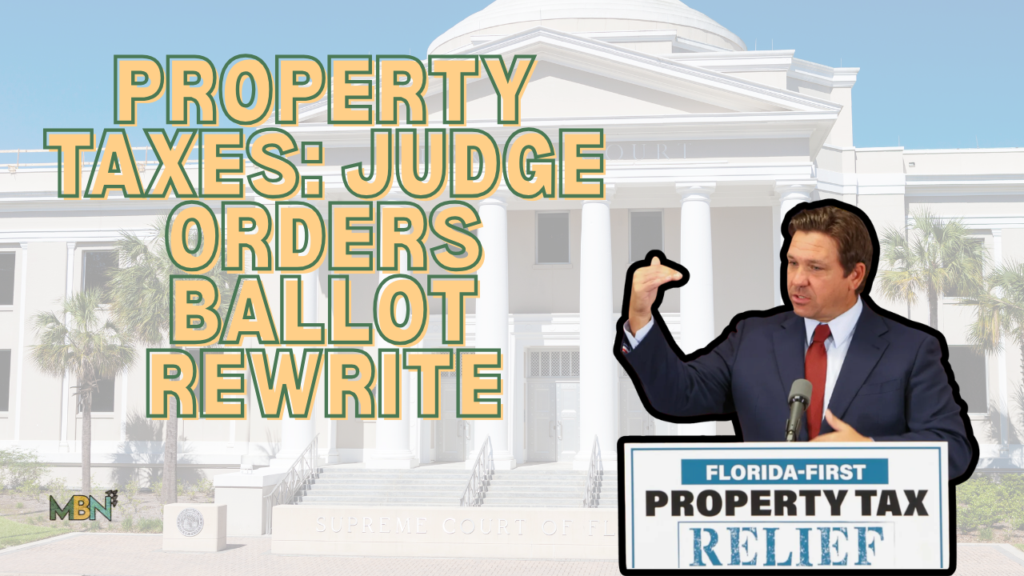

A Leon County Circuit Court judge ruled Monday that the ballot language of Amendment 3, the controversial homestead tax exemption proposal, is legally defective and must be revised within ten days to make it on November’s ballot.
The order issued by Judge David Frank finds the amendment’s title, “Save Our Homes From Excessive Property Taxes,” potentially biased, saying “the title is more akin to a political slogan.”
Specifically, the order addresses the use of the word “save,” calling it “rhetoric designed to elicit an emotional response and is improper.”
Judge Frank also found the title misleading in several ways.
According to Frank’s order, “if a voter rents his or her home, the property tax to be paid on the home would not benefit from the increased homestead exemption and would not be subject to a lower tax but instead would most likely be subject to a higher property tax (as a result of the likely increase in millage rate) that could be viewed as ‘excessive.’ That higher tax would be paid by the landlord and passed on to the voter tenant in the form of higher rent.”
“Simply put,” the order states, “the proposed ballot title does not state the basic legal purpose of the amendment; it endorses it and diverts voters from its actual effect.”
Frank also addressed the ballot summary, which promises to “benefit Florida taxpayers.”
“The ballot summary then sets forth three political taglines – ‘Ensuring funding for core services,’ ‘Protecting small businesses,’ and ‘Ensuring fairness for Florida residents’ — giving reasons why voters should vote for the proposal,” the order states. “But the purpose of a ballot summary is to explain what an amendment would do, not to advocate for its adoption.”
Frank said the amendment does not actually ensure funding for police, fire departments, schools, and infrastructure, which would lose significant revenue if property tax is eliminated.
According to the order, “the amendment cannot fairly or accurately be described as ‘ensuring funding.’”
The ballot summary also mentions protection for small businesses, but does not elaborate further.
“Instead, the proposed amendment broadly limits future assessment increases on all categories of non-homestead property, and provides no protection to small businesses, or other non-homestead property, from the expected higher taxes resulting from increases in millage rates,” the court order reads.
Frank also clarified how the amendment could affect Florida residents who rent. The summary says the amendment will “ensure fairness for Florida residents,” but the court ruled this misleading.
According to the court order, “the proposed amendment would discriminate against Florida residents who rent their homes (single-family or multi-family) by providing tax relief only to owners of homestead properties, thereby increasing the burdens on renters who will likely pay more when their landlords pass on the increased property taxes resulting from higher millage rates.”
What’s next?
The Attorney General has ten days to submit a revised ballot that fixes each named deficiency to the Department of State, as well as the elections supervisor of each county. As long as the revised ballot meets the court’s requirements, Floridians will still vote on the proposal in November.
For a comprehensive list of issues found with Amendment 3’s title and wording, visit page 13 of Judge Frank’s order.