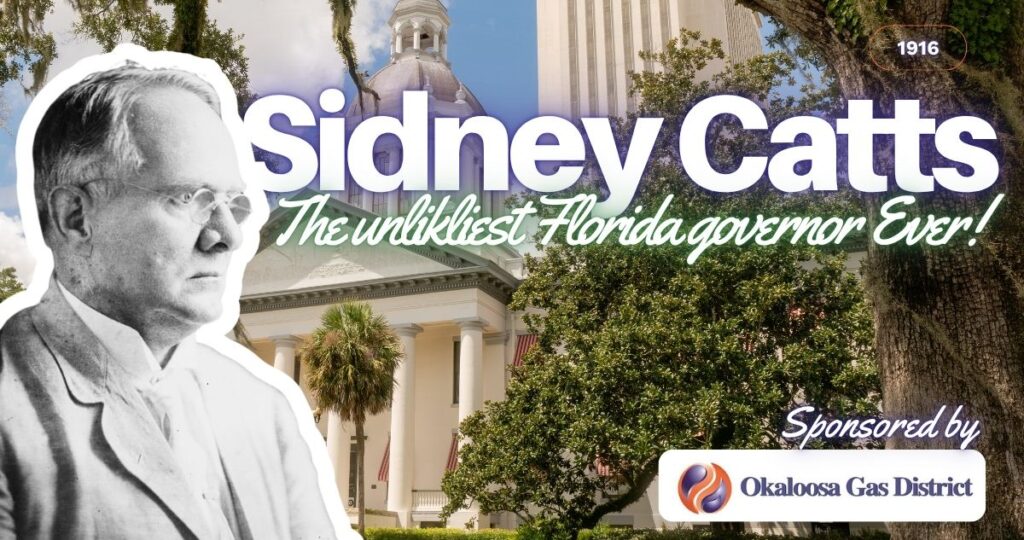

On November 7, 110 years ago – The only resident of the Emerald Coast to become governor finished his outsider campaign with a third-party to defeat the Democratic machine in power in the state. It was a wild tale that involved rumors of Catholic assassination plots, legitimate claims of primary election rigging and one very colorful Baptist preacher turned insurance salesman: Sidney J Catts.
You can learn more about Catts in the upcoming book: A Short History of the Emerald Coast. Pre-register to get your copy now!
This article is sponsored by our friends at Okaloosa Gas!
A disputed path to the ballot
In 1916, Sidney J. Catts first sought the Democratic nomination for governor. At the time, winning the Democratic primary usually meant winning the governorship; Republicans hadn’t held the office since Reconstruction.
Catts’s appeal to rural voters and his willingness to campaign in communities other candidates often bypassed made him a serious contender – but an outsider and an overlooked one to boot.
The primary, as you might have guessed, became contentious. Catts and William V. Knott fought a close, disputed contest through the summer to the primary election.
After a recount fight, the Florida Supreme Court recognized Knott as the Democratic nominee. Catts and many of his supporters believed the party establishment had taken the nomination from him. Rather than leave the race, he accepted the Prohibition Party nomination and entered the general election as its candidate.
Catts’s message mixed populist frustration with appeals to anti-Catholic prejudice – at a high water mark in the country as more and more central and southern Europeans of the Catholic faith entered the United States.
He campaigned for prohibition, but he also made anti-Catholic claims and promoted white supremacist ideas. Florida’s Catholic population was small and largely urban; fewer than 50,000 of Florida’s roughly one million people were of the Catholic faith.
Catts’s campaign played on rural fears. His election showed the political power of voters who felt unseen by the state’s party leaders. It also showed how easily a campaign could mobilize resentment against religious and racial minorities.
On Election Day, November 7, 1916, Catts defeated Knott and took the governor’s office. He was inaugurated on January 2, 1917, as Florida’s 22nd governor.
A turbulent administration
Catts entered office with no dependable legislative coalition: Democrats still dominated the Legislature, and many had supported Knott or resented Catts’s third-party victory. That conflict limited much of his agenda and made his term turbulent from the start.
He advocated several Progressive Era-style measures, including industrial schools for boys and girls and lower loan interest rates. State records also credit his administration with reforms involving the prison system and the treatment of people with mental illness. During his term, Florida ratified the 18th Amendment establishing national prohibition, and Catts publicly endorsed women’s suffrage.
His most significant policy achievement was fighting state-level convict leasing. Under that system, incarcerated people—disproportionately Black Floridians—were leased by the state to private businesses. In North Florida’s turpentine camps, the work was dangerous and conditions were often brutal. High death rates made the system a stark continuation of forced labor after slavery.
Catts had seen conditions around West Florida turpentine camps near his DeFuniak Springs home. He tied his opposition to convict leasing to Florida’s growing “good roads” movement, arguing that the state needed better highways as tourism and automobile travel expanded. With support from the newly created Road Department, he pushed to move 300 prisoners from private companies to public road work. Conditions improved and death rates in the camps declined. In 1919, after the completion of the state prison at Raiford, the Legislature ended Florida’s convict-leasing system.
He publicly described Black Floridians in racist terms and, according to the supplied historical account, refused to condemn two lynchings in 1919. When the NAACP protested, he criticized the organization rather than condemn the violence. As Black Floridians continued leaving the state during the Great Migration, Catts later urged them to remain in Florida, in part because employers feared losing a source of low-wage labor.
Controversy followed Catts beyond his public statements. His administration drew criticism for awarding government jobs to members of his family. He was also indicted over alleged irregularities connected to his administration, though he was later exonerated. Those controversies, along with poor relations with the political establishment, contributed to the decline of his later campaigns for the U.S. Senate and for another term as governor.
Relevant Links from Mid Bay News