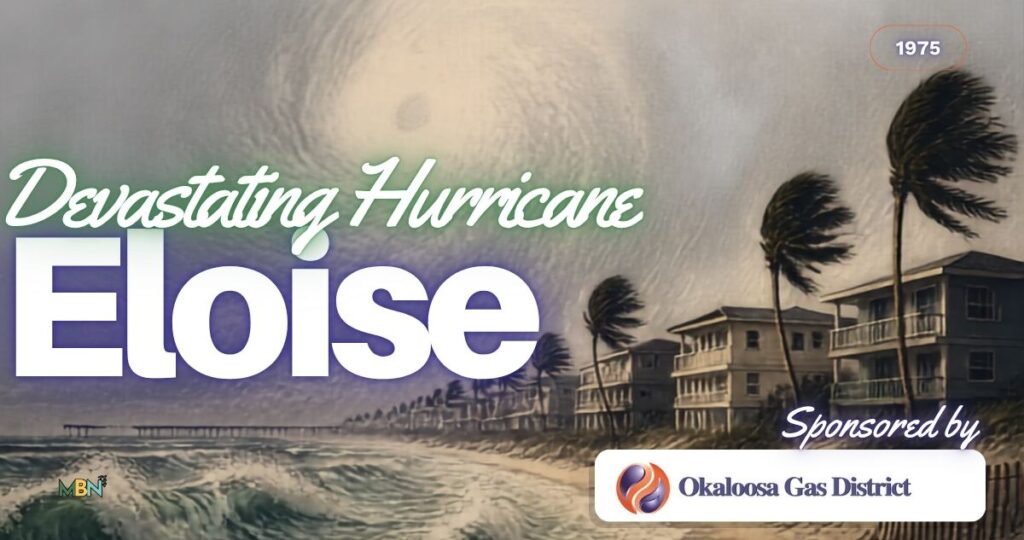

A special thanks to our friends at Okaloosa Gas for sponsoring our History of the Emerald Coast series.
Hurricane Eloise introduced herself in a small clipping at the bottom of the front page of the Boca Raton News on September 2, 1975 – just as Florida’s school kids headed back to classrooms around the state.
The destruction wrought to the Emerald Coast would be similar in proportion to the juggernaut hurricane that hit Fort Walton Beach as a category three storm on September 23.
Eloise obliterated buildings as far inland as Niceville during the most destructive storm to hit the area since 1936.
The Okaloosa Island Pier, newly built, was destroyed – and between 30 to 70 feet of sand dunes were whisked away, depending on the area.
“We’ve been fairly lucky,” said South Florida forecaster Miles Lawrence to the newspaper. He would be right for the southeastern part of the state – but the Emerald Coast would receive a deadly direct hit.
The storm would first kill 34 people in Cuba – before heading due west on a straight line through Puerto Rico to the Yucatan Peninsula. Once over Mexican airspace, the storm veered right and moved due north on a beeline to Miramar Beach. By that time, the storm had killed more than 40 people in the Caribbean.
The storm looked like it would hit New Orleans until the mass of lightning, wind, and rain turned to the northeast and slammed into the Emerald Coast at about 7 AM on September 23. Storm surge got up to ten-and-a-half feet in Destin, according to the National Weather Service.
Nine of ten buildings between Fort Walton Beach and Panama City, Florida, were destroyed south of US 98. Further inland, in Alabama, the state’s officials estimated more than $100 million in crop losses due to the storm.
Robert Smith, the head of the Florida Division of Emergency Preparedness, told reporters that the situation was bad in five counties: Okaloosa, Walton, Bay, Holmes and Washington. “It’s the worst one I’ve ever had,” he said to a reporter with the Associated Press, “You go down every street and you see buildings without roofs, signs down, trees down.”
Natural Resources Director for the State of Florida, Harmon Shields, noted that the erosion had seriously affected the beaches and said that “The Lord had shown [property owners] the setback lines.”