🛣️ City council voted 6–1 to urge FDOT to reconsider an elevated flyover design for U.S. 98
✈️ Officials cited improved traffic flow and military mission readiness as key reasons for backing Alternative 1B
🗣️ Residents raised concerns about public input, funding clarity, and long-term neighborhood impacts
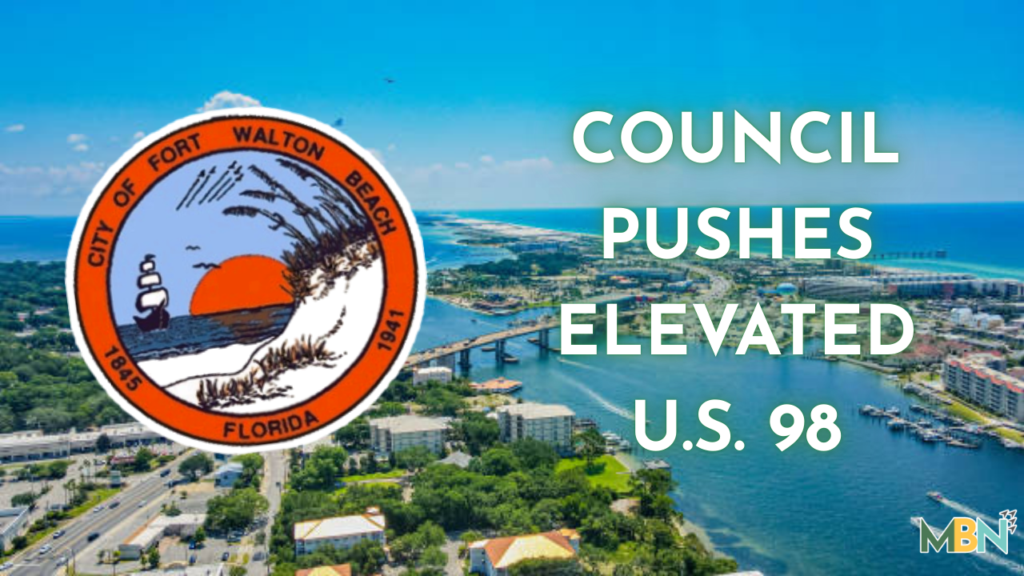
FORT WALTON BEACH — The Fort Walton Beach City Council voted 6-1 on Dec. 16 to formally ask the Florida Department of Transportation (FDOT) to reconsider an elevated design option for the long-planned “Around the Mound” rerouting of U.S. Highway 98.
The action came as the council approved Resolution 2025-31, reaffirming support for Alternative 1B, a design that includes elevated flyovers, over Alternative 1A or a no-build option currently under consideration by FDOT.
City Attorney Jeff Burns said the confusion appears to stem from a lack of a formal, recent statement from the city supporting 1B after a February 2024 public meeting, despite years of earlier council actions backing what was then known as Alternative 2 B. Burns said that gap may have contributed to FDOT advancing 1A as its recommended option at a December public hearing.
“I think it became apparent that, despite the fact that the city had pushed 1B over about a six- or seven-year period, there was never really an official position taken after that February 2024 meeting,” Burns said. “That possibly led to some miscommunication with FDOT.”
The Around the Mound project traces back to November 2017, when the City Council adopted Downtown Master Plan Transportation Alternative 2B as the preferred concept for rerouting U.S. 98 around downtown Fort Walton Beach.
Over the next several years, the council committed funding. It passed multiple resolutions supporting feasibility and environmental studies, including a $50,000 local match in 2019 and up to $1 million in 2021 for the Project Development and Environment study.
By early 2024, FDOT presented three options to the public — Alternatives 1A, 1B, and no build — at a hearing at the Emerald Coast Convention Center. In April 2024, the council adopted Resolution 2024-07, committing additional funds and reiterating support for 1 B.
At a second FDOT hearing in December 2025, however, only Alternative 1A and the no-build option were presented. That prompted city officials and local business leaders to push for reconsideration of 1B ahead of a Jan. 30, 2026, deadline for public comment to FDOT.
“If the city does nothing, then it is likely that Alternative 1A is the option that will be adopted,” City Manager Jason Davis told the council.
Under Alternative 1A, drivers traveling east from the west would be directed to a stoplight where they could turn north toward Eglin Parkway or continue east toward Okaloosa Island.
Traffic coming from Okaloosa Island would encounter two new signalized intersections, with a new two-lane bypass allowing access to Eglin Parkway near the current location of The Block nightclub.
The plan would convert Perry Avenue Southeast into green space, ending at Ferry Road Southeast.
At the same time, an auxiliary road would serve westbound drivers accessing the Publix Shopping Center and First Street Southeast. Alternative 1A could affect up to 72 residential and business properties through potential relocations and carries a projected preliminary cost of $311.8 million.
Alternative 1B differs primarily through the use of elevated flyovers.
Traffic traveling south on Eglin Parkway would merge onto U.S. 98 via an elevated structure, allowing vehicles to head east toward the Brooks Bridge without stopping at a traffic signal. Drivers coming from the west on U.S. 98 would also be able to bypass a signalized intersection using an elevated roadway.
Traffic heading west from the Brooks Bridge would have a dedicated two-lane connection north to Eglin Parkway or could continue straight along U.S. 98, with a single auxiliary lane serving First Street Southeast.
Alternative 1B is projected to impact about 70 properties and carries a similar overall estimated cost, though officials said it has higher construction costs but lower right-of-way acquisition impacts.
FDOT is also considering a no-build option that would leave the existing roadway configuration unchanged.
Council members repeatedly cited traffic efficiency and military access as key reasons for backing Alternative 1 B.
Councilman David Schmidt said data presented by FDOT showed that 1B would reduce travel times compared with 1A, in part because it eliminates at least one signalized intersection.
“Common sense says it clogs the artery,” Schmidt said, referring to additional traffic lights in the at-grade design.
Mayor Nic Allegretto said the city has “one chance” to get the project right, particularly given its importance to nearby military installations.
“Mission readiness is literally critical,” Allegretto said. “The data that report is showing us, and what public works is telling us, is that 1B improves that.”
Councilman Payne Walker said the project also offers an opportunity to enhance downtown vibrancy, stressing that design standards for the elevated sections would be critical to prevent blight and encourage redevelopment.
“There’s been a lot of progress removing blightedness and vagrancy,” Walker said. “This project, if done right, can improve traffic flow and the quality of life here.”
Some residents questioned whether the city had adequately debated the elevated design before now.
Local resident Rob Smith told the council that earlier votes were for a route concept, not specific flyover structures, and urged more public discussion before committing to 1 B.
“I was surprised to hear this had all been supported for all these years,” Smith said. “That’s definitely not something that’s been pre-decided by this council.”
Shalimar resident Jeff Watson said he was concerned about the pace of the process and the lack of clarity for residents and property owners.
“There’s still a lot of questions,” Watson said. “If we’re this far down the road, I would think everyone would know what we’re getting.”
City officials responded that the project remains in the PD&E phase and that detailed design work would follow only after funding and approvals are secured.
Several council members raised concerns about whether choosing a more expensive option could affect the project’s priority for state and federal funding.
City Manager Jason Davis said local governments cannot use city ad valorem taxes to fund a state road. He emphasized that final funding decisions rest with state and federal partners and the Okaloosa-Walton Transportation Planning Organization.
Ultimately, the council agreed that formally stating the city’s preference was necessary, even if funding and design details remain unresolved.
“This tells them this is what we want,” Allegretto said.
The resolution passed 6-1, with Walker the only dissenter. The city’s position will be forwarded to FDOT ahead of the Jan. 30 public comment deadline.
We love to bring you, and all of your neighbors, the news for free – it’s a part of who we are. But just because something is free doesn’t mean it’s cheap.
Your sustaining donation of just $10 per month helps us keep the powerful accountable and make the mortgage on time. If you notice you keep coming back for more stories from us – please consider supporting our work so we can do it for the long haul (and not be homeless).

Register or login with Mid Bay News and never get another pop up on our site!