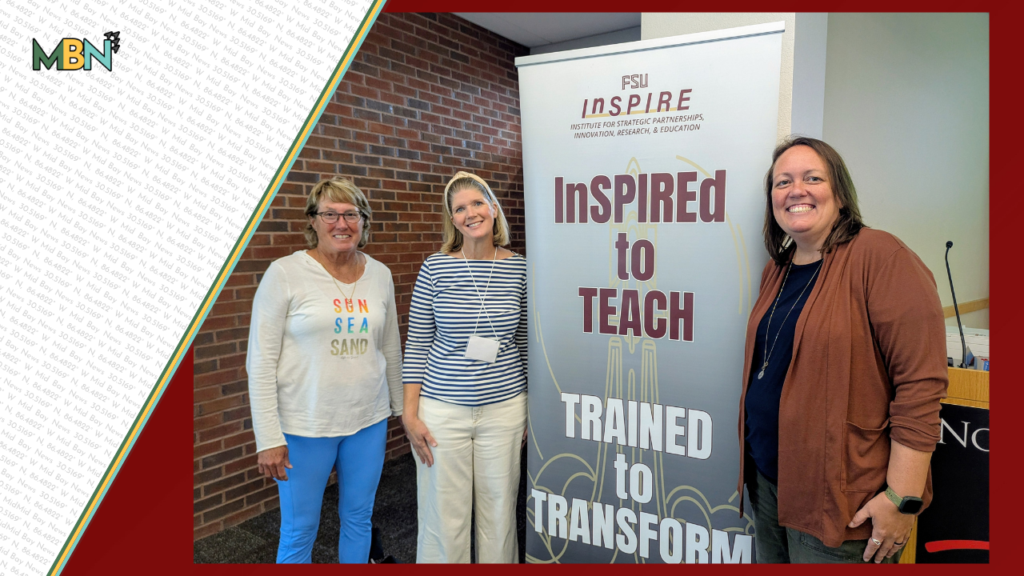

As artificial intelligence rapidly reshapes industries worldwide, educators, economic developers, and defense leaders say that Northwest Florida has a choice: prepare students now or risk falling behind.
That was the message this week at Northwest Florida State College, where teachers from across the Panhandle attended AI101 and Robotics101 courses hosted by Florida State University’s InSPIRE Project. InSPIRE stands for Institute for Strategic Partnerships, Innovation, Research, and Education. Their mission combines four major goals. They want to build a highly skilled workforce while conducting applied research with industry partners. InSPIRE also supports economic development across the Phnhandel, aiming to attract high-paying employers to the region.
But instructors emphasized that teaching artificial intelligence isn’t just about teaching new technology; it’s about teaching students how to question it.
AI isn’t replacing teachers; educators say it’s changing how they teach. Renee Lainey, a fifth-grade science and math teacher at Eglin Elementary, said the training showed how AI can transform traditional classroom assignments into interactive learning experiences.
“Students can take something readable and then turn it into something that is actually interactive.”
She described students using AI to transform PowerPoint presentations into three-dimensional robotic concepts. Lainey said one lesson surprised her: “The students can pick it up faster than the adults.” Rather than replacing creativity, educators said AI frees students to spend more time solving problems together.
The most important lesson isn’t using AI; it’s questioning it. Several educators independently repeated the same phrase during interviews.
“Be a critical consumer.”
Anna Prendel, a fifth-grade teacher at Holley Navarre Intermediate, said AI should be used as a partner, not an answer key. “It’s a co-designing tool.”
Prendel went on to say, “It’s important for us to embrace that it’s here, and then teach the students to be a critical consumer and use it…the right way.”
One example stuck with Prendel long after the lesson ended. Inspired by InSPIRE’s curriculum, she challenged students to design paper airplanes using engineering principles.
“I had students who went home and created over 30 airplanes that night to come in to try to test in the hallway,” Prendel said. Students experimented with everything from cardstock to construction paper, testing which designs flew the farthest while refining them through the engineering design process. “We had the entire school throwing airplanes in the whole school.”
Chloe Johnson, another educator attending the weeklong event, echoed that message by saying, “Is it true? Is it accurate? Just because it pops up…is it vetted?”
Johnson went on to say that students must understand how AI works and why it makes mistakes. Understanding those limitations allows students to apply critical thinking and determine whether AI-generated information is accurate.
“AI is with us to stay,” said Jim Reynolds, director of STEM Outreach for the INSPIRE project. STEM Outreach is simply getting students, teachers, and communities excited about Science, Technology, Engineering, and Mathematics. He also said that AI is often misunderstood, comparing today’s AI movement to the arrival of the calculator decades ago.
Reynolds warned that we still need to help students understand that information may not be factual. By being critical consumers of artificial intelligence, students can better prepare themselves for the future AI workforce.
For regional leaders, artificial intelligence represents more than another classroom tool. They see it as one piece of a broader strategy to diversify Northwest Florida’s economy through aerospace, defense, and advanced manufacturing.
After decades of Northwest Florida’s economy depending heavily on tourism, military, construction, and healthcare, local leaders are trying to diversify that economy by attracting high-tech employers to the region. FSU InSPIRE was created specifically to help build that innovation ecosystem, with funding from Triumph Gulf Coast following the Deepwater Horizon settlement.
Related Triumph approves $4.77 million for economic diversification
One challenge, leaders say, is convincing companies that Northwest Florida has the skilled workforce they need before they decide to relocate or expand.
“Education is a huge part of our vision for this area of Florida,” said FSU InSPIRE Executive Director Drew Allen. “When we envision a thriving hub of innovation, we know that a strong and talented workforce is absolutely essential. One of our goals is to attract industry here, and we know that an available, skilled pool of talent is one of the main requirements they have. Not only are we committed to building that workforce, but we are making sure that the businesses we attract are supplying high-paying career opportunities from technicians to professors and beyond.”
This is where organizations like One Okaloosa, FloridaMakes, and Eglin Air Force Base enter the picture. Economic development organizations such as One Okaloosa work to recruit new employers, while FloridaMakes helps manufacturers modernize, and FSU InSPIRE focuses on building the future workforce those industries will need.
Jim Reynolds said, “The end goal is to create a diversified workforce that is ready for advanced industry.” Reynolds goes on to say, “We’re upskilling the workforce.”
Instead of students leaving for Orlando, Atlanta, and Huntsville in search of high-paying aerospace industry jobs, the hope is they will stay.
“Those students will have jobs in the future in this area.”
Teachers say students are already embracing the future. Prendel described a classroom where students coded Ozobots, little robots designed for an introduction to coding, to navigate food webs before using 3D printers to create animal models and eventually turning those lessons into algebra problems. All of that happened in a classroom full of creativity and accomplishment.
“They will remember that forever.”
Students today likely will have jobs that might not even exist yet.”Currently, we have no idea what the future jobs are.” Lainey went on to say, “Our kindergarteners are basically going to be doing something completely different from what their fathers or mothers are doing.”
This matters because, as technology and the workforce evolve, Northwest Florida is positioning itself for future economic growth.
Regional leaders believe Northwest Florida’s existing military installations, including Eglin Air Force Base, Tyndall Air Force Base, and Naval Air Station Pensacola, give the region a competitive advantage in attracting aerospace and advanced manufacturing companies.
Optimistically, Renee says, “I’m very excited about it.” Anna echoed that by saying, “Stay creative. Stay innovative.”
Jim Reynolds said it best, “The calculator took 25 years to be incorporated into classrooms,” he said. “I don’t think we have that luxury nowadays.”