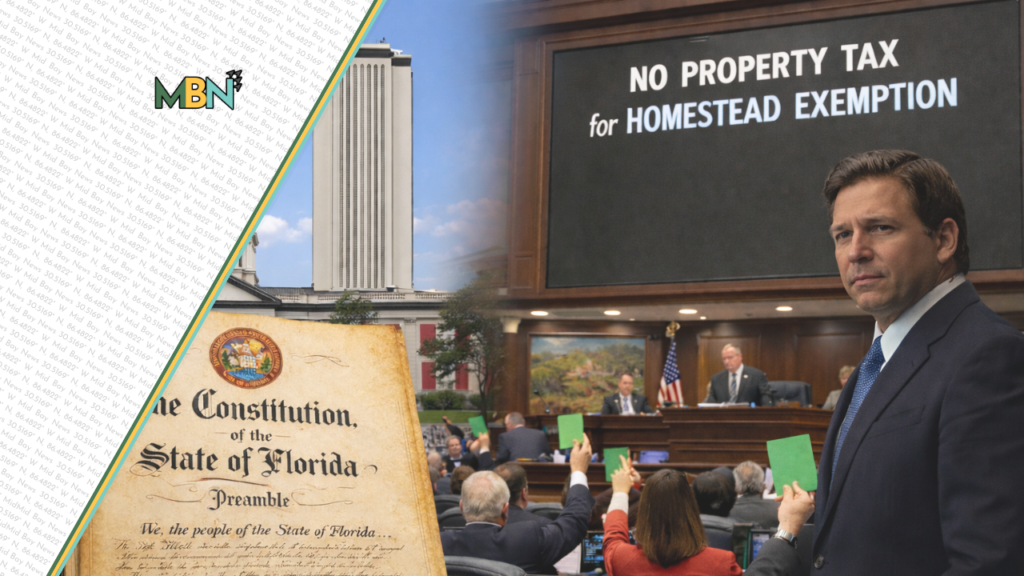
A proposed Florida constitutional amendment would eliminate most non-school property taxes on homesteaded homes.
The change could reduce local government revenue by $13 billion annually once fully implemented.
Local officials warn that the lost funding could lead to cuts in services such as libraries, parks, and community programs.
Florida voters could soon be asked to decide on a constitutional amendment that would eliminate most property taxes on homestead properties while prohibiting local governments from cutting first responder budgets below current funding levels to recoup the lost revenue.
This amendment, called CS/CS/HJR 203 (2026), passed the House overwhelmingly in February. Now, its advocates must get it through the Senate. Before the session, Governor Ron DeSantis said he wanted the legislature to put a bill to eliminate property taxes on the ballot.
But insiders with knowledge of the workings of the state capitol say this would not take place until at least June, which would require the governor to call a special session. Those same sources say the governor’s office is already working on a special session for April concerning another issue.
State Rep. Nathan Boyles, a former Okaloosa County commissioner, said the proposal has to be understood as part of a longer, messy lawmaking process.
“We have a bicameral legislature and an executive, and at the end of the day, there’s a pretty complex process, the proverbial sausage-making, that goes on to ultimately get to what’s hopefully a good product,” Boyles said. “We have to have a starting place for a discussion around property tax relief for homeowners in Florida, and I think it’s a legitimate conversation that we’re having.”
Boyles said the bill was something akin to a “first offer” in a business deal, and that he expected the Senate and the Governor’s Office to negotiate on what the final bill would look like.
If approved by voters, the proposed constitutional amendment would:
If approved, the amendment would not:
According to the Florida House fiscal analysis and estimates from the Revenue Estimating Conference (REC), if voters approve CS/CS/HJR 203:
This reflects the eventual loss of nearly all non-school property tax revenue from homesteads if the amendment were phased out entirely by 2037.
As the proposal heads toward the ballot, the central issue for voters may not simply be tax savings, but how reduced local revenues could reshape public services and quality of life across Florida communities.
Boyles, who represents what he calls a “very low tax jurisdiction” in Okaloosa County, said the pressure driving the debate is coming from places with much higher millage rates.
“Okaloosa County is what I consider to be a very low tax jurisdiction,” he said. “Our property tax millage rate, both the county proper and the cities within the county, is by and large modest, some of the lowest you’d see across the state. For example, we recently bought a residential property in Tallahassee, and the combined millage rate between the county and the city exceeds 18 mills. It’s a really significant burden for a lot of folks in a lot of jurisdictions in Florida.”
The Political Angle
While the proposed tax exemption could increase homeowners’ disposable income, it may also create budget challenges for cities and counties along the Emerald Coast that rely heavily on property tax revenue. If approved by voters, the change would also permanently amend the Florida Constitution.
Homeowners will still be responsible for paying school district taxes. Starting in 2027, cities, counties, and special districts would start on an increasing scale that would eliminate property taxes over the next ten years, no longer collecting those taxes on primary residences.
Boyles described the current version of HJR 203 as an opening salvo rather than a finished product.
“I don’t believe that this HJR is in any way perfect, and I don’t think it is something that will ultimately end up on a ballot for the citizens to vote on,” he said. “But I do think it sets the context for further discussions and negotiations.”
He also noted that lawmakers are still waiting on a more detailed roadmap from DeSantis.
“It’s important to remember the governor has yet to provide a proposal,” Boyles said. “In the absence of that proposal, which we’ve now been waiting on for a while, it’s reasonable for members of the House to put some ideas out there to begin that creative conversation and those deliberations.”
Niceville City Manager David Deitch says that the shift would have an immediate local impact.
“We lose $4.4 million worth of revenue… that’s roughly 20% of my general fund, but it’s 51% of my property tax revenue.”
“Ultimately, it disappears entirely.”
At the same time, the amendment would prohibit local governments from reducing total funding for law enforcement, firefighters, and other first responders below current budgeted levels. Deitch said that requirement would further limit where cities could make adjustments.
“I have to circle the wagons around fire and police, Deitch explained, “the amendment says I cannot reduce their budgets. They’re almost 50% of my general fund.” Ultimately, he says, he would have to cut services or impose fees for services like police and fire. Meaning taxpayers could live in a world where they pay for the police or a fire truck to show up at their homes during an emergency.
Because the proposal would permanently amend the Florida Constitution, a 60% voter approval is required for it to pass. That is a huge talking point for politicians for or against the amendment. The property tax debate has historically been an upfront issue in Florida politics. Emotional responses from homeowners looking to save more money now may swing votes in favor of the amendment and whichever politician is backing the proposal.
Are we “Robbing Peter to Pay Paul?”
If approved, the amendment would lower property tax bills for many homeowners. At the same time, it would reduce a key funding source for cities and counties, potentially placing pressure on services not protected under the measure, such as libraries, infrastructure, and community programs.
Boyles said the issue can’t be viewed solely through the lens of one county’s tax rate.
“This is a complex issue, but it’s one that you have to be able to view at a statewide level,” he said. “When I was a county commissioner, I didn’t have the responsibility to worry about the rate at which property owners in Leon County or Miami-Dade County were being taxed and how that impacted our economy. Now, as a state representative, I do have that responsibility, and that lens shifts a little bit.”
Deitch outlined what those pressures could mean in real terms.
“If I were to completely shut down the Senior Center, the library, the community center, not maintain any of the parks,” he said, “I can close that $4.4 million deficit.” The closure of those services, he warned, would reduce the quality of life for residents, young and old.
What Happens Next
Voting on this constitutional amendment is expected to occur during the 2026 general election on November 3, 2026. This is where Florida voters will get to decide whether to approve it. This decision ultimately rests with Florida voters, who need to weigh potential tax savings for homeowners against the long-term impact on how cities and counties fund public services.
Boyles said his goal is to help those in high-tax areas without gutting well-run local governments elsewhere in the state.
“For me, it’s about how do I participate in the process in a way that can help bring relief to those folks in those higher-tax jurisdictions where I think relief is warranted, while protecting the ability for good local governments like Okaloosa County government to have enough revenue to operate and provide critical services to our citizens,” he said.
For Deitch, the debate isn’t theoretical.
“Every single day I see hundreds of seniors go into the library,… enriching their quality of life. Every single day at 2:30, hundreds of kids go into the library. Boof, gone. Where do you put them?”
“If we don’t give our kids something to do, they will find something to do,” he warned, “We can either invest in our kids on the front end, or we can invest in our kids on the back end.”
“There are real-world consequences.”
Of Florida’s 411 municipalities, 267 are home to roughly half of the state’s population. These residents would see the sharpest decrease in both taxes and services from cities if this theory becomes a reality. County residents, who don’t pay city taxes, could also see a decline in services, as counties derive some revenue from property taxes as well.
We love to bring you, and all of your neighbors, the news for free – it’s a part of who we are. But just because something is free doesn’t mean it’s cheap.
Your sustaining donation of just $10 per month helps us keep the powerful accountable and make the mortgage on time. If you notice you keep coming back for more stories from us – please consider supporting our work so we can do it for the long haul (and not be homeless).
Register or login with Mid Bay News and never get another pop up on our site!