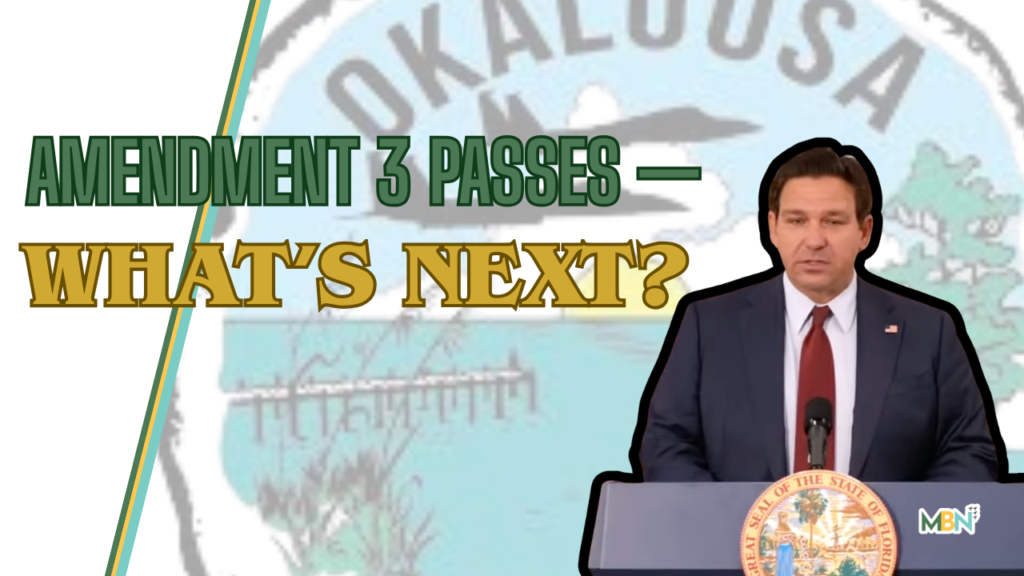

In the wake of midterm elections, Florida’s local government leaders brace for Amendment 3’s impact. A supermajority (62%) voted to pass the constitutional amendment and increase the homestead exemption annually until Jan. 1, 2028, effectively cutting property taxes for Florida homeowners who don’t own any other property if their rates stay the same.
Amendment 3 cut potential revenue for local budgets.
In Florida Panhandle communities, where the population is much lower than South Florida metropolitan areas, property tax makes up a significant portion of city governments’ annual budgets.
Crestview, Okaloosa County’s largest city, will lose around 30% of its annual revenue and 90% of its property tax revenue on Jan. 1, 2028, when the homestead exemption increases to $250 thousand. Niceville will lose around 34% of ad valorem revenue by 2028.
“On January 1 in 2028, we’re projected to lose somewhere between 2.6 and $2.7 million,” Niceville City Manager David Deitch said. “And so, for context, this year’s general fund fiscal year budget is 18- and-a-half-million … so we’re going to lose somewhere in the range of 30 to 40% of our property tax revenue, which is the biggest piece; biggest revenue source that goes into the general fund.”
County residents who voted in-favor of passing Amendment 3, like outgoing Fort Walton Beach City Councilman Payne Walker, said its implementation will force city government to “live within its means, just as the families and businesses that fund it must do every day.”
“The passage of Amendment 3 sends a powerful message to elected officials across Florida: The taxpayers have had enough of government’s seemingly endless appetite for more of their hard-earned money,” Walker said.
Deitch explained his own perspective.
“How do you define waste, right? Everybody in the room is going to define it differently,” Deitch said. “ … People spend so much time watching the 24-hour propaganda channels and in the social media world getting their information, and they are projecting the waste that they see at the federal level and assume it’s across all levels, and that just isn’t the case. The cities and counties in the State of Florida, by law and by constitution, are required to have a balanced budget, and so we are laser-focused on spending taxpayers’ dollars wisely because we have to have a balanced budget.”
Jessica Leavins, Crestview city manager, said she’s sympathetic to those who voted “Yes” on Amendment 3.
“I know what it’s like to need that extra $100 a month to balance your budget,” Leavins said. “I get it. What I say to people is, [Amendment 3] is going to lead to a lot of difficult conversations. … For over five years now, we’ve been working towards putting the cost of the service back on the user, so that property taxes can continue to be lowered. But anytime you’re talking about a 30 percent decrease in revenue, you’re going to have to expect some sort of change.”
Uncertainty from local governments
How will city governments make up for a sizable revenue loss?
Many around Okaloosa County said they aren’t sure yet.
“There’s going to be some difficult conversations, of course, about — Do different services get scaled back?” Leavins said. “Non-essential services, of course, would be the first ones that were considered. … Whether or not I can cover a loss doesn’t equate for [sic] how many more people want to move here next year. Covering the loss is one thing; making up for the loss and then some is another.”
“There’s a number of things, from annexation to, you know, charging taxes on stuff that we don’t currently charge taxes on,” Deitch said. “So, think LP gas that you use in your grill, fuel oil. We’re not taxing those things. So there’s a number of opportunities — None of those will solve the problem.”
Payne said it is up to the taxpayer to make sure city officials implement these changes fairly.
“I fully expect some local government officials to look for ways around these new protections by proposing additional fees, assessments, or other revenue schemes to replace what they can no longer collect through property taxes,” he said. “We must remain vigilant. Here in Fort Walton Beach, voters approved important taxpayer protections in our City Charter in 2024, including restrictions on special assessments. Those protections must be honored and defended.”
Niceville City Council meeting
Deitch also addressed concerns about Amendment 3 at the Niceville City Council meeting on November 10.
“Last Tuesday, Amendment 3 passed, and that Amendment 3 has added some new flavor to our lives here at the City of Niceville and across the state,” Deitch announced to the council chambers. “But I think this is an opportunity to reimagine municipal government. We’ve got some big challenges ahead of us.”
Deitch said he’s already begun planning the next fiscal year budget and brainstorming with officials across the county.
“I’ve already been in contact for the past week — actually, for the past couple months, with the county administrator and my counterparts across the other municipalities in Okaloosa County. We are getting together on Monday and got some ideas; none of them good, none of them quick, none of them easy; and all of them require the state legislature’s help.”
Niceville Fire Chief Alex Kukulus, in his update to the council, asked for direction on working with other regional fire departments to analyze Amendment 3’s impacts and explore regionalization opportunities.
“All fire districts in Okaloosa County are ad valorem based, and taking that significant hit from [Amendment 3 passing]. Conversely, over in Santa Rosa County, as an example, they’re all non-ad valorem-based fire districts. Same Chapter 191, but basically enabling legislation allows them to do more of a flat-rate fee structure. It’s either based just on a flat fee or square footage assessment, not on the value of the property. So, [for example], a $500,000 home, which is 2,300 square feet in Okaloosa County, the ad valorem model at 3.7 mills which is one of our fire district rates, that would be $1,850 a year towards the fire district versus a non-ad valorem rate based on square footage … would be $231. It’s a more level assessment across the board, of these highs and lows. I’m not suggesting these are the rates we want to adopt. This is an example, though, of how something could look, and those would be outside of what Amendment 3 would be impacting. ”
Kukulus said he will work with neighboring fire districts to gauge their interest in regional changes that could provide some relief from Amendment 3’s impacts, and return to the council with more information.
“What we are looking for … is direction to initiate a voluntary discussion with neighboring fire agencies at this point; the ones I’ve identified, Val-P, Niceville, North Bay; invite them to the table and see if they want to participate in this, have their staff help with some of the work and see where this takes us.”
The State’s role
Florida’s next legislative session begins March 7, 2027, with interim committee meetings as early as January. Deitch said he hopes to work with state lawmakers to workshop ideas that could help Niceville, and other Northwest Florida communities, recover from Amendment 3’s impacts.
“It will require the state legislature, with both of the ideas that I have, to participate and change the law,” he said. “Fortunately, there’s a legislative session coming up in January, and so we are actively working on proposals, doing the research, putting the packages together to make the pitch for the upcoming legislative session.”
Beyond a normal legislative session, outgoing Florida Governor Ron DeSantis calls for a special session before January 2027 to implement Amendment 3.
“It’ll set the schedule for further homestead expansion … but also, limiting local governments from just doing an end run around the amendment and taxing [citizens] in other ways,” DeSantis said at a press briefing following the midterm election.
Leavins said Crestview awaits the proposed special session to establish concrete plans addressing the city’s property tax revenue loss.
“I understand if you’re concerned. I need you to give me some more time. We have to go through the special session. We have to see the parameters that our legislator set before us and kind of go from there.”
DeSantis said the special session will address “a taxpayer bill of rights,” as well as some relief for local governments.
“It’s not going to be a tax shift,” he said. “It’s going to be a reduction, and then I’ll also work with the legislature to provide a pool of funding that we can issue grants to local governments for core needs.”
Regardless of new revenue sources or service cuts, Deitch said one thing is for certain:
“Okaloosa County and Florida will fundamentally change forever as a result of [Amendment 3].”