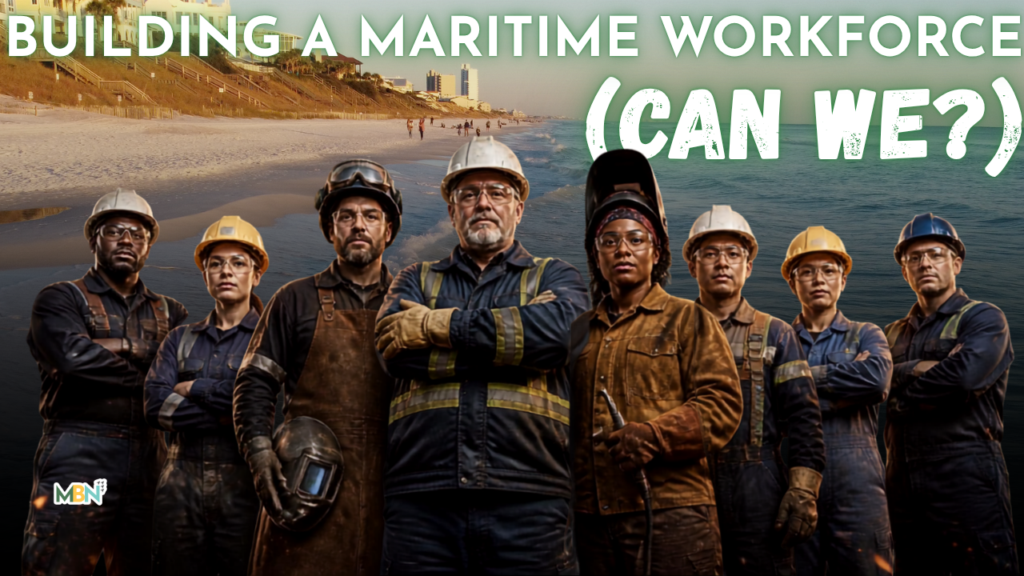

Editor’s Note: Northwest Florida State College recently received a $3 million state grant to establish a Maritime Fabrication Training Center in Niceville—in the heart of one of the nation’s most heavily aerospace- and defense-oriented regions. This is the first in a series of articles exploring a simple question: Why maritime here? The series will examine how Northwest Florida’s military heritage, workforce, colleges and universities, ports, manufacturers, and emerging technologies could position the region to contribute to America’s maritime industrial base and the need for greater surge capacity.
This is the second in a series of articles about manufacturing expansion in the maritime industry coming to the Emerald Coast.
The beginnings of a regional workforce system are already here
Manufacturing strategies often begin with buildings and equipment.
Employers usually begin somewhere else: Who will do the work?
A modern maritime industrial base needs fabricators, pipefitters, machinists, composite technicians, quality inspectors, electricians, engineers, logisticians and supervisors. Equipment can be purchased. Buildings can be constructed. Experience takes time.
Employers like MCS Manufacturing and Blue Wind Technology confront that problem in practical terms. A new machine can be ordered. But an experienced technician, machinist, quality inspector or production supervisor cannot simply be purchased from a catalog.
That is why workforce development may be Northwest Florida’s most important contribution to America’s need for greater surge capacity.
Fortunately, the region isn’t starting from zero.
Northwest Florida has the beginnings of a complementary education system stretching from Pensacola to Panama City. Pensacola State College anchors the western portion of the corridor. Northwest Florida State College occupies its geographic center. Gulf Coast State College serves the eastern side. The University of West Florida adds engineering, research and advanced technical education.
The institutions are not interchangeable—and they shouldn’t try to be.
Gulf Coast State already offers a Composite Fabrication and Testing certificate. Northwest Florida State’s new Maritime Fabrication Training Center will combine hands-on training in composites with metal fabrication and industrial pipefitting. Pensacola State has advanced-manufacturing programs and is expanding marine and diesel training. UWF adds the engineering layer and was recently designated by the U.S. Maritime Administration as a Center of Excellence for Domestic Maritime Workforce Training and Education.
Put those pieces together and something interesting begins to emerge.
A student might enter a short-term technical program, earn an industry credential, go to work for a regional manufacturer and later continue toward an engineering degree—all without leaving Northwest Florida.
But colleges cannot build this workforce by themselves.
Employers have to participate. Schools need current equipment, instructors familiar with production, internships and candid information about hiring needs. Manufacturers need graduates who understand safety, documentation, measurement, quality and the discipline of repeatable work—not simply how to perform an isolated task.
That partnership also protects students.
A training program designed around a single company or contract can become obsolete when the market changes. A worker trained broadly in composites, machining, fabrication, electronics or quality can move among aerospace, defense, maritime, energy and other advanced-manufacturing industries.
That is exactly the kind of adaptable workforce surge capacity requires.
And it leads to the next question.
If Northwest Florida trains these workers for maritime manufacturing, what exactly are we asking them to build?
The answer probably isn’t a destroyer.
More about the Author
Henry Kelley is the co-founder of MCS Manufacturing and Blue Wind Technology, a Pensacola-based company specializing in developing and manufacturing advanced composites for the wind energy sector.
He served as a field artillery officer in the First Gulf War and was awarded a Bronze Star. Kelley has been involved in Northwest Florida politics for the last two decades. He’s the Vice President of the Pensacola Propeller Club.
If you want to write an opinion piece for Mid Bay News, head to midbaynews.com/opinion.