
Editor’s Note: Northwest Florida State College recently received a $3 million state grant to establish a Maritime Fabrication Training Center in Niceville—in the heart of one of the nation’s most heavily aerospace- and defense-oriented regions. This is the first in a series of articles exploring a simple question: Why maritime here? The series will examine how Northwest Florida’s military heritage, workforce, colleges and universities, ports, manufacturers, and emerging technologies could position the region to contribute to America’s maritime industrial base and the need for greater surge capacity.
This is the second in a series of articles about manufacturing expansion in the maritime industry coming to the Emerald Coast.
Why readiness must be built before it is needed
What happens if the United States suddenly needs 1,000 small autonomous vessels instead of 100?
The number is hypothetical, but the problem is real. A country cannot wait for a crisis and then decide it needs factories, technicians, suppliers, molds, tooling, welders, engineers, testing capacity and ports.
Consider another number that is not hypothetical.
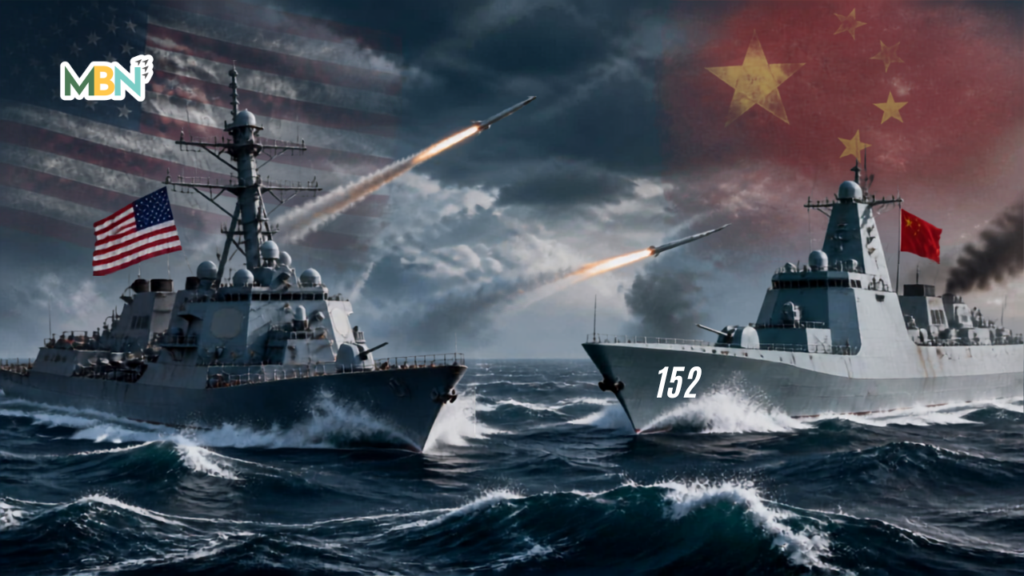
An unclassified U.S. Navy briefing estimated that China’s shipbuilding industry has roughly 232 times the shipbuilding capacity of the United States.
That does not mean China has 232 times as many warships, nor does it mean all of that industrial capacity can immediately be converted to naval production. It measures something more fundamental: the enormous difference in the industrial ecosystems available to build ships.
Shipyards are only part of that ecosystem. Behind them are steel producers, machine shops, toolmakers, component manufacturers, engineers, welders, electricians, suppliers, logistics networks and generations of accumulated manufacturing knowledge.
Those capabilities take years to build.
Surge capacity is the ability to increase qualified production when demand rises sharply. It is not simply empty factory space. A building without trained people, production tooling, approved processes, available materials, engineering data and a functioning supply chain is not production capacity.
The United States still has extraordinary manufacturers, laboratories and shipyards. Many are already operating against demanding schedules. When the same limited suppliers support multiple programs, however, one disruption can echo across the system. Specialized workers retire. Long-lead materials become bottlenecks. Tooling takes time to produce. A machine failure or delayed component can stop work far downstream.
This is the kind of problem Northeastern University’s Defense Industrial Base Institute, or DIBI, was created to address. The institute connects government, industry, higher education, research and capital around challenges involving workforce, manufacturing and supply chains.
For Northwest Florida, the important concept is distributed surge capacity.
America does not need every community to build complete weapon systems. It needs more communities capable of producing qualified pieces of the larger system. One region may fabricate structures. Another may produce electronics. Others may provide machining, coatings, testing, repair, software or final integration.
Distributed does not mean uncoordinated. Every contributor still has to meet the same drawings, specifications, schedules and quality requirements. Digital manufacturing data, standardized interfaces and trusted supplier relationships can allow production to be distributed across a network while primes and integrators retain control of configuration and performance.
For Northwest Florida, that is a far more realistic ambition than trying to recreate a major shipyard.
The question is not whether Pensacola, Niceville or Panama City should start building destroyers. It is which capabilities already exist here, which can be adapted to maritime production, and which gaps must be filled. Composite fabrication, advanced tooling, machining, metalwork, engineering, military experience and technical education all belong in that inventory.
There is one more important piece of the equation.
Surge capacity cannot sit idle waiting for a war.
Factories need customers. Workers need jobs. Equipment needs to operate. Suppliers need orders. Skills have to be practiced and businesses have to remain profitable. That makes the strongest model dual-use: commercial and government work sustaining industrial capability in normal times, with the ability to expand when national demand requires it.
More about the Author
Henry Kelley is the co-founder of MCS Manufacturing and Blue Wind Technology, a Pensacola-based company specializing in developing and manufacturing advanced composites for the wind energy sector.
He served as a field artillery officer in the First Gulf War and was awarded a Bronze Star. Kelley has been involved in Northwest Florida politics for the last two decades. He’s the Vice President of the Pensacola Propeller Club.
If you want to write an opinion piece for Mid Bay News, head to midbaynews.com/opinion.