
Editor’s Note: Northwest Florida State College recently received a $3 million state grant to establish a Maritime Fabrication Training Center in Niceville—in the heart of one of the nation’s most heavily aerospace- and defense-oriented regions. This is the first in a series of articles exploring a simple question: Why maritime here? The series will examine how Northwest Florida’s military heritage, workforce, colleges and university, ports, manufacturers and emerging technologies could position the region to contribute to America’s maritime industrial base and the need for greater surge capacity.
This is the first in a series of articles about manufacturing expansion in the maritime industry coming to the Emerald Coast.
From an autonomous rescue at sea to a new training center in Niceville
Both soldiers survived.
What came next may tell us something important about the future of warfare—and, perhaps surprisingly, about industrial capacity in Northwest Florida.
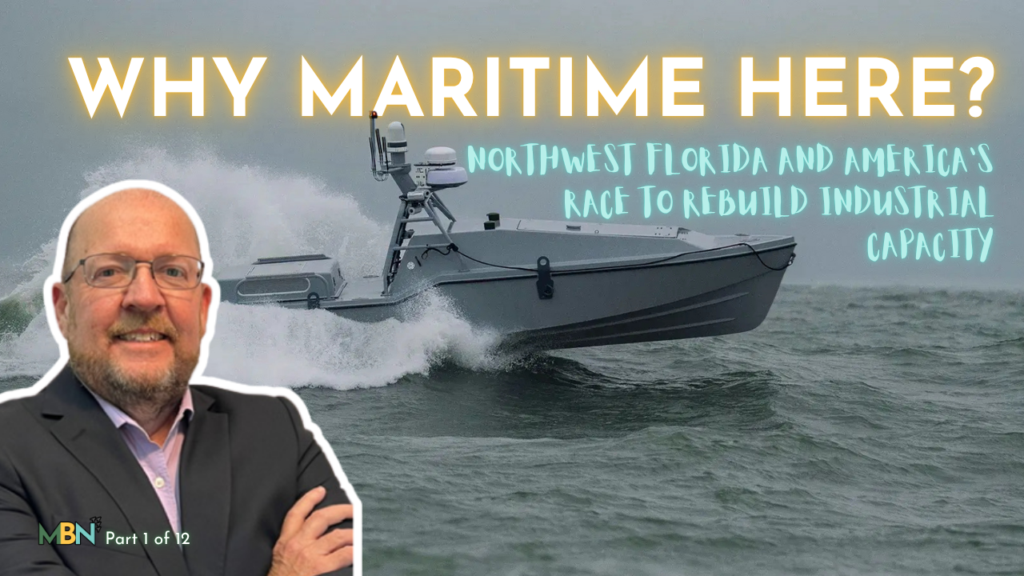
The first vessel to reach the soldiers wasn’t a destroyer or another traditional Navy ship. It was a 24-foot, composite-hulled unmanned boat.
Operating with the U.S. Navy’s 5th Fleet, the small autonomous vessel reached the downed Apache crew, brought the soldiers aboard and transported them across the water to another location, where they were hoisted into a helicopter and evacuated.
Think about what happened. An Army attack helicopter was lost during combat operations. A small, autonomous maritime vessel helped recover its crew.
Aerospace. Maritime. Composites. Autonomous systems.
All came together in a single combat operation. For those of us living in Northwest Florida, that story is worth considering.
Few regions of the country are more closely identified with military aviation. From Naval Air Station Pensacola and Whiting Field in the west, through Hurlburt Field, Duke Field and Eglin Air Force Base, to Tyndall Air Force Base in the east, military aviation has shaped our communities, our workforce and much of our economy.
We are, unmistakably, Air Force and aerospace country.
So a recent announcement in Niceville raises an obvious question: Why is a state college sitting in the middle of Air Force country building a Maritime Fabrication Training Center—including a program specifically dedicated to composites?
The answer begins with how modern defense systems are built. America will continue to need large shipyards and traditional vessels, but it will also need smaller autonomous craft, sensors, communications equipment, composite structures, electronic systems, tooling, repair capabilities and thousands of components supplied through a much broader industrial network.
Maritime manufacturing does not always happen beside the water, and it does not always end with a complete ship. A modern vessel is a system of systems. Its structures, panels, housings, piping, electronics, sensor mounts and other components may be manufactured by specialized suppliers many miles from final assembly.
That creates a potential role for regions that already understand advanced manufacturing and national defense. Northwest Florida has technicians, engineers, manufacturers, veterans, researchers and colleges accustomed to exacting work. It also has bays, Gulf access, ports, highways and proximity to major military and shipbuilding activity.
None of this means Niceville is preparing to build destroyers. The more realistic question is whether Northwest Florida can help manufacture, test, maintain and improve selected parts of the larger maritime system—and whether it can prepare enough qualified people to do that work reliably.
The important phrase is surge capacity: the people, facilities, suppliers and knowledge America needs before demand suddenly increases. Factories cannot be improvised after a crisis begins. Neither can experienced technicians, qualified processes or trusted supply chains.
Over the coming articles, we will examine composites, workforce development, small manufacturers, testing, transportation, ports, funding and regional cooperation. We will ask what Northwest Florida already possesses, what remains missing and what role the region could realistically play.
Can the people, skills, institutions and industries that helped Northwest Florida support American airpower also help create the surge capacity America increasingly needs on the water?
To understand why the answer may be yes, we first need to understand one of the technologies connecting these industries.
And for that, we need another article and we need to go back a few thousand years—to mud and straw.
About the Author
Henry Kelley is the co-founder of MCS Manufacturing and Blue Wind Technology, a Pensacola-based company specializing in developing and manufacturing advanced composites for the wind energy sector.
He served as a field artillery officer in the First Gulf War, and was awarded a Bronze Star. Kelley has been involved in Northwest Florida politics for the last two decades. He’s the Vice President of the Pensacola Propellor Club.
If you want to write an opinion piece for Mid Bay News, head to midbaynews.com/opinion.