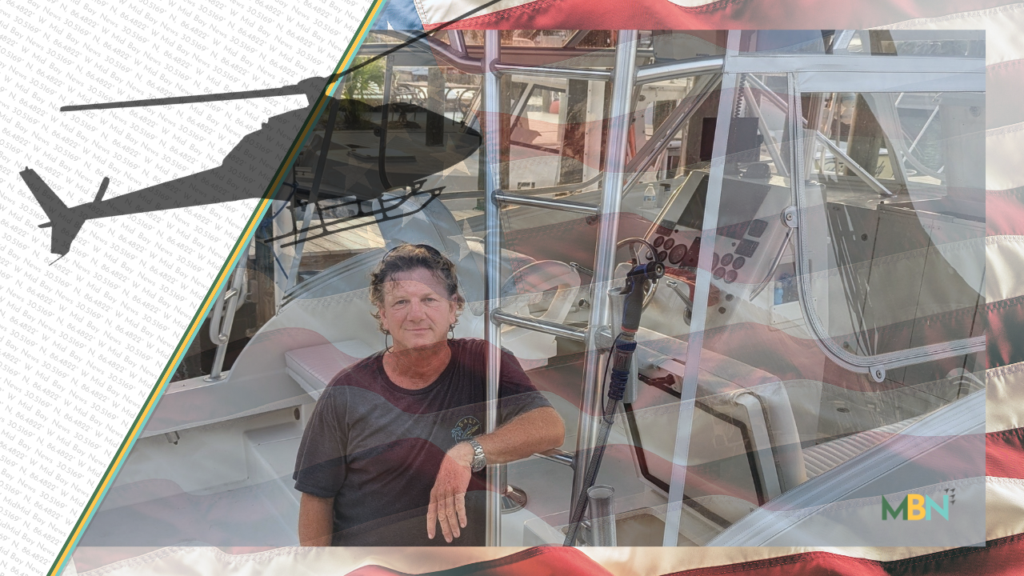

35 years in uniform taught Alan Osborne that an oath isn’t just something you can retire from.
The former Army and Air Force Special Operations Officer spent decades flying combat missions around the world. Today, instead of carrying mission briefings into a cockpit, he carries binders of public records into county commission meetings.
And while his venue may have changed, his mission, he says, hasn’t.
Osborne has become a prominent, and often polarizing, voice in Walton and Okaloosa counties. His public records requests, engineering reviews, lengthy emails, YouTube commentary, and frequent appearances before elected boards have made him one of the Emerald Coast’s most active citizen advocates, drawing attention to issues ranging from land use and stormwater management to government transparency and ethics.
To supporters, he is a diligent watchdog willing to do the work most citizens don’t have time to do. To critics, his approach can be confrontational and his conclusions disputed.
Osborne sees it differently. For him, the work is an extension of the oath he took decades ago.
The Soldier
Before he became a familiar face at county meetings and a loud voice on YouTube, Alan Osborne was a farm kid from North Carolina, raised in a world where consequences came fast and usually with a belt.
He describes his childhood as one where you didn’t argue with adults, and you certainly didn’t outrun accountability. Alan says, “There was no such thing as talking back to my parents unless I wanted a belt from my grandfather.”
That strict sense of responsibility followed him into the Army, where he enlisted at a young age and began a 35-year and 11-day career in the Department of Defense.
“I served 35 years in the Department of Defense… about 10 of it in the Army. I held a commission in the Army. I’ve also been a warrant officer in the Army. I went in the Army as an enlisted guy.”
From there, he was given a direct commission to Air Force Special Operations Command, where he spent roughly 2 more decades.
Those years were not spent behind a desk. Osborne says his military assignments spanned the globe.
“I spent five years in combat,” he says. “I was in Desert Storm, Desert Shield, Provide Comfort, Northern Watch, Allied Force, Invasion of Panama, Evacuation of Haiti. I hunted terrorists in the Philippines… I flew four tours as a gunship pilot in Afghanistan.”
The toll, he says, was personal.
“I spent eight Christmases away from my kids, and I buried six of my own crew members.”
His war stories are not limited to the post 9/11 era. In the 1980’s, Osborne flew Cobra attack helicopters along the Berlin Wall, part of the Cold War machinery that watched the line between East and West.
As his career advanced, the missions became more sensitive. “I’ve had a presidential security clearance,” he said. “So everybody that says I’m crazy, do you think the United States government would let me fly over the president in a gunship with a cannon pointed at his convoy?”
For Osborne, the stories aren’t simply war stories. They explain how he came to view responsibility, authority, and service.
He repeats throughout his conversations that he never swore loyalty to a particular politician or superior. He swore an oath to the Constitution.
“I served the Constitution for 35 years, and I never took an oath to any man or any woman,” he says. “I took an oath to the belief that Americans should be treated free… that Americans who fall under the Constitution should be treated fairly, and they should be governed by people who can not act like kings or dictators.”
In one story, he remembers a superior telling him, “You work for me.” Osborne said he pushed back.
“I looked around him. I said, ‘Brad, I work for the Constitution. You just happen to be my boss at present… I’ve never sworn allegiance to you or anybody in D.C. I swore an allegiance to a belief.”
That distinction, between allegiance to a person and allegiance to an idea, has become central to the way Osborne describes his life after the military.
The uniform came off. The oath, he says, stayed with him.
The Watchdog
When Alan Osborne left the military, he didn’t retire so much as redirect his crosshairs.
The battlefields changed from Berlin, Panama, and Afghanistan to county commission chambers and harbor board meetings, but the language he uses to describe his work hasn’t softened much.
“I’ve done 40 years,” he says. “I’ve gone to 600 public meetings that nobody paid me to go to. And as a citizen of America, I think I’ve participated way more than most people who whine about what I say.”
And there are people, the people he calls whiners, who disagree with what he has to say. Vehemently.
Alan ran for office in 2024. He lost the Walton County Sheriff’s contest to incumbent Michael Adkinson, earning about nine percent of total votes as a write-in candidate. He says he’d do it again, but if you listen closely, it sounds less like ambition and more like exhaustion.
The Media Personality
“Really, I’m tired of doing this,” Osborne admits. “I’m almost 60 years old, and I’ve tried to give public service since I was 17. But it’s my time to relax a little bit… I want somebody else to do it. I don’t know how to half be in the fight.”
That last phrase may best describe Osborne’s approach to civic life.
He says he started his YouTube channel years ago “to share the truth.” The platform now serves as another avenue through which he discusses local government, public records and issues he believes deserve greater public attention.
YouTube identifies him as a “news personality,” a description Osborne embraces.
“Because I am a news reporter. Right. That’s what YouTube calls me—a news personality,” he said.
His work has made him a recognizable presence in Walton and Okaloosa counties. He regularly attends public meetings, submits records requests, reviews government documents and speaks directly to elected officials, as he did in Destin in July.
Fighting Opponents and Compiling Data
Some of the issues he has pursued have been contentious.
Among them are disputes involving development and stormwater management in Walton County, where Osborne has questioned whether local decisions have complied with development orders, regulatory requirements and other legal obligations. In emails and public comments, he has cited engineering findings, state agency correspondence, depositions, and other records to support his concerns.
County officials and staff have disputed Osborne’s interpretations of some of those matters.
Osborne’s approach is rarely quiet.
He believes citizens have an obligation to attend meetings, ask questions, and demand answers from the people they elect.
“If people don’t hold their local representatives responsible, then those people will inbreed and become our state representatives, and then they will inbreed at that level and go to Washington, and believe that everything that they did was right, and they’ll do something worse,” he said.
He also has strong opinions about the intersection of politics and law enforcement.
“I don’t think any sheriff ought to be endorsing any candidate,” Osborne said. “What if he has to investigate?”
His style can be blunt. He uses profanity, colorful metaphors and direct accusations, a combination that has made him both difficult to ignore and, at times, difficult to agree with.
Osborne knows that.
But he believes fear is one of the most powerful forces keeping citizens from challenging their government.
“The greatest weapon I’ve ever seen wielded upon a human being anywhere in the world is fear,” he said. “They’ve made the public fearful of standing up and telling the truth because they’ll weaponize [the system] against you.”
For Osborne, refusing to be intimidated is part of the job.
The Cost
For all his hype, Alan Osborne talks about his life’s work in the language of limits.
There is always a number, and he is always edging up against it. Those numbers are not abstract for him. They are the reason he insists that he has already done more than his fair share.
The cost now isn’t just emotional; it’s financial and personal, tied up in the patch of waterfront he owns and the taxes he pays for it.
Osborne points to a boat slip not far from where he’s sitting, water he owns outright, with no mortgage.
“You know how much my tax is on that boat slip right there?” he asks. “I give that county $12,000 a year for this.”
He compares it to his holdings back home.
“I have 600 acres in North Carolina, and my taxes on that boat slip are more than that.”
To Osborne, those tax figures are symptomatic of a deeper fracture. He views it as a fundamental breakdown in fairness: the expectation that everyday residents must adhere to strict regulatory mandates. In contrast, the people in power, in his view, frequently bypass the very benchmarks they were elected to uphold.
“I own this place. I don’t owe a cent on it,” he says. “And I’m tired of renting my property from the government to have them… not even follow their own rules that I waited years to be adopted.”
There is another cost, one Osborne describes more reluctantly.
Time.
When asked what has been hardest to lose in the fight, he doesn’t mention money or political battles.
“Time with the people that I love that should not have been spent fighting for people to follow the rules,” he said.
That answer sits uneasily alongside his insistence that he’s ready to step away.
Because he hasn’t.
Not yet.
The Second Mission
Osborne says he has never regretted getting involved.
“No, never,” he said. “All we have to do to have America fail is for good people to stand by and do nothing.”
That belief is at the center of his civic philosophy.
He worries that the country is moving away from the principles he spent his military career defending.
“I fear America is in trouble,” he said when asked what keeps him awake at night. “Christianity and freedom are in trouble, and most people have no idea.”
His beliefs about government are rooted, he says, in the Constitution rather than in a political party.
“It rides based on the Constitution,” Osborne said. “Without the Constitution, Americans have lost the rallying point. That belief must always be greater than greed and political party.”
Whether every resident agrees with Osborne’s conclusions is another question.
His influence is easier to see.
He has become a fixture at local government meetings. Citizens bring him concerns. He digs through public records. He publishes his arguments online. Elected officials know his name. And issues he raises often become part of the public conversation.
His role has also extended beyond Walton County, into neighboring Okaloosa County, where he has become involved in disputes over development, waterfront property, government decisions and public accountability.
Despite his insistence that he’s ready for someone else to take up the work, Osborne says that if the issues were resolved tomorrow, he wouldn’t simply walk away.
He’d tell others to keep watching.
“Appreciate the result and encourage others to be vigilant and remember, the government answers to the people,” he said.
For someone who has spent much of his life in service, that may be the closest thing to retirement he can imagine.
The military mission ended.
The civic one didn’t.
And if his grandchildren someday ask what he did after leaving the military, Osborne already knows what he wants them to remember.
“That Pops tried to always be a good and faithful American,” he said.
Then came the qualification.
“Not perfect, because the perfect are nailed on crosses.”