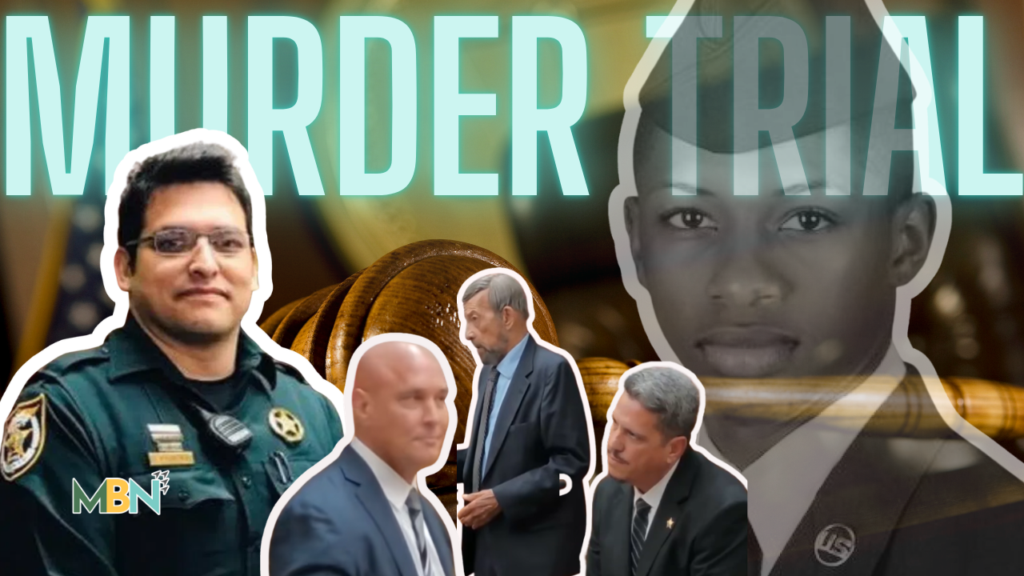

Former Okaloosa County Sheriff’s Deputy Eddie Duran took the stand Tuesday in his own defense, offering an emotional account of the May 2024 shooting that killed Hurlburt Field airman Roger Fortson as his attorneys sought to convince the court that the murder case against him should be dismissed.
The second day of the hearing focused heavily on what Duran knew, saw and believed in the seconds surrounding the shooting, as well as whether his decision to use deadly force was consistent with law enforcement training and the law.
Duran’s defense team, led by Gainesville trial attorney Rod Smith and local attorney and former judge Michael Flowers, called two use-of-force experts who testified on behalf of the defense in Duran’s account of the encounter.
The State, represented by First Judicial Circuit Assistant State Attorney Mark Alderman, repeatedly challenged portions of the defense’s evidence and arguments. The judge reserved rulings on several objections, noting that there is no jury in the proceeding.
The hearing recessed Tuesday without a ruling on Duran’s motion to dismiss.
Duran Takes the Stand
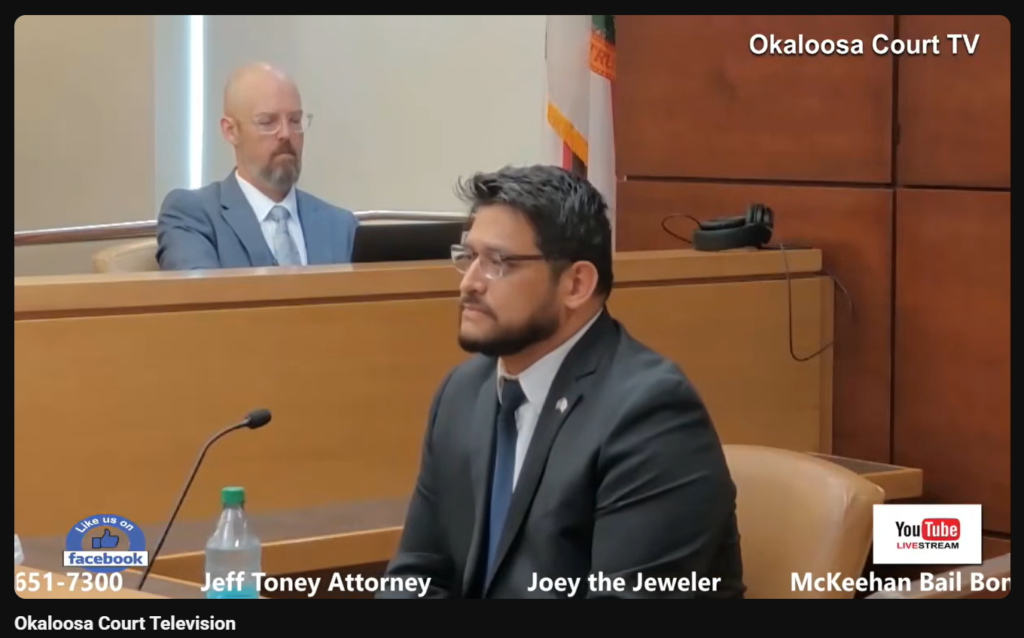
Duran described his law enforcement background before walking the court through his assignment on May 3, 2024, when he responded to the Chez Élan Apartments in Fort Walton Beach.
Duran had served as a military police officer in the U.S. Army before working as a police officer in Oklahoma and eventually joining the Okaloosa County Sheriff’s Office. He testified that he had responded to more than 50 domestic violence or disturbance calls during his career.
On May 3, Duran was assigned to Zone 17 in the sheriff’s office’s Central District. He said he was sent to the apartment complex because the deputy assigned to the zone was already handling another call.
Duran explained that officers are trained to avoid standing directly in front of a door when approaching a residence because someone inside could fire through it.
He initially positioned himself on one side of the door, but moved after considering the four-foot railing, wall and lack of cover behind him.
Duran testified that when he listened at the door, he initially heard nothing.
That silence, he said, concerned him because he had been told there was an ongoing disturbance.
Based on what he said was his training and prior experience, Duran said he considered the possibility that someone inside the apartment could be in danger or unable to come to the door.
He testified that he had previously encountered situations in which a victim was prevented from answering a door.
When the door opened, Duran said he was positioned along the door frame and immediately saw Fortson.
Duran explained that officers are trained to initially scan a person’s eyes, waistband and hands.
He said he observed frustration and aggression in Fortson’s expression, but later clarified that those observations were not the legal justification for his decision to fire.
Instead, Duran testified that the firearm in Fortson’s hand, Fortson’s movement toward him and Fortson’s failure to comply with commands were central to his perception of an immediate threat.
Duran described Fortson’s firearm as being held in an upward-canted position, approximately 45 degrees.
During questioning, Duran was also asked about referring to Fortson as an “assailant” in an affidavit.
Duran said he used the term generally, but ultimately testified that he considered Fortson to have attacked him because Fortson moved toward him with a firearm after Duran gave him a command to step back.
Lewis Kliem: “Not Even a Close Case”
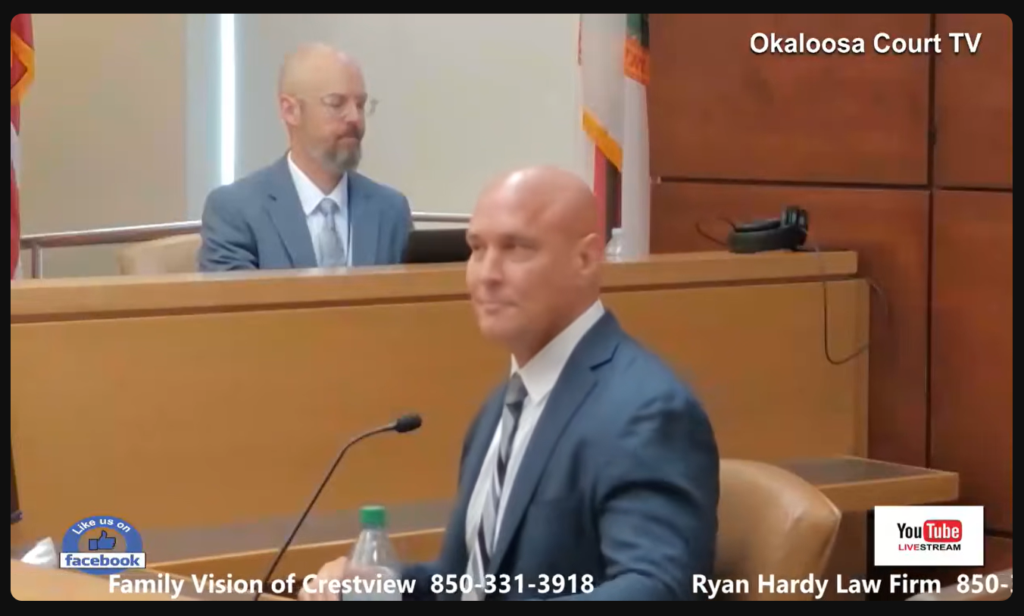
The defense called use-of-force expert Lewis Kliem, who told the court that he believed Duran’s use of deadly force was reasonable under the circumstances.
Kliem said he was retained by the sheriff’s office to analyze the incident and reported his opinions to the sheriff and command staff.
Based on the information available to Duran at the time, including the reported disturbance, the belief that officers had been identified and Fortson opening the door with a firearm in his hand — Kliem said a reasonable officer could have concluded Fortson posed an imminent threat of death or serious bodily injury.
Kliem said he did not consider that conclusion a close question.
“Not even a close case from a legal standpoint,” Kliem said when describing his assessment of the shooting.
A major portion of Kliem’s testimony focused on the difference between the constitutional standard governing reasonable use of deadly force and an Okaloosa County Sheriff’s Office policy that required an “overt act” described as a hostile or attacking movement in addition to an imminent threat.
Kliem testified that the policy was more restrictive than the constitutional standard.
He said an agency can impose a policy that is more restrictive than the law without automatically making force unreasonable under the law if an officer violates that policy.
Kliem used a hypothetical policy requiring deputies to shoot only people wearing red shoes to illustrate his point. He also warned that requiring officers to wait for a specific overt act before responding to an armed threat could have dangerous consequences. The defense’s expert then testified the final movement required to fire a gun can happen in fractions of a second, potentially between one-tenth and one-quarter of a second. Kliem said that, if the policy were interpreted to require officers to wait for that movement, officers could effectively be required to “get shot first.”
He also rejected the idea that there was a meaningful distinction between Fortson already holding a firearm when he opened the door and hypothetical scenarios in which an armed person retrieved a gun after seeing officers.
Kliem said the surrounding circumstances, rather than simply the location where the gun was obtained, determine whether an officer can reasonably perceive an imminent threat.
He acknowledged that a person can legally possess and carry a firearm inside his home, but argued that otherwise lawful conduct can take on a different legal meaning depending on the surrounding circumstances.
Kliem also testified that running away or turning an officer’s back toward an armed person is not necessarily a safer alternative.
He said Duran’s response was consistent with the training he reviewed and that the sheriff’s office training reflected an imminent-threat analysis without the additional overt-act requirement.
Detective Hernandez and the Body Camera Audio
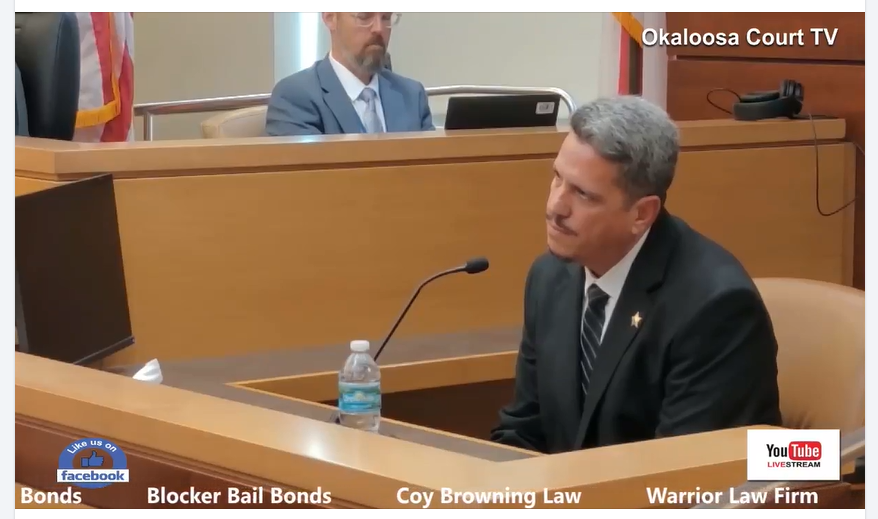
The court also heard testimony from Detective Peter Hernandez of the Orange County Sheriff’s Office, who is assigned full-time to the Florida Department of Law Enforcement’s Electronic Surveillance Support Team.
Hernandez testified that he oversees the statewide audio-video enhancement lab and has more than 18 years of law enforcement experience.
He said he has completed more than 400 audio and video enhancements, many of which have been used in Florida criminal courts.
For the Duran case, Hernandez was provided body-worn camera footage and asked to enhance a specific portion of its audio.
Hernandez said he used specialized software to isolate the relevant section and reduce ambient noise, including sounds such as wind and birds.
He testified that the enhancement did not change the substance of the recording, though some portions remained inaudible.
Hernandez said he heard what he believed were words including “off police” in the recording.
The State objected to Hernandez offering an interpretation of what the audio contained.
Under questioning, Hernandez acknowledged that the software can reduce some sounds and emphasize others and that his interpretation of what he heard could be subject to interpretation.
That issue became part of a larger debate over how enhanced audio should be presented and whether telling a listener what words to listen for could influence what they believe they hear.
Massad Ayoob: The Speed of an Armed Encounter
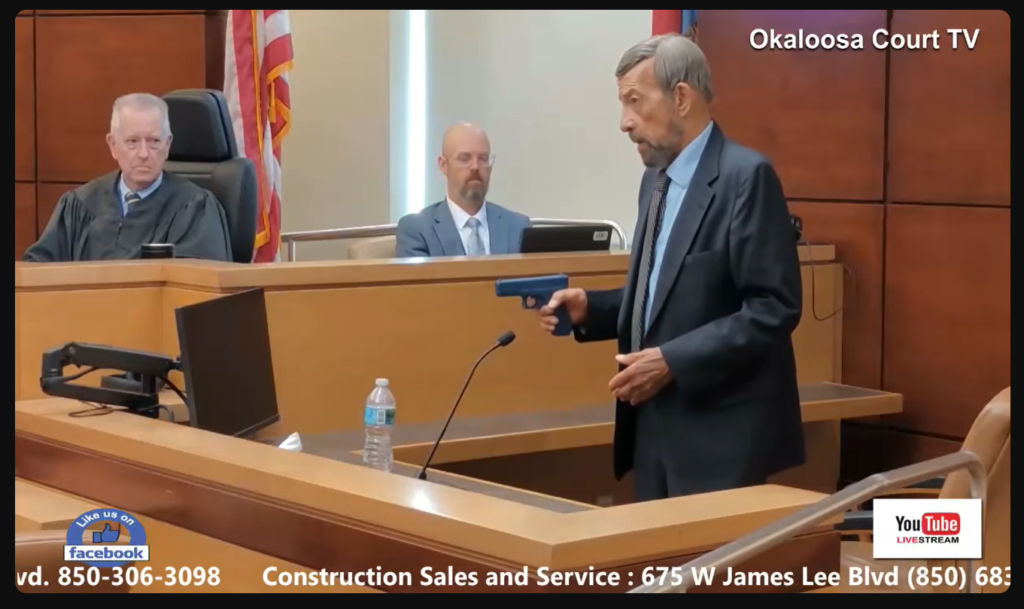
The defense also called Massad Ayoob, an expert in the dynamics of violent encounters, use-of-force policies and officer-involved shootings. Ayoob testified that he has spent decades in law enforcement and use-of-force instruction and has served as an expert witness in criminal and civil cases involving self-defense and officer-involved shootings.
He told the court that he reviewed discovery, personnel and training records, autopsy materials, depositions and officer statements in the case. He also visited the scene and met with Duran.
Ayoob said his analysis focused on the totality of the circumstances and how the events compared with known action-reaction dynamics and law enforcement training.
Ayoob described the shooting as a classic domestic disturbance call and said such calls are among the most dangerous encounters for law enforcement.
Much of his testimony focused on the “low ready” position, a firearm already drawn, with the muzzle pointed downward and the officer maintaining a firing grip.
Ayoob explained that a person holding a gun in that position can raise and fire it much faster than an officer can necessarily react to the movement.
He testified that raising a handgun from low ready and firing at close range can take roughly a quarter of a second.
To demonstrate his point, Ayoob produced a video using a Glock 47 and a shot timer to measure the movement.
He told the court that popular culture can create the impression that shootings unfold in slow motion when, in reality, an armed encounter at close range can unfold almost instantaneously.
Ayoob also addressed an alternative proposed by critics of Duran’s actions: that Duran could have drawn his own firearm and ordered Fortson to drop his weapon.
He characterized that scenario as a “Mexican standoff,” in which both people would be armed, and the first person to fire could have the advantage.
The defense presented a second demonstration involving Ayoob and a retired state trooper using simulated ammunition and protective equipment to recreate close-range confrontations similar to the body-camera footage.
The State objected to the demonstrations, arguing that they could create an impression of what might have happened rather than accurately depicting what actually occurred.
The defense argued that the demonstrations were necessary to illustrate the speed and danger of the encounter.
Objections and Reserved Rulings
The prosecution raised multiple objections throughout the defense’s presentation.
In several instances, the judge reserved ruling on the objections, noting the difference between the current proceeding and a jury trial.
The distinction is significant because the dismissal hearing is being decided by the judge rather than a jury. The court can hear the evidence and later determine what weight it should receive as it considers whether the State has established the legal basis necessary for the murder case to proceed.
For now, the court has not ruled on Duran’s motion to dismiss.
What Comes Next
The hearing recessed Tuesday with the central question still unresolved: whether the circumstances Duran encountered at Fortson’s apartment legally justified his use of deadly force or require the murder charge to proceed to trial.
The defense’s experts argued that the shooting was consistent with law enforcement training, the constitutional standard governing use of deadly force and the realities of an armed encounter at close range.
The State has continued to challenge the defense’s interpretation of those events and the evidence being offered to support Duran’s motion.
The hearing is expected to continue Wednesday.
We’ll stay on this.