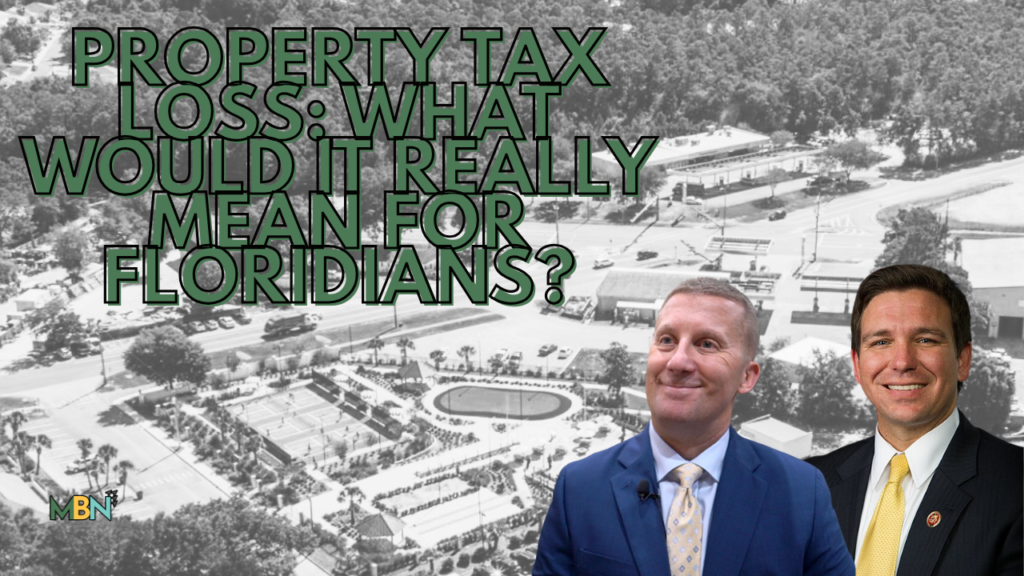

On Nov. 3, Floridians will head to the polls and vote on a proposal that would drastically reduce property taxes for homeowners. This “Joint Resolution” would increase the Florida homestead exemption — the portion of a home’s value that isn’t taxed — to $250,000 over two years.
Florida Governor Ron DeSantis spearheaded the “Save Our Homes” proposal. According to a press release from the Office of the Governor, he claims the resolution would make living in Florida more affordable, protect small businesses and ensure fairness for homeowners.
However, David Deitch, Niceville City Manager, said the proposal would “destroy the state of Florida.”
DeSantis’ proposal would require local governments to “use remaining property taxes solely for core public needs” — But what happens when this money runs out, and what does the amendment actually mean for Floridians?
“The projection from the tax collector’s office is we would lose just over $1.5 million [annually] on January 1, 2027 when the homestead exemption increases from $50,000 to $150,000, and then on January 1, 2028, when it goes up to $250,000, we lose over $2.5 million. And then as it increases, obviously that number just goes up and up and up, and so the 2028 number represents somewhere between 30 and 35% of our property tax revenue [lost].”
Deitch said residents will feel the effects of losing this tax revenue in their day-to-day lives.
“[The City of Niceville] has ‘must-pays,’ in the sense that if we don’t pay those things then the city will stop functioning, so I won’t have enough revenue for those,” Deitch said. “I’ll barely have enough revenue for those must-pays, so the other items, the quality of life things which, to me, are vital to this community … I won’t have enough money to cover that stuff, even property tax aside. Those would be the first things that people would see go. It’s all the ‘quality of life’ stuff that is going to disappear first.”
DeSantis’ proposal would require “local governments to use remaining property taxes solely for core public needs including public safety, education and schools, infrastructure, and natural resources.”
Deitch said this is misleading.
“If you eliminate the property taxes, I can’t ensure funding for core services, and if core services are defined as it is here, for ‘public safety, education and schools, infrastructure, and natural resources,’ that’s all it’s limited to. That’s how the governor is defining core services. Nowhere in there does it say parks and libraries and senior centers and community centers, and anything like that, so I am limited to what it says.”
How could a property tax cut affect residents & City services?
Fire department & life-saving services
Deitch said a loss of property tax revenue would expedite a merger between the Niceville, Valparaiso, East Niceville and North Bay fire districts.
“We have four distinct fire departments five miles apart, one of which is inside city limits,” he said. “That just doesn’t make any walking-around sense. What you’re going to see is those independent fire districts are going to take a massive, massive financial hit if this passes, and so there might be no alternative but to consolidate.”
Deitch said the four fire districts could become one independent fire department, meaning “the Val-p Fire Department and the Niceville Fire Department would not fall under the City [jurisdiction] anymore.”
“In that scenario, the City would not have to pay for a fire department anymore, which would help with our revenue problem, but if that happens there are many, many hoops we’d have to jump through in order to get to that point.”
At the Niceville City Council meeting on June 9, the council discussed a resolution that would enter Niceville into an agreement with Okaloosa County to offer Advanced Life Support programs and training to local firefighters.
Deitch said if the property tax cut passes, he will fight to ensure life-saving services are “the last thing to go.”
“I don’t know how we can put a price tag on somebody’s life. A government’s primary responsibility is public safety, and that doesn’t just mean law enforcement. It means medical, it means safe roads, it means clean air and clean environment; It means a number of things that fall under public safety.”
Staffing cuts
A revenue loss of this scale would cause hundreds of Floridians to lose their jobs, Deitch said.
“Just here in Okaloosa County, we’re going to lose hundreds of jobs, and then multiply that by 67 counties. In some scenarios we have individuals who, you know, have both husband and wife that could potentially both lose their job, and so you have two people that, let’s say, make $50,000 a year each; They’re gonna save $1,000 in property tax but lose $100,000 worth of income.”
Deitch said this spike in unemployment may cause people to leave Florida altogether.
“It’s not like a fireman, a policeman, a public works member can go to the county and get a job, or go to Walton County and get a job, or go to South Florida and get a job,” he said. “All the counties and cities in the state are going to have this exact same problem.”
Parks & recreation
Deitch said local parks and outdoor spaces that have staff attending to the grounds would lose their employees.
“Turkey Creek and the children’s park [would be] no longer manned. They would stay open but they’re no longer manned or maintained, and so eventually they will deteriorate to the point that we wouldn’t be able to safely allow people to use those facilities.”
Deitch said this could also impact local sports and children’s activities.
“Twin Oaks Mullet Festival site, where all of our sports fields are at, that property may have to go back to the Air Force, so there would be no ball fields for our kids to play at,” he said. “That would include the dog park, that’s also out there, and the disc golf is out there — all that would go away.”
Deitch predicts the closure of parks and sports facilities could cause a domino effect leading to increased crime.
“If kids don’t have parks and ball fields to play at, they’re going to find something to do with their time, and usually I mean getting in trouble,” he said. “Whether it’s drugs or alcohol or teenage pregnancy or whatever, they are going to find something to do with their time.”
Senior citizens
Deitch said the Niceville Senior Center would suffer if it lost property tax revenue. A possible outcome would cause the center to open only three days a week, instead of its current six.
Currently, membership to the Senior Center is completely free for Niceville residents. This would change under the property tax cut.
“We’re looking at membership fees for the Senior Center and making that completely financially independent, but only if people pay for membership fees, right?” Deitch said. “The Senior Center, this coming fiscal year, is projected to cost about $470 thousand. I could probably raise enough money to maintain it using membership fees.”
Losing common spaces around Niceville would be disastrous for senior citizens, Deitch said, who make up almost 20% of Niceville’s population.
“The biggest crisis for seniors, and it’s an epidemic, is loneliness. … If you take away a library, you take away a senior center, you take away a community center, you take away Turkey Creek, they no longer have spaces to come together with their tribe and fellowship and enjoy life together, right? And so then they sit at home all day, and then their quality of life deteriorates; Their mental and physical abilities rapidly deteriorate.”
Niceville Public Library
Another service Deitch predicts would suffer under a property tax revenue decline is the public library.
“I sit here in this office every day, and during the school year I see hundreds of kids pour across the street right here from [C.W. Ruckel Middle School and Niceville High School] and go into the library,” Deitch said. “Some of them, they’re just hanging out waiting on mom and dad to pick them up, but a lot of them, they’re going in there because there’s tutors in there, there’s computers, and some of these kids don’t have a computer or internet access, so they need to be able to get their homework done.”
Though DeSantis’ proposal doesn’t qualify libraries as a core public need, Deitch argued they are vital to any community.
“They might not be necessary for you because you don’t use them, but they are for somebody,” he said. “That unemployed single mom who’s looking for a job, it’s necessary for her. For those kids who need tutoring, it’s necessary for them. For those seniors who don’t have a community, the library and the senior center is where they go and they get fellowship … that is vital to this community.”
Role of local government
Deitch said DeSantis’ proposal would take power away from city and county lawmakers, because “whoever has the gold makes the rules.”
“Cities and counties will have to go to Tallahassee, hat in hand, and say, ‘Hey, I need money for cops,’ or ‘I need money for the fire department,’ or ‘I need money for roads.’ We are going to have to go and beg and plead for money, because we can’t afford to maintain our level of services.”
Deitch said this could also give local governments less flexibility to handle issues.
“I have residents that come sit at this table all the time complaining about one thing or another,” he said. “They can still do that, but then all I’m going to be able to say is, ‘Hey, I’m sorry, I can’t help. You need to talk to your representative. You need to talk to your senator.’”
How could the City make up lost revenue?
Deitch said he’s considered several ways to increase revenue for the City, should the Joint Resolution pass.
“We can impose special assessments like fire fees and police fees and road fees. … The county could go in and — Instead of having a half-cent sales tax, do a 1.5%, which is the cap under Florida law, but that wouldn’t cover the gap that’s going to be created by the loss of property tax.”
Who would benefit from a property tax cut?
According to a report on the Florida Senate’s Special Session F regarding property taxes, tax exemptions phased in by the Joint Resolution “are limited to any person who has Florida residency prior to January 1, 2027.”
Anyone who established Florida residency after Jan. 1, 2027 is required to “maintain Florida residency for up to five years” before they’re eligible for the full increased homestead exemption, according to the report.
“Renters, they’re going to continue to pay property tax, right?” Deitch said. “Businesses, if you own land, if you own anything, the financial pain for all those folks are going to go up, right? There’s going to be an economic impact on businesses, but there’s also going to be a negative economic impact on those who are least-able to pay for their housing, because the property owner of a rental property, an apartment complex, whatever, they’re not going to absorb that cost. They’re going to pass it on to the renters and exacerbate the affordable housing crisis we already have.”
Looking Ahead
With months left until Floridians cast their votes, Deitch said Niceville will launch a campaign with Okaloosa County “in the next week or two” to educate voters on the effects of their ballot.
“It’s going to be on websites, on social media, through town halls and public events, and we’re going to be out speaking on this all the time to ensure that when the voters go to the polls, they’re educated,” Deitch said. “Vote your conscience, but I want to make sure that they’re at least informed about what the implications are going to be.”
Deitch said there’s work to be done by community members, as well. He hopes residents who feel strongly about the proposed property tax deduction will start conversations in their circles.
“Help us to be advocates for this to educate people, because I think most voters are uninformed, and all they’re going to see is ‘save our home from excessive property taxes,’” Deitch said. “That’s all they’re going to see, so we need as many champions out there educating as we can.”
Deitch urges Floridians to vote on Nov. 3. Residents can register to vote in Florida online through the Florida Department of State.
“At the end of the day, people are going to save $1,000 a year, probably less [on property tax],” Deitch said. “What I ask the people I talk to is — If it’s $1,000 a year, it’s like $2 a day, $3 a day. You can’t even buy a cup of coffee for that much money, so what are you willing to sacrifice for $2 a day or $3 a day? Are you willing to sacrifice your ball fields for your kids, or your grandkids? Are you willing to sacrifice your senior center, your library? Are you willing to give that stuff up for $2 a day or $3 a day? Because that’s really what it amounts to.”