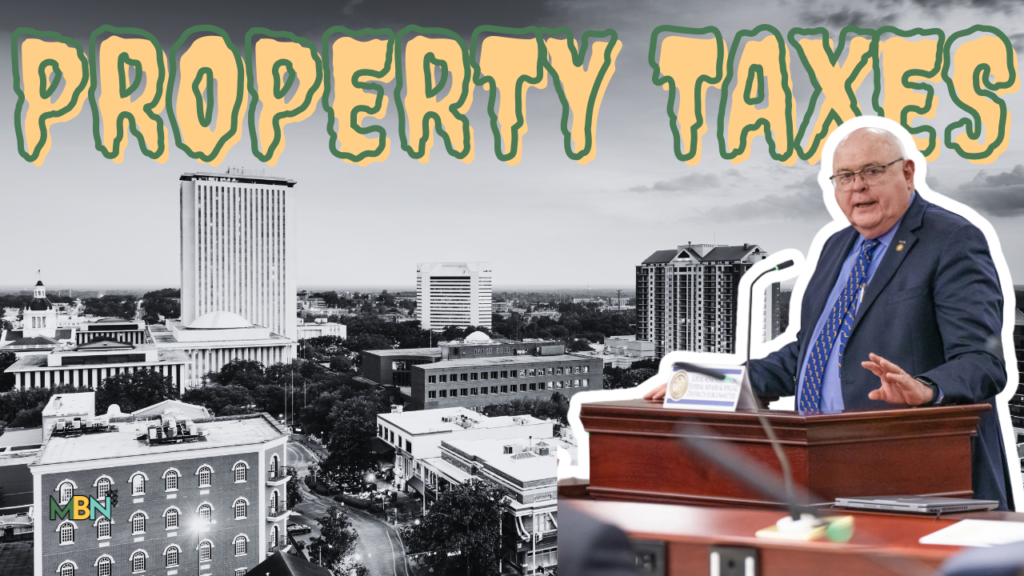

NICEVILLE — State Rep. Patt Maney says a proposed constitutional amendment aimed at cutting residential property taxes could come with a steep local price tag: millions of dollars lost for fire districts, cities and Okaloosa County government — and a potential shift in the tax burden to renters and small businesses.
Speaking at a recent Niceville-Valparaiso Chamber of Commerce breakfast Wednesday, Maney laid out his concerns about the residential property tax measure expected to appear on the November ballot, calling it “bad policy” that wasn’t fully thought through and may even be unconstitutional. Maney and his northwest Florida colleague and fellow Republican Nathan Boyles were the two GOP members who broke ranks on the vote.
That opposition puts Maney at odds with his party’s leadership and the governor, who pushed the measure to help Floridians struggling with the cost of living. But Maney argues that the amendment, as written, could blow a hole in local government budgets and spark years of legal battles — all to play a shell game of taxation that helps no one.
‘No Plan’ for Replacing Lost Revenue
Maney began his remarks with a quick update on Tallahassee. The governor has not yet signed the state budget, he said, so he can’t yet say which, or if any, of his more than $20 million in local projects will survive. But the lawmaker, a retired judge and Army general, quickly pivoted to what he sees as a more immediate issue for local communities: the looming property tax amendment.
Maney said his first concern is the lack of a clear plan for how the state will pay for the tax break.
He acknowledged that the governor correctly recognized that “Americans, particularly Floridians, are hurting on cost of living” and tried to address it. One idea floated in Tallahassee was to create a trust fund to offset the lost revenue.
But crucial details were never spelled out, Maney said:
- How would the trust fund be structured?
- Where would the money come from?
- Would it be constitutionally protected — meaning legislators couldn’t later “sweep” it for other uses — or just another pot of money created by statute?
He pointed to past experience with the Sadowski housing fund, which lawmakers have repeatedly raided for unrelated spending because it is not constitutionally protected.
For a change as sweeping as altering how local governments are funded, he argued, serious analysis is essential. “Before we change the way local governments are funded, we need to really give it a lot of analysis,” Maney said. But major fiscal bodies, including the Joint Legislative Budget Commission and the constitutionally created tax and budget review panel, never fully examined the proposal.
Constitutional Questions
Maney told the breakfast crowd he doubts the proposal will reach voters without a court fight — and that it may not survive one.
In his view, the amendment’s wording raises equal protection concerns under both the U.S. Constitution and the Florida Constitution because it treats Florida residents differently based on when they moved here.
As Maney described it, residents who move to Florida after January 1 would not receive the full benefit of the property tax reduction, while those who were here earlier would.
He compared the proposal to a now-defunct tax from the 1970s and 1980s, when Florida charged people an extra fee for bringing vehicles into the state after they had already paid tax on them elsewhere. The Florida Supreme Court struck that system down, saying the state could not effectively tax the same purchase twice.
Maney also flagged another constitutional requirement: ballot language in Florida must be “clear and factual.” Describing taxes as “excessive,” he said, is not a neutral fact but a political judgment — one that local officials might strongly dispute.
On those grounds and others, he predicted legal challenges and said the amendment could ultimately be declared unconstitutional before or after voters weigh in.
Millions at Stake for Fire Districts and Cities
To move the conversation from theory to local impact, Maney said he worked with the Okaloosa County tax collector over the past fall and spring to model what the amendment would mean for area governments if it passes.
The numbers he presented at the breakfast were stark:
- North Bay Fire District
- Year 1 loss: $743,891 (37.35% reduction in property tax revenue)
- Within 5 years: $1,985,000 (59.09% reduction in property tax revenue)
- East Niceville Fire District
- Year 1 loss: $382,956 (38.93% reduction in property tax revenue)
- Within 5 years: $1,061,000 (66.55% reduction in property tax revenue)
- City of Niceville
- Year 1 loss: $1,515,514 (29.9% reduction in property tax revenue)
- Within 5 years: $3,800,000 (50.18% reduction in property tax revenue)
- City of Valparaiso
- Year 1 loss: $494,762 (31.8% reduction in property tax revenue)
- Within 5 years: more than $1 million (45.39% reduction in property tax revenue)
- Okaloosa County (countywide)
- Year 1 loss: $14,757,428 (20.03% reduction in property tax revenue)
- Year 5 loss: $36,130,054.73 (30.64% reduction in property tax revenue)
Maney framed it as a seventh-grade math problem. If local governments see that level of tax revenue disappear and no new money appears to replace it, they will face a simple but painful choice.
That outcome, he suggested, would likely be a mix of service cuts and tax shifts.
Who Pays if the Amendment Passes?
Maney argued that while the amendment’s ballot language focuses on relief for homeowners, the real-world effect could be higher costs for others.
Because the measure specifically targets certain residential properties, he said, the burden is likely to shift to non-homestead properties, which include:
- Rental properties
- Small business storefronts and office spaces
- Other investment and commercial properties
Higher tax bills for landlords and business property owners, he warned, could then ripple out to renters, small business owners, and customers in the form of increased rents and prices.
That’s why, he argued, the stakes are high not just for city halls and fire districts, but for everyday residents and local businesses who rely on those services and pay those rents.
‘Look Past the Bumper Sticker’
Throughout his remarks, Maney was careful to say he was not campaigning in the room for or against the amendment. He also repeatedly declined to criticize the governor or fellow lawmakers by name, even as he dissected the policy.
Instead, he urged the Chamber audience — a mix of business leaders, local officials and residents — to dig into the details of what they will see on the ballot in November.
In the end, he suggested, voters themselves may decide whether to accept the tradeoffs or send a message back to Tallahassee. “We need to think more deeply about it and figure out whether we need to tell the legislature to go back and try again,” Maney said.