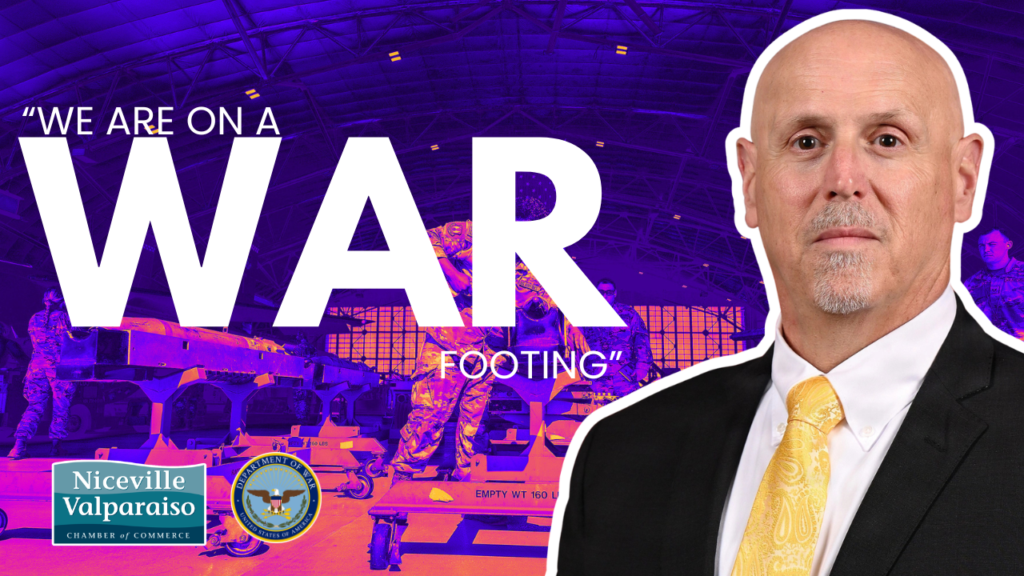
When Dale Marks, Assistant Secretary of War for Energy, Installations, and Environment, stepped to the podium at the Niceville-Valparaiso Chamber of Commerce on Tuesday, he didn’t just offer hometown nostalgia. He delivered a blunt message: Northwest Florida is on the front line of America’s industrial “arsenal of freedom,” and time is now the nation’s most dangerous adversary.
Back on the Emerald Coast after a year in Washington, D.C., Marks said it was “so good to be home,” recalling his early days in Okaloosa County, when he was a relative unknown pitching big ideas to skeptical local leaders.
“I drove right up the middle and scared a lot of you,” he said, describing how he came in fast and hard with ambitious plans. “After about the first year, you realized I wasn’t going to slow down—and we all sort of got on the train together.”
That same relentless pace now defines his work at the highest levels of the Department of War. As Acting Deputy Under Secretary for Acquisition and Sustainment, Marks is responsible for the buying, building, and maintaining of capabilities across the entire department—an immense portfolio that touches nearly every defense-related job and contract in Northwest Florida.
He credited his time on the Emerald Coast with shaping his view of how national defense actually works.
“The military does not operate in a vacuum,” he told the Chamber audience. “We operate within the strength of our host communities. And I would say this is the very best one.”
Marks used much of his speech to connect global instability to the regional defense economy. He described a world in which hostile actors are deliberately disrupting key regions, threatening trade routes like the South China Sea and Red Sea, and trying to rewrite the rules of the global economy.
In that environment, he said, the U.S. no longer has the luxury of peacetime pacing.
“We are on a wartime footing,” Marks said, echoing what he described as a daily refrain from the President. “Our greatest adversary isn’t a country or a specific weapon system. Our greatest enemy today is time.”
He contrasted the speed of America’s adversaries—who adapt and field new capabilities in real time—with the U.S. acquisition system, which he said has spent decades perfecting slow, careful, “exquisite” programs that often arrive too late and in too few numbers.
“What good is the perfect solution if it arrives a day late?” he asked. “In 21st-century conflicts, the fast and the good will beat the perfect and the on-time.”
For the defense businesses, contractors, and civic leaders in the room, Marks’ point was clear: the way Northwest Florida does business with the military must change to match the urgency of the moment.
Marks framed the department’s acquisition transformation strategy around three priorities, each of which he said “runs directly through the Florida Panhandle”:
On the first priority, he called this region “the proving ground for the 21st-century battlespace.” From Eglin to Hurlburt and the surrounding test ranges, he said, Northwest Florida is where new concepts are proven and, increasingly, pushed rapidly into operational use.
He highlighted the Advanced Precision Kill Weapon System (APKWS) as a case study in local ingenuity with global impact. Faced with an urgent need to counter cruise missiles and one-way attack drones, teams here adapted existing unguided rockets with laser guidance kits, mounted them on F‑16s, and proved they could shoot down cruise-missile surrogates—then moved quickly to replicate and field the system worldwide.
“We didn’t launch a multi-decade program or spend billions on a brand-new interceptor,” Marks said. “We looked at what we had, we tested it, and we just did it. That’s the speed and creativity we need.”
He challenged local businesses to move beyond prototype culture.
“If the tech can’t go to scale, it’s useless,” he said. “We have to close the gap between brilliant ideas and battle-winning capabilities. This is a team sport.”
On the second priority—protecting and sustaining the force—Marks pointed to this region’s painful experience with Hurricane Michael and the ongoing rebuild of Tyndall Air Force Base as a model for the future.
Tyndall, he said, is being rebuilt as an “installation of the future,” with smart buildings, hardened cyber defenses, and redundant energy systems designed to keep the base operating through storms, attacks, or other disruptions.
But he said resilience doesn’t end at the gate. Family readiness, he argued, is mission readiness.
All of these, he said, are strategic assets that allow service members to focus on the mission knowing their families are supported.
“Every new housing development, every top-tier teacher hired, every improvement to our local grid contributes directly to national security,” Marks said, urging local leaders to see quality-of-life investments as part of the national defense architecture, not just local amenities.
Marks reserved some of his strongest language for the state of the defense industrial base and the workforce pipeline that feeds it.
For too long, he said, the system has revolved around a small number of major prime contractors, creating a kind of “fortress” that limited innovation and capacity. That approach, he argued, is no longer sustainable.
“That era is over,” he said. “We’re actively working to bring in more startups, small businesses, and nontraditional vendors to fuel competition and innovation.”
But none of that works, he added, without enough skilled workers. Nationally, there are about 2.9 million open skilled jobs and only 1.2 million skilled workers produced each year, leaving a 1.7 million worker gap even before accounting for future growth. For every five skilled workers who retire, only two replace them.
Here again, he said, Northwest Florida is part of the solution. He praised Northwest Florida State College, the Okaloosa County School District, and local leaders such as Mel Ponder for building programs in advanced manufacturing, industrial trades, and nursing that are directly aligned to defense and community needs.
He urged local employers to hire from these pipelines, expand apprenticeships, and treat workforce development as a core business and security imperative.
To large prime contractors, his message was equally direct: mentorship of small businesses is not a box-checking exercise; it is essential to building the capacity and resilience the country needs.
“You are not just vendors. You are stewards of the industrial ecosystem,” Marks said. “When you lift up a small business, you are strengthening the entire industrial base we all depend upon.”
Marks closed by returning to the central theme of his address: Northwest Florida is a vital strategic partner, not a supporting actor.
“This is where the joint force comes to develop, test, and train on our most important warfighting capabilities,” he said. “We cannot sustain our force without your community’s support, and we cannot win the fight without the local industry partners in this room.”
With warfighters deployed in dangerous places around the world, Marks said, they do not care about bureaucracy. They care about whether they have the tools they need—and whether they come home safely.
“The future fight is not on the horizon,” he warned. “It is here today. We cannot, we will not be the generation that fails to answer the call.”
For a region whose economy and identity are tightly woven with the military, his message was clear: the choices local leaders, educators, and businesses make today will echo far beyond the Emerald Coast—and may determine whether America is ready when the call comes.
Was this story important to you? Please support the work we do at Mid Bay News with a donation! Click below to get started!
We love to bring you, and all of your neighbors, the news for free – it’s a part of who we are. But just because something is free doesn’t mean it’s cheap.
Your sustaining donation of just $10 per month helps us keep the powerful accountable and make the mortgage on time. If you notice you keep coming back for more stories from us – please consider supporting our work so we can do it for the long haul (and not be homeless).

Register or login with Mid Bay News and never get another pop up on our site!