Search
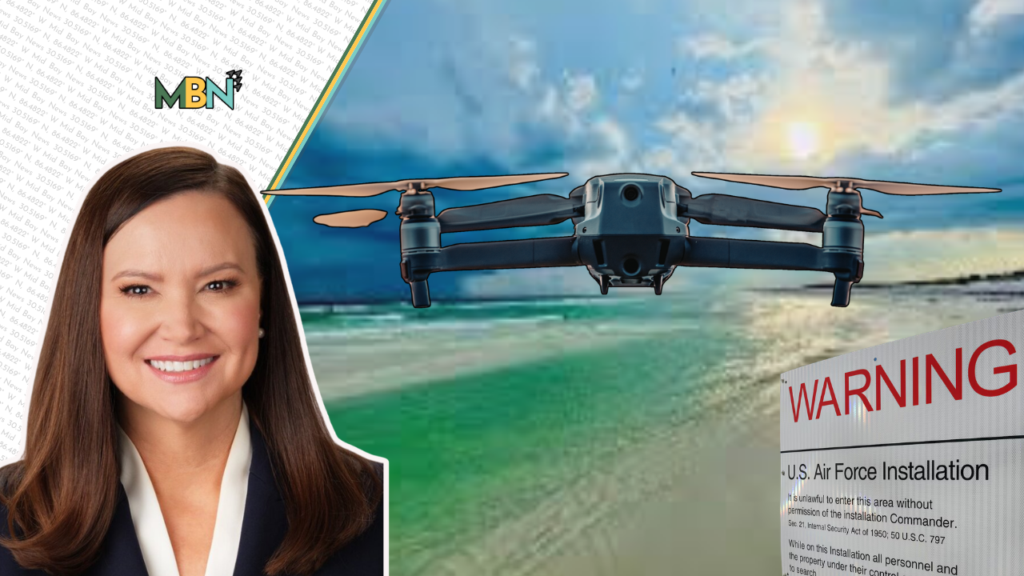
From Washington to the beaches of the Emerald Coast, a new Senate bill could make certain drone flights over military airspace a federal crime.

Drone Espionage Act Hits Home on the Emerald Coast

In Brief:

  • 👤 Who: Sen. Ashley Moody and bipartisan Senate co-sponsors

  • 📜 What: Drone Espionage Act, updating the Espionage Act of 1917

  • 🗓️ When: Advanced Feb. 5, 2026

  • 📍 Where: U.S. Senate Judiciary Committee, Washington, D.C.; local relevance on the Emerald Coast

  • ⚖️ Why: To address rising drone surveillance threats and protect sensitive military installations

WASHINGTON, D.C. — Legislation aimed at closing what supporters describe as a dangerous gap in federal law cleared a key hurdle Thursday as the Senate Judiciary Committee advanced the Drone Espionage Act to the full Senate for consideration.

The bill, introduced by U.S. Sen. Ashley Moody, would update the The Espionage Act of 1917 made it a federal crime to take unauthorized videos of U.S. military installations. While certain forms of espionage and surveillance are already prohibited under federal law, videography of sensitive national defense sites is not explicitly criminalized under the century-old statute.

Moody, whose home state is home to 21 military installations and three combatant commands, said the legislation reflects the rapid evolution of drone technology and the growing threat posed by unmanned aircraft systems flying over sensitive sites.

“Florida is home to 21 military installations and three combatant commands—we must keep our bases protected and secure,” Moody said in a statement. “The Drone Espionage Act modernizes our laws to meet technological advancements and will protect against bad actors wishing to collect intelligence of sensitive military installations on American soil.”

The measure would expand the Espionage Act to include videography of national defense sites and strengthen federal authorities to prosecute individuals who attempt to gather sensitive imagery through drones.

Moody introduced the legislation in May of last year and was joined by a bipartisan group of senators, including Ted Budd, Tom Cotton, Mike Lee, Bernie Moreno, Thom Tillis, Elissa Slotkin, Roger Wicker, Ted Cruz, Marsha Blackburn, Tommy Tuberville, Markwayne Mullin, Katie Britt, and Dave McCormick. Companion legislation in the House was introduced by Jen Kiggans.

Supporters point to several recent cases that underscore the issue. In Newport News, Virginia, a Chinese national studying at the University of Minnesota was convicted after flying a drone with a camera over a naval shipyard. In February 2025, a Canadian man was charged with using an unmanned aircraft to photograph Patrick Space Force Base. In November 2024, a Chinese citizen living in Los Angeles was charged and sentenced for flying a drone over Vandenberg Space Force Base and taking images. In 2020, three Chinese nationals were sentenced for illegal imagery at Naval Air Station Key West.


While the legislation focuses on national security and espionage enforcement, drone operations themselves are regulated by the Federal Aviation Administration, which oversees U.S. airspace. The FAA establishes rules for both recreational and commercial pilots, including registration requirements, remote identification standards, altitude limits, and restrictions near airports, military installations, and other sensitive areas.

The agency also provides free education for hobbyists through The Recreational UAS Safety Test (TRUST), a no-cost online course required for recreational drone flyers. The course is designed to ensure operators understand basic airspace rules, safety guidelines, and responsible flying practices before taking to the skies.

Along the Emerald Coast, where tourism and military operations coexist, the issue carries particular local relevance. Portions of the coastline fall within restricted or controlled military airspace due to the presence of Eglin Air Force Base and Hurlburt Field. Visitors and residents frequently fly drones over the Gulf for scenic beach photography, but some of those beachfront areas lie beneath military training routes and special-use airspace. Flying in restricted zones — even unintentionally — can carry federal penalties and create safety risks for military aviation operations.

If approved by the full Senate and House, the Drone Espionage Act would mark one of the most significant updates to federal espionage law in decades, specifically targeting unauthorized drone surveillance of U.S. military installations.

📌 For More Information

Readers looking to better understand federal drone laws, restricted airspace, and safe flying practices can visit the following official resources:

Federal Aviation Administration – Unmanned Aircraft Systems (UAS):
https://www.faa.gov/uas

FAA Recreational Flyers (TRUST Safety Course):
https://www.faa.gov/uas/recreational_flyers/knowledge_test_updates

FAA B4UFLY App (Check Airspace Before You Fly):
https://www.faa.gov/uas/b4ufly

Eglin Air Force Base:
https://www.eglin.af.mil

Hurlburt Field:
https://www.hurlburt.af.mil

Before launching a drone along the Emerald Coast, officials recommend confirming whether the area falls within restricted or military-controlled airspace.

No Mo' Pop Ups!

Register or login with Mid Bay News and never get another pop up on our site!

Login Now


Register With Mid Bay News