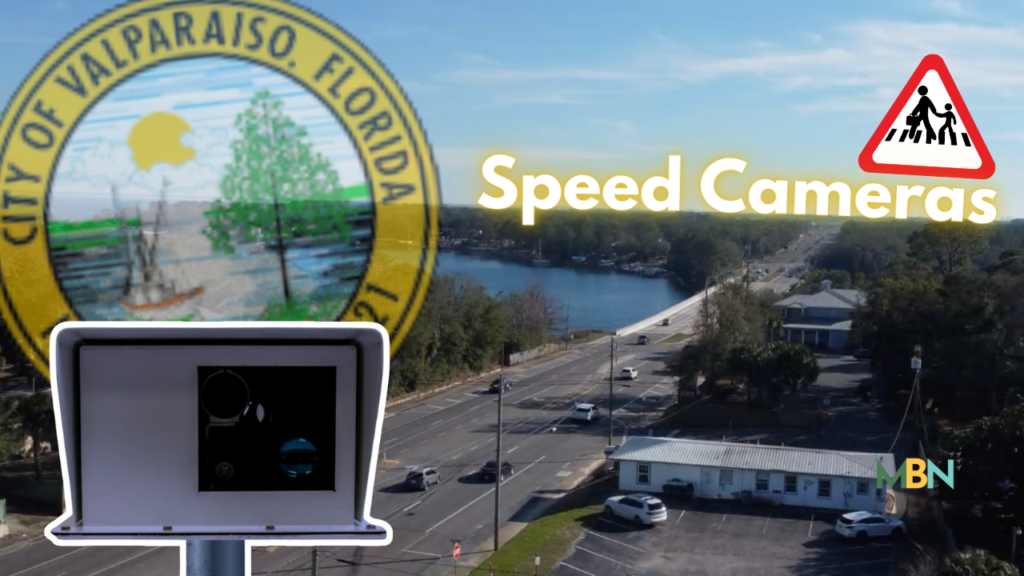
What the Speed Study Showed Around Lewis School
Blue Line representative Barbara Manton conducted a five-day speed study on the roads around Lewis School in Valparaiso from November 3–7.
They focused on the official school zone flashing-light windows:
- Morning: 7:05 a.m. – 7:40 a.m.
- Afternoon: 1:55 p.m. – 2:25 p.m.
Blue Line reported that during those limited windows:
- Morning (7:05–7:40)
- 4,376 cars passed through the school zone
- 4,228 of those were going more than 10 mph over the speed limit
- That’s about 96.6% of vehicles speeding more than 10 mph over
- Afternoon (1:55–2:25)
- 7,030 cars passed during the flashing-light period
- 6,948 were speeding more than 10 mph over
- That’s about 98.8% of vehicles speeding
The sales reps at the meeting framed the numbers as evidence that nearly every driver exceeds the school-zone speed limit by more than 10 miles an hour, even during drop-off and pick-up times.
They also cited results in other cities, noting that similar programs in Florida communities like Shalimar have produced speed reductions of 90% after cameras are installed, warning letters are sent, and full enforcement begins.
Blue Line’s Pitch
Cutting speeding drastically
Blue Line laid out a detailed pitch to the Valparaiso City Commission for automated LIDAR speed cameras in school zones, arguing the system would dramatically cut speeding around Lewis School with no upfront cost to the city.
Police Chief Joe Hart told commissioners he had vetted multiple vendors and found Blue Line’s offering the strongest fit for Valparaiso.
“This company is way above any of the others that we explored,” Hart said, adding that Blue Line gives the city flexibility in how the system is set up. “We chose Blue Line because of what we learned,” he explained, “We feel it would be a better fit for our locality.”
Hart also said he has been in close contact with neighboring agencies already using the technology”.
“I had lunch with the Shalimar chief today,” Hart said. “We didn’t talk income, but he said there’s been a dramatic [difference] of what they projected they would get and what they’re getting now – a reduction – that’s what we’re after is behavior.”
No Upfront Cost — and How the Money is Split
Blue Line stressed that the program requires no upfront cost from Valparaiso. The company handles hardware, installation, maintenance, and back-office processing.
Instead, Blue Line would be paid a per-citation fee:
- $100 total civil citation (set by state law)
- About $35 to the City of Valparaiso
- $25 to Blue Line Solutions
- The remaining $40 split among other government entities (including state agencies and school-related funds)
City Administrator Carl Scott pointed out that the city would have to continue to pay a magistrate $150 on a per-case basis and that police officers would have to come off the street to testify in front of the magistrate as well for each contested ticket.
The citation is a civil penalty — it does not add points to a driver’s license. It does not count as a traditional moving violation for insurance purposes, according to the presentation.
So, if everyone decided to ignore the school zone tickets and keep driving the way they are now, Valparaiso alone would earn an additional $78,000 per day in revenue – based on Blue Line’s five-day study. That likely wouldn’t happen because of behavior modification from getting repeated $100 tickets – but still, there’s plenty of money to be made for the city.
Cameras During Flashing Lights Only — or All Day?
One of the key choices facing the city is when the cameras would be active.
Blue Line explained that under Florida law, the system can operate:
- Only during the flashing-light school-zone times, or
- All day within the designated school-zone hours, even when the flashers are not on
Their representative gave an example of how thresholds can be set:
- During flashing (say, 15 mph limit), a car might have to be going 26 mph or more to get a citation.
- Once the road returns to its regular limit (for example, 35 mph), the citation threshold would bump up (e.g., 46 mph or more).
Chief Hart underscored that Blue Line gives Valparaiso the ability to tailor the program to local preferences.
“They give us the option of setting it like we want to,” Hart said, noting that the department will also ensure signage and flasher times line up with state traffic-control standards so tickets will hold up in court.
What Happens Next
The presentation was informational; the commission did not take immediate action on a contract with Blue Line at this meeting. If the city moves forward, Blue Line outlined a phased rollout:
- Pre-implementation study (already completed around Lewis School).
- Public information and education — notifications via social media, mailers, and community outreach before any tickets are issued.
- 30-day warning phase — where violators receive warnings, not fines.
- Full enforcement — with civil citations mailed to violating vehicle owners and monthly reporting on speeding trends and citation counts.
Hart said his goal is not to maximize ticket revenue but to change driver behavior around schools.
“That’s what we’re after — behavior,” he said, pointing to neighboring cities that are already seeing fewer speeders in school zones after installing cameras.