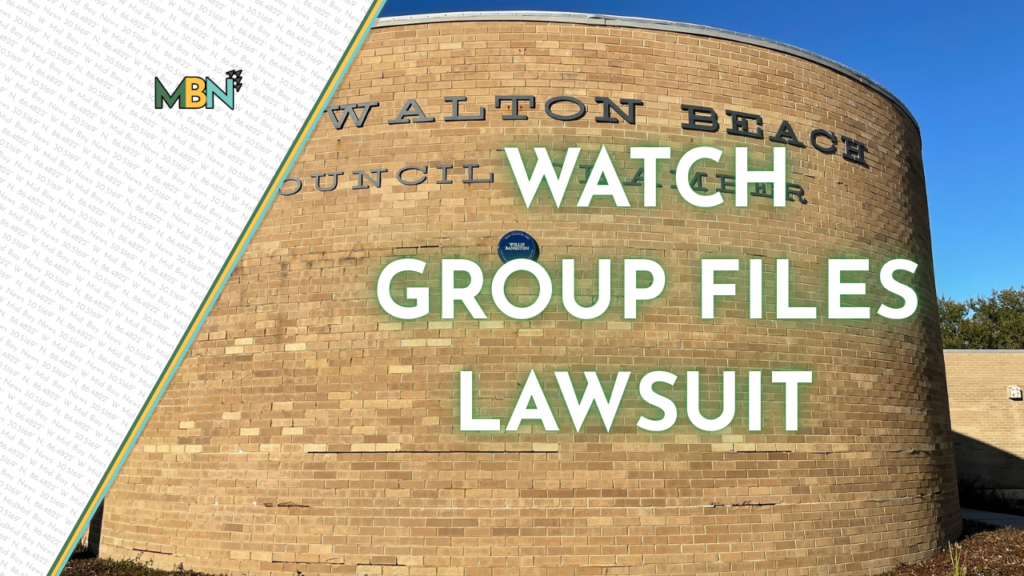
FORT WALTON BEACH— A local political committee has filed a lawsuit seeking to block five proposed amendments to the city charter from appearing on the Mar. 10, 2026, referendum ballot, escalating a months-long debate over a sweeping package of changes that city leaders say would modernize local government. Opponents argue that it is being misleadingly presented to voters.
FWB Watch Group and Travis Smith, a former city councilman, have sued the City of Fort Walton Beach, City Clerk Kim Barnes and Okaloosa County Supervisor of Elections Paul Lux on Jan. 14 in Okaloosa County Circuit Court. The verified complaint asks a judge to declare the ballot titles and summaries for the measures unlawful under Florida election law and to prevent them from being placed before voters “in their current form.”
The lawsuit targets Ordinances 2196 through 2200 — five of six charter-related ordinances adopted on second reading by the Fort Walton Beach City Council on Dec. 16 after months of workshops and recommendations from the city’s Charter Review Committee.
Taken together, the complete package of six ordinances would ask voters to weigh in on changes involving election timing, governance rules, administrative operations, compensation for elected officials, and limits on annual budget increases.
At previous meetings, City Attorney Jeff Burns has said voter approval is required before any changes to the city charter can take effect. But the lawsuit contends that the ballot language approved by the council does not meet the state’s “truth in packaging” requirements because it relies on broad, upbeat phrases while omitting key details about what the amendments would actually do.
Fort Walton Beach leaders approved the charter-related ordinances in December 2025 as part of a Mar. 10 referendum that would place six proposed amendments before voters. Supporters have framed the package as a chance to align the city with statewide election cycles, update outdated charter language and give the council more flexibility in how it governs and budgets.
One ordinance, Ordinance 2195, would move municipal elections for mayor and City Council to November of even-numbered years to coincide with statewide general elections.
Under that proposal, officials would continue to be elected at large for four-year terms beginning Apr. 1 after the election, with a staggered schedule placing council seats one through four on the November 2026 ballot and seats five through seven, along with the mayor’s office, on the November 2028 ballot.
That election-timing proposal is not included in the new lawsuit.
Instead, the complaint challenges five measures that would appear as Ballot Questions 2 through 6.
The plaintiffs argue that each of those questions either bundles multiple unrelated charter changes into a single yes-or-no vote or fails to disclose the amendment’s “chief purpose” as required by Florida law.
Florida law requires ballot titles and summaries for public measures to be written in unambiguous language and to explain the “chief purpose” of the proposal, the complaint states.
The lawsuit cites Florida Supreme Court precedent holding that ballot language is defective if it misleads voters about a measure’s actual effect or fails to inform them of material changes, including the repeal or significant alteration of an existing limitation.
The plaintiffs argue the Fort Walton Beach questions do both, using “feel-good” terms such as “clarifying,” “updating,” and “enhancing efficiency,” while omitting specific changes that could reshape city governance and finances.
The complaint also cites objections raised during the Dec. 16 council meeting by Robert V. Smith, chairperson of FWB Watch Group, who argued that the ballot language was “generic and ambiguous,” improperly bundled distinct policy choices into single questions, and did not comply with state law.
The council adopted the ordinances without revising the ballot language, the lawsuit alleges.
Ordinance 2196 would amend multiple charter sections regarding city elections, term limits, vacancy procedures, and candidate filing fees. The ballot title and question would appear as follows:
Ballot Question 2
Official Ballot
Non-partisan City Elections, Stricter Term Limits, Filling Vacancies, and Filing Fees
“Shall Sections 3, 4, 5, 7, and 25 of the City Charter be amended for purposes of clarifying the non-partisan nature of council seats, updating term-limit provisions, establishing consistent procedures for filling council and mayoral vacancies, and providing flexibility in the establishment of filing fees for city elections?”
City officials have described the measure as a package that clarifies the non-partisan nature of council seats, updates term limits, standardizes vacancy procedures and provides flexibility for setting filing fees.
But the lawsuit argues the ballot language is misleading because it does not tell voters the ordinance would remove an existing charter cap that limits filing fees to $50.
Under the current charter, candidates may pay a filing fee set by ordinance, but the cost may not exceed $50, according to the complaint.
The plaintiffs say Ordinance 2196 would delete that cap and allow filing fees to be set by ordinance or resolution without a stated maximum, a change they argue could make it more expensive for citizens to run for office and should be disclosed in the ballot summary.
The complaint also argues that the ballot title’s emphasis on “Non-partisan City Elections” suggests the measure is primarily about converting elections to non-partisan contests, even though city elections are already conducted on a non-partisan basis.
Ordinance 2197 addresses City Council meetings and governance, proposing changes to how meeting schedules are set, how discipline is imposed and how attendance-related forfeiture of office is handled. The ballot wording reads:
Ballot Question 3
Official Ballot
Council Meetings and Governance
“Shall Sections 6, 8, and 9 of the City Charter be amended to clarify procedures for scheduling Council meetings by resolution, to adjust the disciplinary vote threshold for Councilmembers, and to strengthen attendance and forfeiture of office provisions?”
City staff said during the ordinance debate that the proposal would have no impact on the city budget.
The lawsuit, however, argues the ballot language understates a significant power shift. Under the existing charter, the council may expel a member for disorderly conduct or a violation of its rules, but only by a vote of not less than six members, after notice and an opportunity to be heard.
The plaintiffs say Ordinance 2197 would change that by authorizing the council to refer a member to the governor for suspension and possible removal by the state Senate under the Florida Constitution, after written notice and a chance to be heard.
The complaint also says the ordinance would add detailed forfeiture provisions requiring such a referral if a council member loses required qualifications, violates charter prohibitions, is convicted of certain crimes, or accrues three unexcused absences from regular meetings or more than 50% of the calendar year.
By framing those changes as merely “adjusting” a disciplinary threshold and “strengthening” attendance rules, the lawsuit argues, the ballot question masks the amendment’s true effect.
City leaders describe Ordinance 2198 as an effort to modernize administrative language and improve operational efficiency. The ballot wording reads:
Ballot Question 4
Official Ballot
Changes to remove outdated language and enhance efficiency of City Operations
“Shall the City Charter provisions relating to city officers and their duties be amended to eliminate outdated language, provide clearer descriptions, and enhance the efficiency of the City’s daily operations?”
During a council meeting in December, Councilman Payne Walker raised concerns that the amendment would further restrict the council’s ability to consider consolidating the Fort Walton Beach Police Department with the Okaloosa County Sheriff’s Office, citing past consolidation studies and cost comparisons with other cities.
Walker warned that the change would permanently limit future councils’ options, though the ordinance passed 6-1, despite his objections.
The lawsuit argues the ballot language does not disclose a major policy entrenchment: embedding autonomous police and fire departments into the charter and constraining future councils’ ability to restructure them.
According to the complaint, Ordinance 2198 would rewrite charter language so departments, boards and authorities could be created and changed by resolution after at least one advertised public hearing, rather than by ordinance.
The complaint also says the ordinance would add language requiring the city to maintain municipal police and fire departments that are “autonomous” and, absent a unanimous council vote or voter approval by referendum, may not be “disbanded, discontinued, merged, contractually replaced, defunded, or otherwise significantly diminished beyond minimal capabilities,” subject to state law.
The plaintiffs argue that an average voter reading the ballot question would likely see it as a housekeeping measure rather than a charter rewrite that could restrict future policy options related to public safety services and budgeting.
Ordinance 2199 would amend charter Section 33 to authorize compensation for elected officials, allowing them to choose between a cash stipend and city-paid health insurance coverage. The ballot wording reads:
Ballot Question 5
Official Ballot
Authorizing Compensation to City Elected Officials
“Shall the City Charter be amended to authorize compensation for the Mayor and City Councilmembers and to provide health insurance coverage for city elected officials and their immediate families, with premiums paid by the City?”
During the council discussion, Burns explained that council members opting for monetary compensation would receive $1,000 per month, and the mayor would receive $2,000 per month. Officials choosing insurance coverage would not receive the cash stipend, and there is no specific cap on insurance benefits in the charter language, according to the city’s summary of the debate.
The lawsuit argues the ballot language is misleading because it does not tell voters that the charter currently prohibits compensation for elected officials — a ban adopted in 2024 — and that the ordinance would repeal that prohibition.
The complaint also argues that the ballot wording does not list the specific monthly amounts or clearly state that the health insurance benefit would cover immediate family members, with premiums paid by the city.
Ordinance 2200 proposes repealing Section 35 of the charter, which currently limits annual increases in budget expenditures. The ballot wording reads:
Ballot Question 6
Official Ballot
Deleting Charter Section 35 which Establishes Limitations on increases to the Annual Budget Expenditures
“Shall the City Charter be amended to repeal Section 35 titled ‘Limitation on Annual Budget Expenditures’, which limits annual increases in the budget, and which does not limit increases to property tax millage rates?”
City leaders have described the measure as repealing a spending cap that restricts annual increases in budget expenditures but does not restrict property tax millage rates. The spending cap was passed in November 2024 with more than 60% of Fort Walton Beach residents voting in favor, according to background reporting on the charter package.
Burns said ballot language was added to clarify that repealing the section would not affect millage rates.
The lawsuit argues that the ballot question fails to explain what Section 35 actually does, specifically, capping specific categories of spending so that annual increases cannot exceed the lesser of 3% or the change in the Consumer Price Index, without prior referendum approval.
The plaintiffs also argue the clause about millage rates is misleading and argumentative because Section 35 does not address millage rates at all, and because removing a spending cap could increase pressure for future tax increases.
The complaint asks the court to declare the ballot titles and questions in Ordinances 2196 through 2200 unlawful and to temporarily, preliminarily and permanently block the measures from being placed on the Mar. 10 ballot in their current form.
The plaintiffs also request that the case be treated as a priority election matter and heard on an expedited schedule, arguing that voters and the public will suffer irreparable harm if forced to vote on charter amendments based on misleading ballot language, as the integrity of the election process cannot be repaired after the fact.
If an election proceeds using the contested language before final judgment, the plaintiffs ask the court to declare any referendum results null and void and attempt to block the city from certifying or implementing any charter changes approved through those ballot questions.
We love to bring you, and all of your neighbors, the news for free – it’s a part of who we are. But just because something is free doesn’t mean it’s cheap.
Your sustaining donation of just $10 per month helps us keep the powerful accountable and make the mortgage on time. If you notice you keep coming back for more stories from us – please consider supporting our work so we can do it for the long haul (and not be homeless).

Register or login with Mid Bay News and never get another pop up on our site!